




Can trekking poles help with carrying a heavy wild camping backpack?
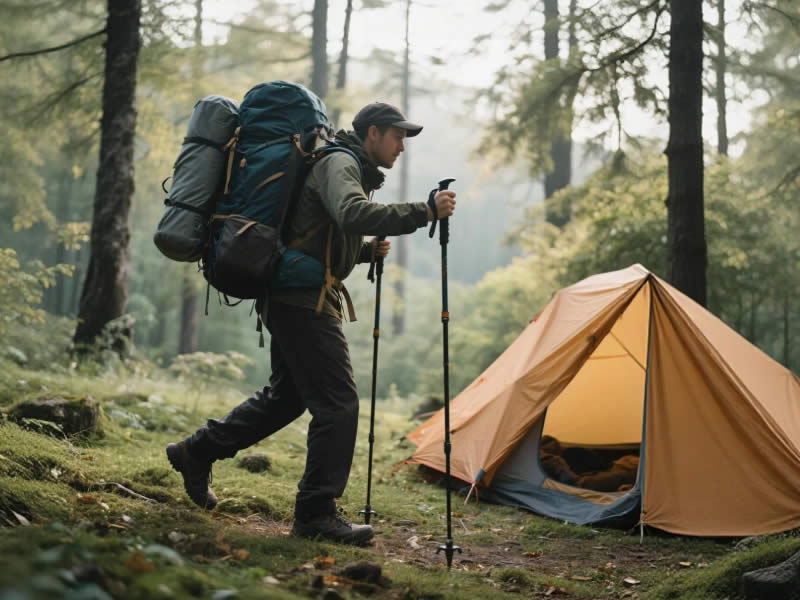
Yes – trekking poles are a game‑changer for carrying a heavy wild camping backpack. When loaded with a tent, sleeping bag, stove, food, and water, your pack can weigh 15–25 kg. This extra weight places enormous stress on your knees, hips, and lower back, especially on steep descents and uneven ground. Trekking poles transfer 15–20% of your body weight and pack load from your legs and spine to your arms and shoulders, reducing knee impact and back strain. On descents, they act as brakes, offloading the force that would otherwise jar your joints. On rough, rocky terrain, they provide stability and reduce the risk of ankle twists. For this heavy‑load use, you need 7075 aluminium poles with lever locks – carbon is more brittle and can snap under the lateral forces of a heavy pack. Adjust length for terrain: shorten on ascents, lengthen on descents. And crucially, use the wrist straps correctly – the strap should bear the weight, not your grip. This article explains the benefits, the biomechanics, and the essential features for using trekking poles with a heavy wild‑camping pack.
1. The biomechanics of carrying a heavy pack without poles
When you walk with a heavy pack, your body's centre of gravity shifts upward and slightly forward. Your lower back, hips, and knees have to work harder to stabilise and propel you. On descents, the impact force at each footstep can be 3–5 times your body weight – amplified by the pack. Without poles, this force is absorbed solely by your joints. Over a multi‑day trip, this cumulative load can lead to knee pain, back pain, and fatigue.
2. How poles reduce the load
a. Load transfer – When you plant a pole and push down, a portion of your body weight (and pack weight) is transferred through the pole to the ground. Studies show this can reduce knee joint forces by 20–25% on descents and 10–15% on ascents.
b. Braking effect – On descents, a well‑planted pole acts as a brake, reducing the speed at which your foot hits the ground. This lowers the impact force on your knees.
c. Stability – With a heavy pack, your balance is compromised. Two poles provide a wider base of support, reducing the risk of missteps that could twist an ankle or strain your back.
d. Uphill assist – On steep climbs, pushing down on the poles transfers some of the work from your legs to your arms, reducing quadriceps fatigue.
3. The importance of pole material for heavy loads
- 7075 aluminium – This is the best material for heavy‑load use. It is strong, durable, and ductile – it bends under extreme force rather than snapping. A bent section can often be straightened in the field. Many heavy‑duty poles (Leki Makalu, Black Diamond Trail Back) also have a steel lower section to resist abrasion on rocky ground.
- Carbon fibre – Carbon is light and stiff, but brittle. Under the lateral forces of a heavy pack (e.g., when you stumble or plant the pole at an angle), carbon can splinter. For heavy wild camping, avoid carbon.
- Budget aluminium (6061) – Less durable than 7075 and more prone to bending under heavy loads. Suitable for occasional use, but not recommended for multi‑day trips with heavy packs.
4. Locking mechanisms – lever locks over twist locks
- Lever locks (cam locks) – These are essential for heavy loads. They provide a secure, mechanical grip that does not slip under the sustained pressure of a heavy pack. They are field‑adjustable and can be cleaned of grit. Use Leki SpeedLock Plus, Black Diamond FlickLock, or Decathlon cam locks.
- Twist locks – Rely on friction and are prone to slipping under heavy loads, especially when wet or muddy. Not suitable for wild camping with a heavy pack.
5. Adjusting pole length for a heavy pack
- Flat ground – Set the pole so your elbows are at 90° when the tip is on the ground. This gives you a comfortable, neutral stance.
- Ascents – Shorten by 5–10 cm. This lowers your hands, giving you better leverage to push up the slope.
- Descents – Lengthen by 5–10 cm. This allows you to plant ahead of your feet, creating a braking effect that protects your knees.
- With a heavy pack, you may need to shorten poles slightly more – the extra weight makes the load transfer more effective with shorter poles on ascents.
6. Wrist straps – the key to load transfer
The wrist straps are not just to stop you dropping the pole. They are the primary mechanism for transferring the load from your pack to the ground.
- Adjust correctly – The strap should sit across the base of your palm (the heel of your hand), not across your wrist.
- Push through the strap – When you plant the pole, push down through the strap, not your grip. Your hand should remain relaxed; the strap bears the weight.
- Test – You should be able to push down firmly on the pole with a completely relaxed grip, relying solely on the strap. If you cannot, your strap is too loose or incorrectly positioned.
7. Choosing the right poles for wild camping
- Leki Makalu – The gold standard. 7075 aluminium, steel lower section, SpeedLock Plus, cork grips. Durable and repairable.
- Black Diamond Trail Back – 7075 aluminium, FlickLock, comfortable foam/cork grip. Reliable and field‑adjustable.
- Decathlon Forclaz MT900 – Best value. 7075 aluminium, lever locks, cork grips, replaceable tips. Durable enough for most wild camping.
- Black Diamond Trail Pro – Similar to Trail Back, with a more robust grip for heavy loads.
8. Practical tips for heavy‑load use
- Carry spare tips – The extra weight increases tip wear; carry spares.
- Fit mud baskets – On wet ground, baskets prevent the pole from sinking too deep.
- Check locks regularly – Lever locks can loosen with heavy use. Carry a hex key and tighten as needed.
- Pack the poles securely – When not in use, collapse and stow them securely on your pack.
9. Final verdict
Yes – trekking poles are a game‑changer for carrying a heavy wild‑camping backpack. They reduce knee and back strain, improve stability, and make steep descents and ascents more manageable. Choose 7075 aluminium poles with lever locks, adjust your length correctly, and use the wrist straps to transfer load. On a multi‑day trip with a heavy pack, quality poles are as essential as your tent and sleeping bag – they will protect your joints and extend your walking range. Invest in a good pair, and your body will thank you.




