




What is the correct arm swing when using trekking poles for Nordic walking?
Nordic walking is a specific fitness technique that uses specially designed poles. Unlike standard trekking, where you adjust pole length for terrain, Nordic walking uses fixed‑length poles with angled grips and requires a distinct, powerful arm swing. The correct arm swing for Nordic walking is a straight‑arm pendulum from your shoulder—your arm remains almost fully extended throughout the swing, with the wrist strap (or glove) transferring the push‑off force. Start with the pole planted behind you, push down and back, then let the arm swing forward to about chest height—like a pendulum—without bending the elbow. The hand should open at the back of the swing to release the pole, then close as it swings forward. The rhythm is opposite to your stride: right arm with left leg, left arm with right leg. Avoid bending your elbows—that's for trekking, not Nordic walking. A relaxed, long swing engages your core and shoulders. Practice with a partner to check your form.
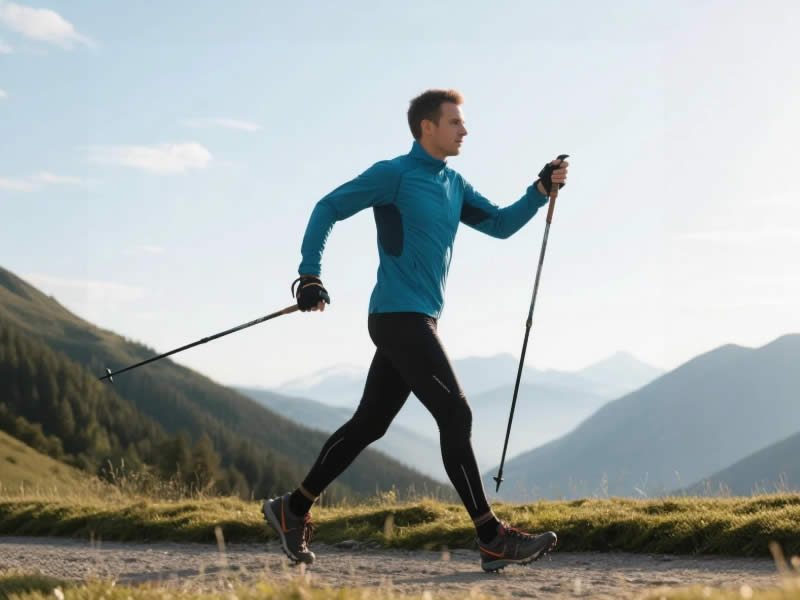
1. The Nordic walking technique – a quick overview
Nordic walking is a fitness discipline that originated in Finland. It uses specially designed poles that are shorter than trekking poles and feature angled grips and a glove‑like strap system. The technique is highly specific:
- Straight arm – The arm remains straight throughout the swing.
- Diagonal rhythm – Right arm swings forward with the left leg, and vice versa.
- Push‑off – The pole is planted behind the body, and you push down and back to propel yourself forward.
- Open hand – At the back of the swing, the hand opens to release the pole, which is held by the glove.
2. The start of the swing – the push‑off
The swing begins with the pole planted behind you, at an angle of approximately 45° to the ground. As your opposite leg steps forward, you push down and back on the pole. This push‑off engages your triceps, shoulders, and lats, providing a powerful forward thrust.
- Arm straight – Your arm should be almost fully extended, with a slight bend at the elbow (about 5–10°).
- Push down and back – The force goes through the strap, not your grip.
- Full extension – The push should continue until your arm is extended behind your body, with the pole tip still on the ground.
3. The forward swing – the pendulum
After the push‑off, the pole lifts off the ground, and your arm swings forward like a pendulum from the shoulder. The arm remains straight, and the pole swings forward to approximately chest height (about shoulder level).
- Smooth, controlled swing – The forward swing is not a forced lift; it is a natural continuation of the movement.
- Chest height – The pole tip should reach about chest height, but not above your head.
- Open hand – At the top of the forward swing, your hand naturally opens, and the pole is held only by the glove strap. This allows the pole to swing back freely.
4. The return swing – closing the hand
As the arm swings back down, your hand closes around the grip again in preparation for the next push‑off. This is a smooth, continuous motion.
- No pause – The swing is continuous—no pauses between the forward and backward motion.
- Rhythm – The rhythm is the same as walking, but with a longer, more powerful arm swing.
5. Common mistakes
- Bent elbows – This is the most common error. In Nordic walking, the arm should be straight. Bending the elbow shortens the lever and reduces the power of the push‑off.
- Swinging too high – The pole should not go above chest height. A high swing wastes energy and disrupts the rhythm.
- Gripping too tightly – A tight grip restricts the natural pendulum motion. Your grip should be relaxed; the glove or strap does the work.
- Planting too far forward – The pole should be planted behind your body, not ahead. Planting ahead creates a braking effect, which is inefficient.
- Rushing the swing – The swing should be smooth and controlled, not rushed. A rushed swing breaks the rhythm and reduces power.
6. The role of the glove or strap
Nordic walking poles use a special glove‑like strap that attaches firmly to your hand. Unlike trekking pole straps, which are worn around the wrist, the Nordic walking glove allows you to open your hand at the back of the swing without dropping the pole.
- Push through the glove – The push‑off force is transferred through the glove, not your grip.
- Release and re‑engage – The glove allows your hand to open and release the pole at the back of the swing, then close again as it moves forward. This is a key part of the technique.
7. How to practice
- Without poles – Practice the arm swing without poles first. Stand with your arms straight, and swing them forward and back from the shoulder in a pendulum motion.
- With poles on flat ground – On a flat, clear path, practice the full swing – push‑off, forward swing, release, and re‑engage.
- Check your rhythm – Right arm with left leg, left arm with right leg. Count "right, left" to keep the rhythm.
- Film yourself – Recording your technique can help you identify bent elbows or a too‑high swing.
8. Correcting common errors
- Bent elbows – Consciously try to lock your arm straight. You will feel the stretch in your shoulders.
- Pole too long – If you find it hard to keep your arm straight, your poles may be too long. Check your pole length – it should be 0.68 × your height.
- Gripping too tightly – Relax your hand. The glove should take the load.
- Swing too high – Focus on swinging to chest height, not above. A lower swing is more efficient.
9. Final verdict
The correct arm swing for Nordic walking is a straight‑arm pendulum from the shoulder, with the arm almost fully extended throughout the swing. The push‑off is down and back, the forward swing reaches chest height, and the hand opens and closes in a natural rhythm. Avoid bending your elbows, gripping too tightly, or swinging too high. With practice, the rhythm becomes automatic, and you will experience the full benefit of Nordic walking – engaging your core, shoulders, and back, and turning your walk into a full‑body workout. If you are new to Nordic walking, consider taking a lesson from a qualified instructor to get the technique right from the start.




