




How to use trekking poles to increase walking speed on gentle hills?
Yes – trekking poles can increase your walking speed on gentle hills if you use a shorter, quicker arm swing rather than the long, powerful push used on steep climbs. The key is to match your pole rhythm to your natural cadence: plant the pole level with your heel, push back through the strap, and use the momentum to "pull" yourself forward. This reduces the effort your quads need to push with each step. On longer, lower slopes, a double plant every 4th or 5th step can give you a momentum boost. Practice this on a gentle incline first; once it becomes automatic, it can add 0.5–1 km/h to your uphill pace. Here's a detailed breakdown of the technique, the science behind it, and how to integrate it into your walking.
1. Why gentle hills are a different challenge
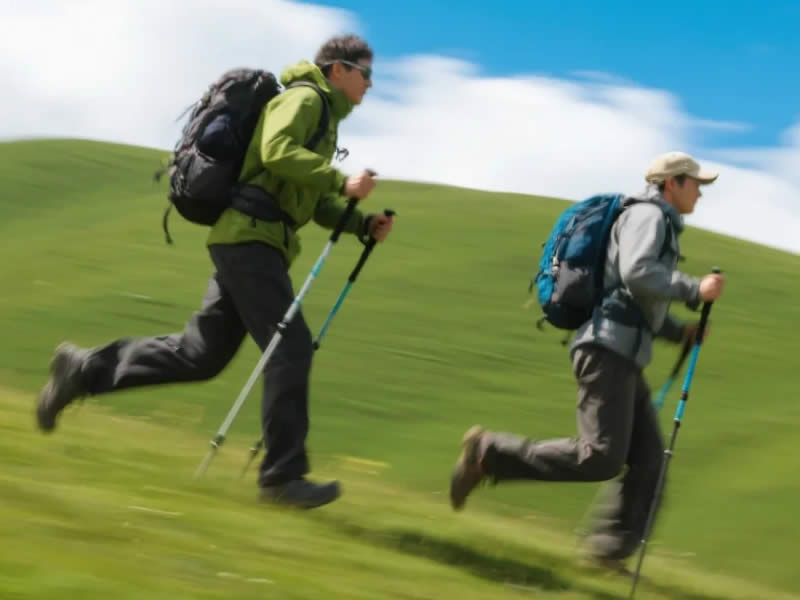
Gentle hills – the long, rolling slopes common on trails like the South Downs Way or the Coast to Coast – are not steep enough to require a powerful double‑plant, but they are still enough to slow you down. Your cadence naturally drops slightly as you start to climb, and the extra effort goes primarily into your legs. By engaging your upper body with a quick, efficient pole motion, you can restore your pace and even increase it.
2. The technique: short, quick, and rhythmical
The most effective technique for increasing speed on gentle hills is the rapid short swing – a quick, shallow arm motion that works with your cadence, not against it.
a. Shorten the swing – Instead of a long, sweeping motion from behind your body to ahead of your chest, keep the movement compact. The pole should travel only from a slight back angle to a slight forward angle. Think of it as a "flick" rather than a "push."
b. Plant at your heel – Plant the pole level with your heel, not far ahead. Reaching far ahead breaks your rhythm and slows you down. A level plant keeps the motion short and fast.
c. Push back immediately – As soon as the tip touches the ground, push back through the strap. The forward momentum of your foot landing combines with the backward pressure of your arm to create a "pull" that accelerates you up the slope.
d. Match the rhythm to your cadence – Your arm swing should match your footfall – left pole with right foot, right pole with left foot. On a gentle hill, focus on maintaining a steady, quick cadence rather than a powerful push.
3. The science – why it works
- Reduced braking – When you plant far ahead, you create a brief braking effect before you push. By planting level with your heel, you eliminate that braking phase, allowing a smoother transition into the push.
- Load transfer – The short swing still transfers a portion of your body weight to your arms and shoulders, reducing the load on your quads. This delay in leg fatigue allows you to maintain a higher pace for longer.
- Momentum – The rapid push creates a small amount of forward momentum with each step, which adds up over dozens of steps, resulting in a net increase in speed.
4. The double plant as a momentum booster
On very long, gentle hills where you are starting to tire, you can add a double plant every 4th or 5th step.
- Plant both poles together a short step ahead, push down simultaneously, and use the boost to accelerate.
- Return to alternating after the boost. This gives you a surge of momentum without disrupting your rhythm for more than a step.
5. Comparing gentle hill technique vs. steep hill technique
| Aspect | Gentle Hill (Speed Focus) | Steep Hill (Power Focus) |
|---|---|---|
| Plant position | Level with heel | Ahead of foot |
| Arm swing | Short, quick | Long, powerful |
| Rhythm | Matches cadence | Can be slower, more deliberate |
| Pole length | Same as flat | Shorten by 5–10 cm |
| Double plant | Occasional boost | Frequent, often every step |
6. Common errors to avoid
- Overreaching – Planting too far ahead is the most common mistake. It breaks your rhythm and reduces speed.
- Too long a swing – A long, sweeping motion slows you down. Keep the arc short.
- Rushing the arm without engaging the core – The power should come from your core and shoulders, not just your arm muscles. Focus on standing upright and letting the swing originate from your shoulder.
- Stiff arms – Keep your arms relaxed. Tension wastes energy.
7. How to practice
- Choose a gentle slope – Find a hill where you can feel a slight increase in effort but don't need to lean forward.
- Walk at your normal pace – Without poles, get a sense of your cadence and breath.
- Add the poles – Start with a short, quick arm swing, planting at your heel. Focus on the rhythm.
- Increase speed – As you get the rhythm, consciously try to quicken your step. The poles should feel like they are "pulling" you.
- Rest and repeat – Take a break, then try again. It may take a few attempts before the technique becomes natural.
8. When the technique doesn't work
- Very steep sections – On steep slopes, a short swing won't provide enough power. Switch to the steeper‑hill technique.
- Loose, uneven ground – On scree or loose rock, you may need to slow down for safety.
- Fatigue – When you are very tired, the quick swing may feel too demanding. Slow down and use the poles for support.
9. Final verdict
Yes – trekking poles can increase your walking speed on gentle hills when used with a short, quick arm swing and a level plant. The technique reduces braking, transfers load to your upper body, and adds a small momentum boost with each step. Practice on a gentle slope, focusing on rhythm and a compact swing. Once you have mastered it, you can add 0.5–1 km/h to your uphill pace, making your long walks feel more efficient and less tiring. It is a subtle adjustment, but one that can make a noticeable difference over the course of a day's walking.




