




Can trekking poles be used for self‑defence against aggressive dogs?
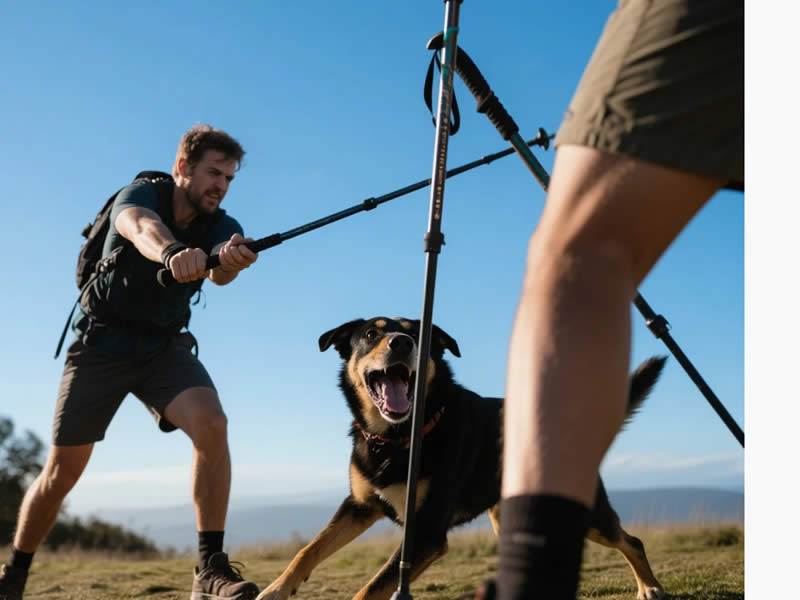
Yes – but only as a last resort and strictly for deterrence, not attack. The primary purpose of a trekking pole in a dog encounter is to create a physical barrier between you and the animal, not to strike it. Extend the pole fully, hold it horizontally in both hands, and point the sharp carbide tip towards the dog. Keep the pole between you and the animal. A firm "No!" or "Stay!" combined with a slow retreat is often more effective than any physical action. If the dog lunges, a sharp jab towards the chest or nose (not a full strike) may deter it. However, the safest approach is to avoid confrontation: stand still, avoid eye contact, and back away slowly. Carrying dog deterrent spray (e.g., citronella‑based) is a more humane and effective option. Never swing the pole like a bat – it can injure the dog and put you off balance. This article provides a comprehensive guide to using trekking poles safely and responsibly in the rare event of an aggressive dog encounter on UK trails.
1. Understanding the risk of dog encounters on UK trails
In the UK, most dogs encountered on trails are friendly or at least neutral. However, some dogs – whether stray, poorly trained, or startled – may act aggressively. The most common triggers are perceived threats to their owner, territory, or food. While attacks are rare, it is sensible to be prepared, especially if you walk in remote areas where help is not immediately available.
2. The role of the trekking pole in an encounter
A trekking pole is not a weapon; it is a tool for walking. In a defensive situation, its primary value is as a distance‑keeping device – it increases the space between you and the dog without requiring physical contact. Used correctly, it can deter a dog from approaching without causing injury.
3. Correct defensive technique
a. Extend the pole – If you are carrying a folding pole, extend it to its full length. If using a telescoping pole, ensure it is locked securely – you don't want it collapsing under pressure.
b. Hold it horizontally – Grip the pole with both hands, one near the handle and one near the middle of the shaft. Hold it horizontally in front of your body, pointing the carbide tip towards the dog. This creates a wide barrier that the dog must get past to reach you.
c. Point the tip towards the dog – The sharp carbide tip, if the dog gets close, can be used to deliver a quick jab towards the dog's chest or snout to create a deterrent. Do not aim for the eyes – that is unnecessary and cruel.
d. Stay upright and still – Dogs are often triggered by sudden movements or running. Stand your ground, keep the pole between you and the dog, and speak in a firm, low voice – "No!" or "Stay!" – without shouting or screaming.
4. What to do if the dog lunges
If the dog lunges towards you:
- Jab, don't swing – A short, sharp jab towards the dog's chest (the sternum area) or the tip of its nose can startle the dog and make it back off. Do not swing the pole like a baseball bat; this risks injuring the dog and losing your balance.
- Use the pole as a shield – If the dog tries to bite the pole, let it. The pole is harder to bite than your arm, and the dog will quickly lose interest.
- Maintain your stance – Keep the pole between you and the dog. Do not turn your back or run.
5. What NOT to do
- Do not swing the pole violently – Swinging can injure the dog severely and could be seen as disproportionate use of force. It also makes you more likely to lose your balance.
- Do not use the pole as a spear – Do not thrust the pole aggressively with full force. A firm jab is enough to create distance.
- Do not hit the dog's head or eyes – This is unnecessary and could cause permanent damage.
- Do not run – Running triggers a chase instinct. Stand your ground.
- Do not make direct eye contact – Direct eye contact can be interpreted as a challenge. Look at the dog's body, not its eyes.
- Do not scream – High‑pitched screaming can excite or agitate the dog further. Use a firm, low voice.
6. Alternatives to using a pole
- Dog deterrent spray – Citronella‑based sprays (like Pet Corrector or similar) are more effective and humane than physical force. A short burst of spray in the dog's direction can stop an aggressive approach. These sprays are legal in the UK and widely available.
- Treats – Carrying a handful of dog treats can be a useful distraction. Throw them away from you to draw the dog's attention away.
- Your pack – If the dog gets close, you can use your backpack as a shield between you and the dog.
- Ultrasonic devices – Some walkers carry small ultrasonic dog repellers that emit a high‑frequency sound unpleasant to dogs but inaudible to humans.
7. Legal considerations in the UK
In the UK, it is illegal to carry a weapon for self‑defence. A trekking pole is not a weapon; it is a walking aid. However, if you were to use a pole to strike a dog with excessive force, you could be prosecuted for animal cruelty or assault. The law expects you to use reasonable force to protect yourself, but the force must be proportionate to the threat. A sharp jab to deter an attacking dog is likely to be considered reasonable; swinging the pole like a bat to cause serious injury is not. Always prioritise de‑escalation and retreat over confrontation.
8. After the encounter
- Report the incident – If the dog is known to be aggressive or if you are injured, report the incident to the local police and the dog warden.
- Check for injuries – If you have been bitten or scratched, wash the wound thoroughly and seek medical advice.
- Reflect – Consider whether you might have done anything differently. Often, the dog was reacting to fear, not malice.
9. Final verdict
Trekking poles can be used as a deterrent against aggressive dogs, but they should be used as a barrier, not a weapon. Hold the pole horizontally, point the tip towards the dog, and use a firm voice to command the dog to stop. If the dog lunges, a short jab towards the chest or nose can create distance. Never swing the pole violently – it is dangerous and may be illegal. The safest option is to carry a citronella‑based dog deterrent spray, which is more humane and effective. Stay calm, stand your ground, and back away slowly. With the right approach, you can navigate dog encounters safely and responsibly on the trails.




