




Can trekking poles be used as a camera tripod for long exposures?
Yes, but with significant limitations. A single trekking pole can function as a monopod, not a full three‑legged tripod. For long exposures up to 3–5 seconds, it can work well with the right technique: plant the tip firmly, attach a small 1/4″‑20 screw adapter (which clamps onto the pole shaft), use a 2‑second self‑timer or a remote shutter to avoid camera shake, and hang your backpack from the pole to add weight and stability. However, for exposures longer than 5 seconds, a proper tripod is essential – a single pole cannot prevent the subtle sideways movements caused by wind, ground vibration, or the photographer's own motion. Trekking poles are best used for waterfall shots, low‑light landscapes, and astrophotography when you can brace the pole against a rock or your body. This article explains the technique, equipment, and limitations in detail.
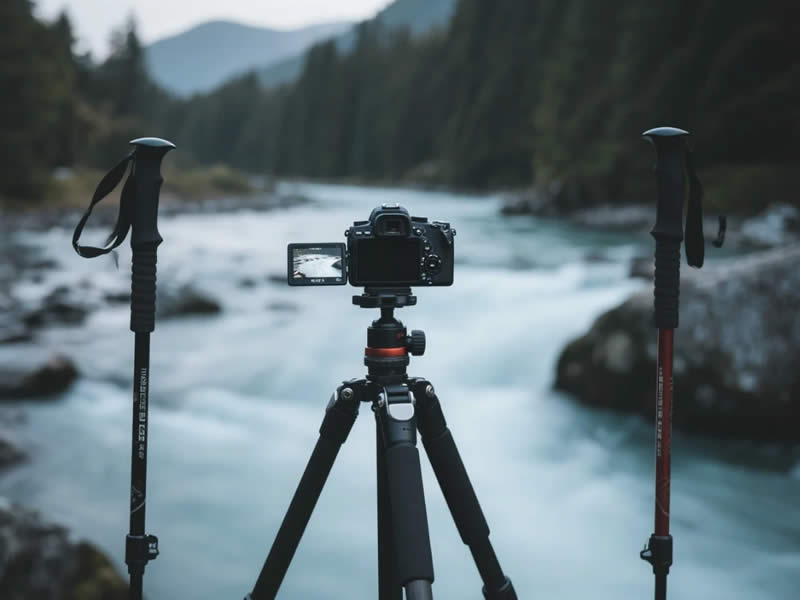
1. The monopod principle
A trekking pole used as a camera support is a monopod – a single‑point support. It reduces vertical shake (up‑and‑down movement) but does not eliminate sideways movement or rotation. This is fine for exposures up to a few seconds, but for longer exposures (e.g., 10+ seconds), the slightest movement will blur the image.
2. Equipment you need
a. 1/4″‑20 camera adapter – A small metal or plastic clamp that attaches to the pole shaft (just below the grip) and provides a standard 1/4″‑20 screw for your camera. Available from Decathlon, Amazon, or photography shops. Cost: £5–15.
b. A lightweight camera – The technique works best with compact cameras, mirrorless systems, and action cameras. A heavy DSLR with a large lens will put too much strain on the adapter and the pole, increasing the risk of shake.
c. Remote shutter release – A Bluetooth remote or cable release allows you to trigger the shutter without touching the camera, eliminating vibration. Alternatively, use the camera's 2‑second or 10‑second self‑timer.
d. A backpack – Hanging your backpack from the pole (using the wrist strap or a carabiner) adds weight and lowers the centre of gravity, significantly improving stability.
e. Rubber tip cover – If you are shooting on a hard surface (rock, pavement), a rubber tip cover can prevent the carbide tip from slipping. On soft ground, the bare tip will bite into the soil.
3. Setting up your pole as a monopod
- Attach the adapter – Clamp the adapter onto the pole shaft, about 10–15 cm below the grip. Ensure it is tightened securely.
- Screw on the camera – Attach your camera to the adapter's 1/4″‑20 screw. Do not over‑tighten; use a rubber washer to prevent scratching.
- Set the pole length – Extend the pole to the desired height. For a lower angle, keep it short; for an eye‑level shot, extend it fully.
- Plant the tip – Place the tip on a stable surface. On soft ground, push it in; on hard rock, ensure it is on a flat, non‑slippery area.
- Add weight – Hang your backpack from the pole (using the wrist strap or a carabiner). This adds stability by lowering the centre of gravity.
- Set the timer or remote – Use a self‑timer or a remote shutter to fire the camera.
4. Technique for long exposures
- Brace the pole – If possible, lean the pole against a rock, a wall, or your body to add extra stability.
- Use the 2‑second timer – This gives the camera time to settle after you press the shutter.
- Avoid wind – Wind is the enemy of a long exposure. Find a sheltered spot, or wait for a lull.
- Focus carefully – Use manual focus or focus lock to avoid the autofocus hunting during the exposure.
- Shoot in RAW – This gives you more flexibility to adjust exposure and noise in post‑processing.
5. Limitations – when it won't work
- Exposures over 5 seconds – The pole cannot prevent the subtle movements caused by wind, ground vibration, or your own breathing.
- Heavy cameras – A heavy camera/lens combination can cause the pole to flex, introducing shake.
- Very low light – In extremely low light, even a small amount of shake will be visible.
- Water – If you are shooting near water, the pole may vibrate from the water flow.
- Wind – Even a gentle breeze can cause enough movement to blur the image.
6. When a tripod is essential
- Astrophotography – Long exposures of 10–30 seconds require a rock‑solid tripod.
- Milky Way shots – Exposure times of 20–30 seconds require a tripod.
- Waterfalls with silky water – If you want the water to be smooth, you may need an exposure of 2–5 seconds. A monopod can work for 2–3 seconds, but beyond that, a tripod is better.
- Night cityscapes – For 10+ second exposures, a tripod is essential.
7. Tips for better results
- Use a lens with image stabilisation – If your lens has IS, turn it off when using a monopod – it can actually introduce motion blur.
- Use a small aperture – For long exposures, use a small aperture (f/8–f/16) to keep the scene sharp and reduce the amount of light entering the lens, requiring a longer exposure.
- Use a neutral density filter – If you want a very long exposure (e.g., 10+ seconds) for water smoothing, you may need an ND filter. With a monopod, you are better off using a tripod.
- Experiment – Try a few test shots to see what works. Check the sharpness on the camera's screen.
8. Alternatives to the trekking pole
- A dedicated monopod – A dedicated monopod is more stable than a trekking pole and can support heavier cameras.
- A GorillaPod – A flexible, lightweight tripod that can be wrapped around rocks or branches.
- A beanbag – A beanbag placed on a rock can provide a stable, low‑profile support for a camera.
9. Final verdict
Trekking poles can be used as a camera support for long exposures up to 3–5 seconds, provided you use a 1/4″‑20 adapter, a remote shutter or self‑timer, and add weight (e.g., your backpack) to the pole. For exposures longer than 5 seconds, or for astrophotography and very low‑light work, a proper tripod is essential. The trekking pole is a versatile tool, but it is a monopod, not a tripod. Use it for waterfall shots, low‑light landscapes, and situations where you can brace the pole against a stable surface. With the right technique, you can capture sharp images without carrying a tripod – but know its limits.




