




How to use trekking poles for pulling yourself up on steep steps?
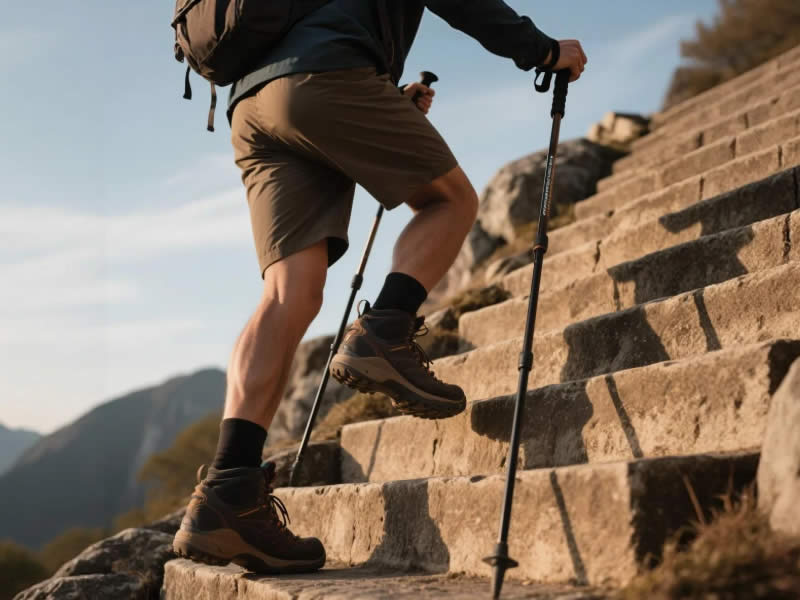
On very steep steps—such as the ascent to Pen y Fan in the Brecon Beacons, the Watkin Path on Snowdon, or the staircase sections of the Coast to Coast—the standard alternating pole technique is not enough. You need a more powerful, synchronised movement to lift your body weight. The key is to shorten your poles by 10–15 cm, place both tips on the step ahead of you, push down through the wrist straps (not your grip), and step up—this transfers effort from your legs to your arms. Use a double plant on each step: plant both poles together, push down, and step up with one foot, then the other. This technique saves your quads on long, steep ascents, allowing you to climb more efficiently and with less fatigue. Practice on a short staircase first to get the rhythm. Here is a comprehensive guide to mastering this essential skill.
1. Why steep steps demand a different technique
On flat ground, the alternating diagonal stride (left pole with right foot) is efficient because the effort is evenly distributed. On steep steps, the gradient changes the biomechanics:
- Your hands are higher relative to the ground, reducing leverage.
- Your quads work harder because each step requires lifting your body weight vertically.
- The rhythm is disrupted because steps are irregular and require a stop‑start motion.
The double‑plant technique addresses these challenges by converting the pole action into a powerful upward push that supplements your leg strength.
2. Setting up your poles for steep steps
a. Shorten your poles by 10–15 cm – This is the most critical adjustment. A shorter pole lowers your hands, allowing you to push down vertically rather than forward. On flat ground, your elbows are at 90°; on steep steps, they should be at 70–80°.
b. Test the length – Stand on a step. Plant both poles on the step above you. Your elbows should be bent, with your hands at about waist height. Adjust until it feels powerful.
c. Check your locks – Ensure your lever locks or twist locks are fully tightened. A slipping lock on a steep step is dangerous.
3. The double‑plant technique – step by step
- Approach the step – Walk up to the step with your poles in a neutral position.
- Plant both poles – Place the two carbide tips firmly on the step ahead of you, about shoulder‑width apart. The poles should be vertical or slightly angled backward.
- Engage the wrist straps – Push your hands up through the straps so they sit across the base of your palms. The straps should bear your weight, not your grip.
- Step up with one foot – Lift your right foot onto the step. As you do this, keep the poles planted.
- Push down – Simultaneously push down through both straps, straightening your arms. This upward thrust reduces the weight your leg has to lift.
- Bring the other foot up – Once your right foot is on the step, bring your left foot up to join it.
- Recover – Lift the poles, place them on the next step, and repeat.
4. Why this technique works
- Load transfer – By pushing down through the poles, you transfer a portion of your body weight from your legs to your arms. This reduces the work your quads have to do.
- Leverage – A shorter pole gives you better mechanical advantage. You are pushing vertically, which is more efficient than a forward push.
- Rhythm – The double plant creates a steady, predictable rhythm, reducing the mental effort of navigating irregular steps.
5. Common mistakes to avoid
- Poles too long – If your poles are not shortened enough, you lose leverage. Shorten more than you think you need.
- Gripping too tightly – A tight grip fatigues your forearms. The straps should do the work.
- Planting too far ahead – On steep steps, plant the poles on the step you are about to step onto, not the step above. Planting too far ahead over‑reaches and reduces leverage.
- Rushing – Steep steps require patience. Move slowly and deliberately.
- Not using both poles – On very steep steps, using both poles together is more powerful than alternating.
6. Adapting for different step types
- High steps (30–40 cm) – Shorten your poles further (15–20 cm) and plant them on the same step as your feet, not ahead. Use the poles to push yourself up as you step.
- Irregular steps (natural rock) – On natural rock steps, the surface may be uneven. Plant the poles on stable, flat parts of the rock.
- Wet steps – On wet or mossy steps, the carbide tips may slip. Plant firmly and test the grip before putting your weight on the poles.
7. When to switch to alternating rhythm
Once the gradient eases (less than 20%), return to the alternating diagonal stride. The double plant is only for steep sections where each step is a significant lift.
8. Strengthening the muscles used
- Triceps – This technique heavily engages your triceps. Include triceps dips or push‑ups in your training.
- Shoulders – Shoulder presses or overhead carries can help.
- Core – A strong core stabilises your torso during the push. Planks and deadlifts are useful.
9. Practice on a staircase
Before attempting this technique on a mountain trail, practice on a short, steep staircase (e.g., a fire escape or a hill path). Focus on the rhythm of planting, pushing, and stepping. Within a few minutes, the motion will become automatic.
10. Final verdict
The double‑plant technique is an essential skill for walkers tackling steep, stepped ascents. Shorten your poles, plant both tips on the step ahead, push down through the straps, and step up. This technique transfers load from your legs to your arms, saving your quads and making steep climbs more efficient. Practice on a short staircase first, and soon you will be climbing steep steps with greater ease and less fatigue. Your legs will thank you at the summit.




