




Can trekking poles be used to measure distance by stride counting?
Yes – trekking poles can help with distance measurement by stride counting, but they are just a tool, not a pedometer. The technique involves three simple steps: measure your average stride length on flat ground, count your steps using the pole plant rhythm (every left‑pole plant equals one step), then multiply steps by stride length to get an approximate distance. Marking 5‑step intervals by counting left‑pole plants (1‑2‑3‑4‑5, reset) makes counting easier. For improved accuracy, use a tally counter or a phone app, and re‑measure your stride periodically as terrain and fatigue can affect it. On hills, your stride shortens, so adjust your count accordingly. This method provides an estimate within ±5–10% – useful for rough pacing, but not a substitute for GPS or map‑based navigation. This article explains the method in detail, offers tips for improving accuracy, and discusses the limitations of stride‑counting with trekking poles.
1. The principle: stride counting with poles
Stride counting is a traditional method of estimating distance. You walk a known distance, count your steps, calculate your average step length, then use that step length to estimate distance on future walks. Trekking poles can make this method easier because they provide a consistent, rhythmic motion that helps you count steps without losing focus.
2. Step‑by‑step method
a. Calibrate your stride – On a flat, measured path (e.g., a 100‑metre track), walk at your normal pace. Count your steps (every time your left foot lands, count one). Divide the distance by the number of steps to get your average stride length. For example, if you walk 100 metres in 125 steps, your stride is 0.8 metres (80 cm).
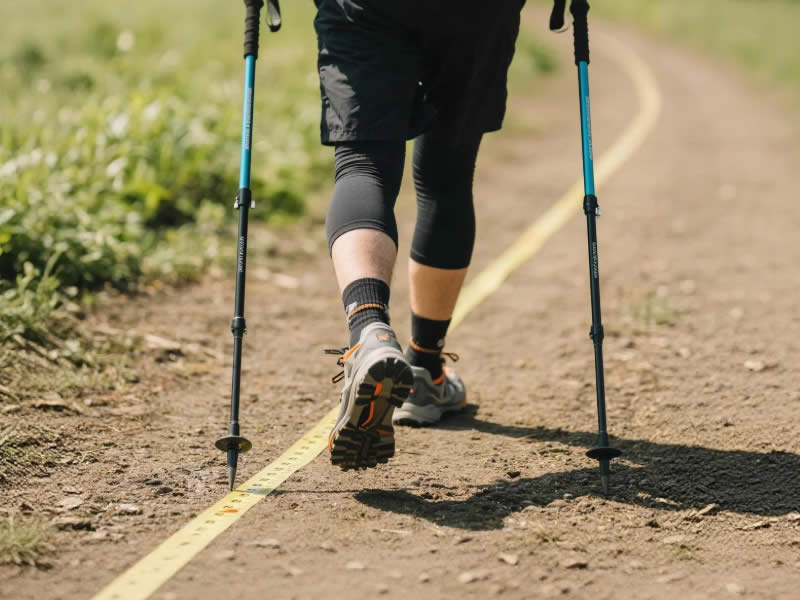
b. Count your steps using the pole rhythm – As you walk, plant your poles in an alternating rhythm (left pole with right foot, right pole with left foot). Every time your left pole plants, that corresponds to one step. This gives you a natural, rhythmic way to count steps without losing track.
c. Mark intervals – To make counting easier, count in groups of five or ten. For example, count left‑pole plants as: 1‑2‑3‑4‑5, reset. This reduces the mental load of counting into the hundreds.
d. Calculate distance – Multiply your total steps by your stride length. For example, 2,500 steps × 0.8 m = 2,000 metres (2 km).
3. How the poles make counting easier
- Rhythm – The alternating pole plant creates a steady, consistent rhythm. This makes it easier to keep count, especially on long, monotonous sections.
- Visual cue – Watching the pole plant gives you a physical marker for each step, reducing the risk of losing count.
- Consistency – The rhythm helps you maintain a consistent pace, which is important for accurate stride‑length measurement.
4. Improving accuracy
a. Re‑calibrate regularly – Your stride length changes with terrain and fatigue. On a steep hill, your stride shortens; on a long flat section, it may lengthen. Re‑measure your stride on different types of terrain.
b. Use a tally counter – A simple mechanical tally counter (or a phone app) can help you count steps without losing track. Click it with your thumb each time your left pole plants.
c. Adjust for terrain – On hills, your stride can shorten by 10–20%. If you know a section is hilly, apply a correction factor (e.g., multiply your usual stride by 0.9).
d. Use a GPS to verify – Compare your stride‑counted distance with a GPS reading on a known section to check your accuracy.
e. Practice – The more you use the method, the more consistent your stride becomes. Over time, your accuracy will improve.
5. Limitations of stride counting
a. Accuracy – Stride counting is only accurate to about ±5–10% on flat terrain, and worse on hills. For precise navigation, use a GPS.
b. Variable stride – As you tire, your stride length changes. You may start with a long stride and finish with a shorter one, leading to underestimation of distance.
c. Terrain – On rough ground, you may take shorter, more cautious steps, reducing your stride length. The method works best on well‑maintained paths.
d. Mental load – Counting for hours can be tiring and distracting. It may be more useful for shorter sections or for estimating distance to a waypoint rather than for the whole walk.
6. When to use stride counting
- Backup method – If your GPS fails or you lose map reading, stride counting can give you a rough estimate of distance travelled.
- Training – It is a useful skill for navigation courses and for developing a sense of distance.
- Rough estimates – On a familiar route, it can help you estimate how far you have walked without relying on technology.
- Night walking – When visibility is low, counting steps can help you judge when you should reach the next path junction.
7. When NOT to rely on stride counting
- Precise navigation – In poor visibility or complex terrain, where accurate distance is critical, rely on map and GPS.
- Boggy or rocky ground – Where your stride is highly variable, the method is unreliable.
- Steep hills – On long, steep ascents or descents, your stride changes so much that the estimate becomes meaningless.
8. Practical example
A walker calibrates their stride on a flat road: 100 metres = 120 steps (stride = 0.83 m). On a walk, they count 3,600 left‑pole plants. Distance = 3,600 × 0.83 = 2,988 m (3 km). A GPS check shows the actual distance is 3.1 km – the estimate is within 4% accuracy.
9. Final verdict
Trekking poles can help with distance measurement by stride counting, but they are only a tool – the accuracy depends on your technique, terrain, and practice. The method is most useful as a rough estimate, a backup to GPS, or a training exercise. For precise navigation, use a map, compass, and GPS. But if you find yourself without electronics, the pole‑assisted stride count can give you a reasonable idea of how far you have walked – and that could be the difference between a successful walk and getting lost.




