




Can trekking poles be used as avalanche probes in emergency?
No – trekking poles are not a substitute for an avalanche probe. They are too short (typically 130–145 cm vs 240–300 cm for a proper probe), lack the rigidity to penetrate hard debris, and have no depth markings. Using a trekking pole could give you a dangerously false sense of security. In the UK, avalanche terrain is limited to the Scottish Highlands, but if you are walking there in winter, you should be carrying proper avalanche safety equipment – not relying on your walking poles. A trekking pole might help you prod shallow, soft snow to locate a dropped item, but it is not a rescue tool.
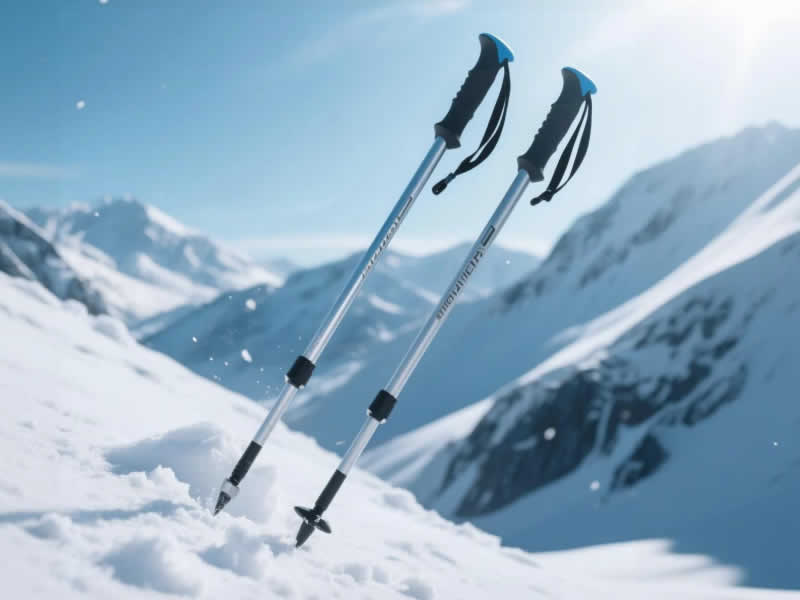
1. Why a trekking pole is not a probe
The differences are critical:
a. Length – A proper avalanche probe is 240–300 cm long. A trekking pole is typically 130–145 cm. In an avalanche, the debris can be several metres deep. A pole that is too short to reach the victim is useless.
b. Rigidity – An avalanche probe is designed to be stiff and to penetrate hard, compacted snow. It is made of aluminium or carbon and has a sharp tip. A trekking pole is not rigid enough to push through dense avalanche debris – it will bend or break.
c. Depth markings – Probes have centimetre markings to help you gauge the depth at which you hit the victim. Trekking poles have no such markings.
d. Joint strength – The joints of a trekking pole are designed for walking loads, not for probing. They can bend, break, or collapse under the force needed to penetrate debris.
2. The risk of false security
The most dangerous aspect of using a trekking pole as a probe is that it may give you a false sense of security. If you think you are probing, but your pole is not reaching the victim, you may waste precious time. In an avalanche, speed is critical – the victim has only 15 minutes before the chances of survival drop significantly. Every minute counts.
3. What you should carry instead
If you are walking in avalanche terrain (typically in the Scottish Highlands in winter), you should be carrying:
- A proper avalanche probe (240–300 cm) – Lightweight and collapsible.
- An avalanche transceiver (beacon) – For locating a buried person.
- A shovel – For digging.
- Formal avalanche training – Gear alone is not enough.
In the UK, avalanche training is available from organisations like Glenmore Lodge and the British Association of Snowsport Instructors (BASI).
4. When a trekking pole might help
In a very shallow, soft snow slide (under 1 m), a trekking pole might help you prod the snow to find a dropped item (like a glove or a pole). However, this is not a rescue situation – it is a retrieval of a non‑critical item. For a real rescue, you need the correct equipment.
5. The legal and moral responsibility
If you are leading a group, or even just walking with companions, you have a duty of care. Carrying inadequate equipment for avalanche terrain is negligent. It could endanger not only you but also the people who have to rescue you.
6. Final verdict
Trekking poles cannot be used as avalanche probes in an emergency. They are too short, not rigid enough, and lack the design features needed for probing. If you are walking in avalanche terrain, carry the proper equipment – a probe, a transceiver, and a shovel – and get the training to use them effectively. Do not rely on your trekking poles as a fallback. Your life – and the lives of those you walk with – are too important.




