




How to use trekking poles for balance on nevé (frozen snow)?
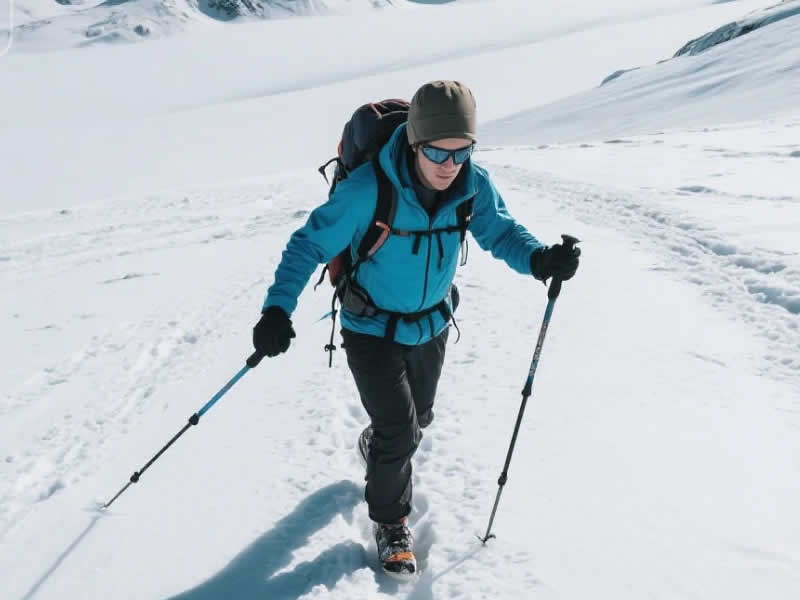
On hard, frozen snow (nevé), trekking poles are essential for traction and stability. The core technique is to plant the pole vertically—straight down, just ahead of your foot—to drive the carbide tip into the ice for maximum bite. Apply downward pressure through the wrist strap to "lock" the tip in place before shifting your weight. Here is a comprehensive guide to using trekking poles effectively on nevé, including preparation, technique, and safety considerations.
1. What is névé?
Névé is granular, frozen snow—often found on glaciers or on snowfields that have undergone melt‑freeze cycles. It can be hard, crusty, and sometimes icy, but it is not pure ice. It may have a soft layer on top with a hard crust beneath. Né vé is common in the Scottish Highlands in spring, on alpine glaciers, and on higher‑level winter paths.
2. Preparation – set up your poles
a. Remove rubber ferrules – Rubber tips are dangerous on nevé. They have no grip. Use the bare carbide tip.
b. Check the carbide tips – The tips must be sharp. A blunt tip will skid on the frozen surface. If they are worn, replace them before the walk.
c. Fit snow baskets – Snow baskets are useful if the névé has a soft layer on top. They prevent the pole from sinking into the soft layer. On solid névé, baskets are not needed and can be removed.
d. Ice grips (spikes) – For very hard, smooth ice, fit a carbide ice grip (a small spike that goes over the tip). These provide extra bite on polished surfaces. They are sold by Leki, Black Diamond, and others.
e. Lengthen poles slightly – On nevé, you may want to lengthen your poles by 2–3 cm to allow you to plant the pole vertically without bending forward.
3. Technique – planting the pole
a. Plant vertically – On nevé, plant the pole straight down, not at an angle. A vertical plant drives the tip directly into the ice, maximising its bite. An angled plant can cause the tip to skid.
b. Push down firmly – As you plant, push down firmly through the wrist strap. This "seats" the tip into the ice, giving you a secure anchor.
c. Plant ahead of your foot – Place the pole just ahead of your foot, but not too far ahead. A plant that is too far ahead reduces your stability.
d. Alternating or double plant? – On moderate slopes, use the standard alternating rhythm (left pole with right foot, right pole with left foot). On steeper sections, use a double plant – plant both poles together ahead of your feet, push down, and move one foot at a time. This gives you maximum stability.
4. Technique – traversing nevé slopes
When crossing a slope of nevé:
a. Face the slope – Angle your body slightly towards the hill, not directly across.
b. Plant the uphill pole first – Plant the uphill pole first, push down firmly, then plant the downhill pole. The uphill pole acts as a brake, preventing you from sliding downhill.
c. Keep your weight back – Lean slightly into the hill. This keeps your weight over your feet and reduces the risk of slipping.
d. Short, deliberate steps – Take short, controlled steps. On nevé, a long stride can cause you to lose balance.
5. Additional safety considerations
- Microspikes – On continuous steep névé or ice, microspikes (crampons for your boots) are essential. Poles are a support aid, not a substitute for traction. Microspikes provide the grip your boots need.
- Test the ground – Before stepping, tap the nevé with your pole. A sharp, hard sound means it is solid; a softer sound may indicate a soft layer.
- Ice axe – On exposed terrain, carry an ice axe as well as poles. Poles are not a substitute for an ice axe on steep, icy slopes.
- Plan your route – On nevé, the conditions can change rapidly with temperature. Plan your route to avoid the steepest sections in the middle of the day when the snow is softest.
6. Final verdict
Using trekking poles on nevé is all about technique and preparation. Plant the pole vertically, push down firmly, and use the wrist strap to transfer load. Fit snow baskets if there is a soft layer, and consider carbide ice grips on very hard surfaces. On steep, continuous ice, microspikes are essential. With the right approach, your poles will give you the stability and confidence to navigate frozen snow safely. The golden rule: plant vertically, push down, and keep your weight centred.




