




Are trekking poles better than a traditional NHS walking stick?
It depends on your needs and walking conditions. A traditional single walking stick provides basic support, while two trekking poles offer superior stability through four‑point contact, distributing weight evenly and engaging your upper body. However, a stick is simpler, lighter, and often more convenient for indoor use or short outings. For uneven outdoor terrain and longer walks, two trekking poles are generally more stable and beneficial. For indoor or short, flat walks, a traditional stick is simpler and often sufficient. Always consult a physiotherapist for personalised advice.
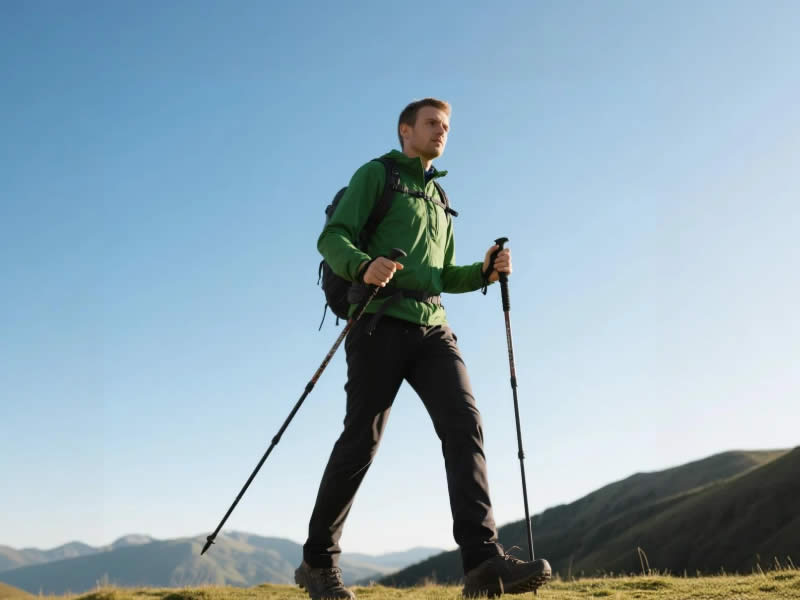
1. The key difference – single vs. double support
The most fundamental difference is the number of support points. A traditional walking stick provides one point of contact (the stick plus your two feet = three points). Two trekking poles provide two extra points of contact (two poles + two feet = four points). This wider base of support significantly improves stability, especially on uneven ground, slopes, and soft surfaces.
2. When a walking stick is better
a. Indoor use – A walking stick is easier to navigate through doorways, narrow corridors, and tight spaces. You only have one stick to manage, and it can be hung on a hook or leaned against a wall.
b. Short, flat walks – On pavements or flat, smooth surfaces, a single stick is often sufficient. It provides a little extra support without the need for the coordination of two poles.
c. Cost and availability – NHS walking sticks are often provided free or at very low cost. Quality trekking poles start at around £50–60 and can be significantly more expensive.
d. Simplicity – A walking stick has no moving parts, no locks to adjust, and no tips to replace. It is the simplest walking aid available.
3. When trekking poles are better
a. Uneven outdoor terrain – On grass, gravel, mud, or rocky paths, two poles provide far greater stability. They give you a wider base of support and allow you to test the ground ahead.
b. Longer walks – Trekking poles engage your upper body, spreading the effort across your arms, shoulders, and back. This reduces fatigue and allows you to walk further.
c. Joint protection – The two poles offload weight from your hips, knees, and ankles. Studies show that using trekking poles can reduce knee impact forces by 20–25% on descents. A single stick offloads less load.
d. Posture – Two poles encourage an upright, symmetrical posture. A single stick can cause you to lean to one side, which may lead to back pain over time.
4. The gait difference – symmetrical vs. asymmetrical
- Walking stick – You use the stick on one side, creating an asymmetrical gait. This can be helpful if one leg is weaker, but over time it can lead to muscle imbalances and back pain.
- Trekking poles – You use both poles in an alternating rhythm (left pole with right foot, right pole with left foot). This creates a symmetrical, natural walking pattern that is easier on your body and encourages a more balanced gait.
5. Adjustability and fit
- Walking stick – Most NHS sticks are fixed length and may not be precisely adjusted to your height. An incorrectly adjusted stick can cause back strain.
- Trekking poles – Fully adjustable, allowing you to set the exact length for your height and the terrain. This ensures a comfortable, efficient walking posture.
6. The learning curve
- Walking stick – Easy to use immediately. You simply hold it and walk.
- Trekking poles – There is a learning curve. You need to learn the alternating rhythm, how to use the wrist straps, and how to adjust the length for ascents and descents. However, within a few walks, it becomes second nature.
7. Cost comparison
- NHS walking stick – Often free or very low cost (around £5–10).
- Trekking poles – Entry‑level poles start at £25–30 (e.g., Decathlon Forclaz MT100). Good‑quality poles with reliable locks and replaceable tips cost £50–100 (e.g., Decathlon Forclaz MT900, Leki Makalu).
8. Which is right for you?
Choose a walking stick if:
- You walk mostly indoors or on flat, paved surfaces.
- You have limited strength or coordination to manage two poles.
- You are on a very tight budget.
- You need a simple, low‑maintenance aid.
Choose trekking poles if:
- You walk outdoors on uneven ground (parks, trails, hills).
- You want to walk further or for longer without fatigue.
- You have joint pain (knees, hips) and want to reduce the impact.
- You want to encourage a symmetrical, upright posture.
9. Final verdict
Trekking poles are not universally "better" than a traditional NHS walking stick – they are different tools for different needs. For indoor use and short, flat walks, a walking stick is simpler and often sufficient. For outdoor walking on uneven ground, two trekking poles offer superior stability, reduced joint impact, and greater efficiency. Many people use both – a stick for indoor and local walks, and poles for outdoor adventures. Always consult a physiotherapist or occupational therapist to determine the best option for your specific condition and walking needs. With the right choice, you can walk safely, comfortably, and with confidence.




