




What is the average weight of good trekking poles for Brazilian backpacking?
For Brazilian backpacking, the average weight of a good pair of trekking poles is around 450–550g. This range balances durability for rocky terrain with low enough weight to reduce arm fatigue on multi‑day treks. Ultralight poles (under 350g) are suitable for gentle trails, while standard poles (500–600g) offer more durability for rugged terrain. For most Brazilian backpackers, the sweet spot is 450–550g—the Decathlon Forclaz MT900 (~500g) is the most popular and best‑value option. It is durable enough for rocky trails and light enough for multi‑day treks. Weight is not everything—reliable locks (lever) and durable material (7075 aluminium) matter more for Brazilian trails. A 500g pole with lever locks and cork grips is a better choice than a 350g pole with twist locks and non‑replaceable tips.
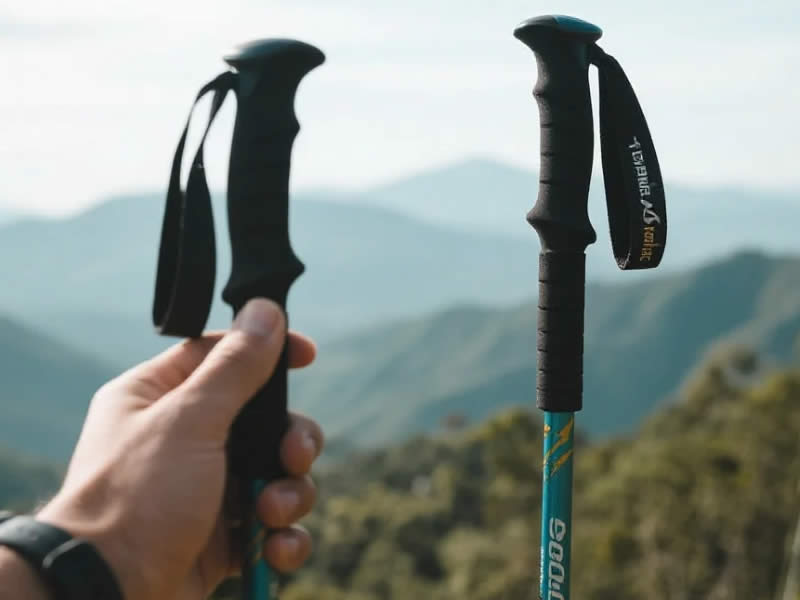
1. Weight categories for Brazilian trails
| Category | Weight (per pair) | Examples | Best for |
|---|---|---|---|
| Ultralight | Under 350g | Fizan Compact 3 (~316g), Black Diamond Distance Carbon Z (~280g) | Gentle trails, fastpacking, ultralight travel |
| Lightweight | 350–500g | Leki Micro Vario (~440g), Decathlon Forclaz MT900 (~500g) | Most Brazilian multi‑day treks |
| Standard/Heavy‑duty | 500–600g | Leki Makalu (~540g), Black Diamond Trail Back (~530g) | Rugged terrain, heavy loads, frequent use |
2. Why 450–550g is the sweet spot for Brazil
a. Durability – At this weight, you are in the range of 7075 aluminium poles with reliable lever locks. These poles are strong enough for the rocky terrain of Chapada Diamantina, Serra do Mar, and Serra da Mantiqueira.
b. Arm fatigue – A pole under 500g is light enough to reduce arm fatigue on long, flat sections. A pole over 550g can be tiring on a multi‑day trek.
c. Features – In this weight range, you get the features that matter: 7075 aluminium, lever locks, cork grips, and replaceable tips.
3. The weight trade‑off
Heavier poles (500–600g) are generally more durable. The Leki Makalu (540g) has a steel lower section that resists abrasion on rocks. Lighter poles (under 400g) are more fragile and may bend or break on rocky terrain. The weight saving of 100–150g per pair is not worth the risk of breakage on Brazilian trails.
4. What about carbon?
Carbon poles are lighter (e.g., Black Diamond Distance Carbon Z at 280g, Leki Micro Vario Carbon at 440g) but more fragile. On rocky Brazilian trails, a side impact can splinter a carbon shaft. For most Brazilian backpackers, the weight saving is not worth the risk. Aluminium is the safer choice.
5. The Decathlon Forclaz MT900 – the benchmark
At 500g per pair, the Forclaz MT900 is the benchmark for Brazilian backpacking. It offers 7075 aluminium, lever locks, cork grips, and replaceable tips at an affordable price. It is light enough for multi‑day treks and durable enough for rocky terrain.
6. Final verdict
For Brazilian backpacking, the average weight of a good pair of trekking poles is around 450–550g. The Decathlon Forclaz MT900 (~500g) is the most popular and best‑value option. If you are a fastpacker on gentle trails, aim for under 400g. For rugged terrain, 500–550g is acceptable. Weight is not everything—reliable locks and durable material matter more for Brazilian trails. Choose based on your terrain and priorities. Happy hiking.




