




Are folding Z‑poles as strong as telescopic poles for rainforest conditions?
No – folding Z‑poles are not as strong as telescopic poles for rainforest conditions. The push‑button joints and thinner tube walls make them more vulnerable to side impacts, grit, and mud. In Brazil's humid, rooty, and rocky rainforest trails, telescopic poles with lever locks are the safer, more durable choice.
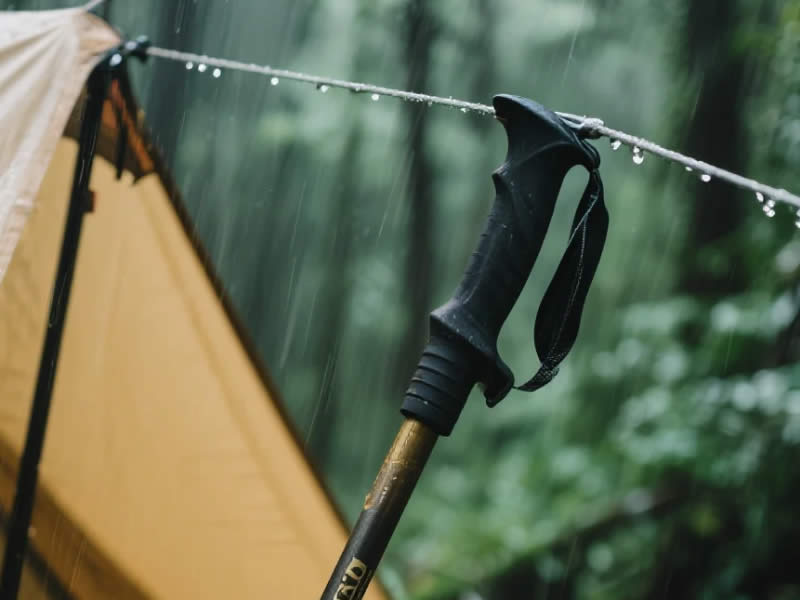
Why telescopic poles win in the rainforest:
- Overlapping sections – stronger under lateral stress.
- Lever locks – reliable in mud; can be cleaned and adjusted.
- Thicker walls – less likely to bend or break on rocks.
When Z‑poles are OK: Gentle, well‑maintained trails, but for Brazilian rainforest conditions, choose 7075 aluminium telescopic poles with lever locks (e.g., Decathlon Forclaz MT900, Leki Makalu). Z‑poles are lighter but less durable.
1. The structural difference
Telescopic poles consist of two or three sections that slide inside one another and are locked using an external lever or twist mechanism. The overlapping length (usually 5–10 cm per joint) creates a continuous, reinforced tube when locked. Z‑poles consist of three sections connected by an internal shock cord and locked by external push‑buttons at the joints. The push‑button passes through a hole in the outer section, but there is minimal overlap; the load is concentrated on a small button.
2. Why rainforest conditions are challenging
The Atlantic Forest (Mata Atlântica) and the Amazon are demanding environments for trekking poles. Key challenges include:
- Mud and grit – can jam push‑button joints.
- Rooty trails – poles are often planted between roots, subjecting them to lateral forces.
- Humidity – moisture can affect the internal shock cord of Z‑poles.
- Frequent planting – the constant planting and pulling out of poles puts stress on the locking mechanisms.
3. Strength under lateral (side) loads – the critical difference
This is where telescopic poles win. When you plant a pole at an angle (common on uneven ground) or hit a rock sideways, the lateral force creates a bending moment. Telescopic poles have overlapping sections that resist bending; the internal overlap spreads the stress. Z‑poles have a single‑wall junction and a small push‑button. The thin wall and concentrated stress point make them far more vulnerable to snapping or bending permanently.
4. The push‑button vs. lever lock
Push‑button joints are convenient but vulnerable:
- Grit – Mud and sand can jam the mechanism, preventing it from locking or releasing.
- Wear – Over time, the button can wear, causing the pole to collapse under load.
- Failure – A broken push‑button is almost impossible to repair on the trail.
Lever locks are mechanical clamps—robust, field‑adjustable, and far more reliable under lateral stress.
5. Real‑world comparison
| Feature | Z‑fold (folding) | 3‑section telescopic |
|---|---|---|
| Packed length | ~35–40 cm | ~65–70 cm |
| Weight per pair | ~280–450 g | ~500–550 g |
| Lateral strength | Lower – thin walls, push‑button joints | Higher – overlapping sections, lever locks |
| Durability on rocks | Lower – can snap or bend | Higher – bends but rarely breaks |
| Repairability | Harder – push‑buttons not user‑replaceable | Easier – replace sections, tighten locks |
| Best for | Well‑maintained trails, travel, ultralight | Rugged terrain, rainforest conditions |
6. When Z‑poles are a good choice
- Well‑maintained trails – If you are walking on gentle, non‑rocky paths.
- Ultralight hiking – Where weight saving is a priority.
- Travel – They pack small for flights.
7. When telescopic poles are the safer choice
- Rainforest conditions – Where mud, grit, and side impacts are common.
- Rocky terrain – Where the pole may be wedged between rocks.
- Heavy use – Regular walking in demanding conditions.
8. Final verdict
For Brazilian rainforest conditions, 7075 aluminium telescopic poles with lever locks are the stronger, more durable choice. Z‑poles are lighter and pack smaller, but they are more vulnerable to side impacts and grit. For reliable performance in the Amazon or Atlantic Forest, choose telescopic poles. Happy hiking.




