




Do shock‑absorbing springs in trekking poles work well on Brazilian cobblestone paths?
Yes – shock-absorbing springs in trekking poles can help on Brazilian cobblestone paths, but mainly by reducing arm fatigue, not by protecting knees. On cobblestone paths, the spring absorbs the jarring vibration with each plant, making the walk feel more comfortable. However, on uneven cobblestones, the spring can make the pole feel "spongy" and reduce precision. The primary knee‑saving benefit comes from load transfer through wrist straps, not the spring. Springs add weight and complexity. If you buy anti‑shock, choose a model with a lock‑out feature to get a more direct feel. For knee protection, focus on wrist straps and correct pole length.
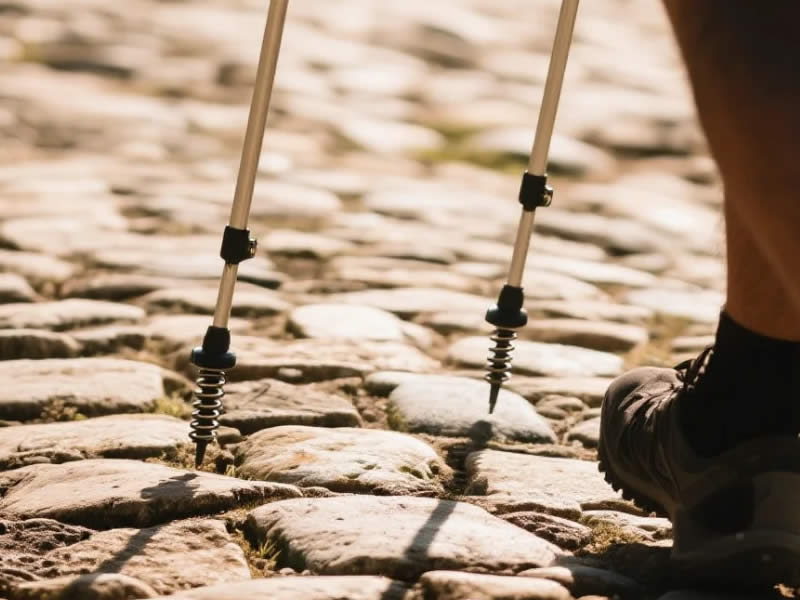
1. Brazilian cobblestone paths – a common challenge
Brazil has many cobblestone paths, particularly in colonial towns (e.g., Ouro Preto, Paraty, Salvador) and on historic trails. These paths are uneven, hard, and jarring to walk on. The constant vibration can cause hand and arm fatigue, and the impact can be uncomfortable.
2. How anti-shock works on cobblestones
Anti-shock systems contain a spring or elastomer inside the shaft. When you plant the pole on a hard surface, the spring compresses slightly, absorbing a fraction of the impact energy. On cobblestones, this reduces the high-frequency vibration that travels up the shaft to your hands and arms. This can make a long walk on cobblestones feel more comfortable.
3. The limitations
- Spongy feel – On uneven cobblestones, a spring can make the pole feel less direct, reducing the precision of your plant. This can be unsettling on uneven ground.
- Not for knee protection – The primary knee‑saving benefit comes from load transfer through wrist straps, not from the spring.
- Weight and complexity – Springs add weight and a potential failure point.
- Reduced feedback – The spring can mask the feel of the ground, making it harder to judge the stability of your plant.
4. The lock-out feature – the compromise
If you buy anti‑shock poles, look for a lock‑out feature. This allows you to disable the spring, turning the pole into a solid pole for sections where you need a more direct feel. On cobblestones, you can lock the spring for a more stable plant.
5. What most Brazilian hikers use
For Brazilian trails, solid poles (without anti-shock) are more common. The Decathlon Forclaz MT900 and Leki Makalu are the most popular choices – they are reliable, simple, and provide a direct feel on all surfaces.
6. Final verdict
Anti‑shock springs work well on Brazilian cobblestone paths for reducing hand and arm fatigue, but they are not essential. For knee protection on descents, focus on wrist straps and correct pole length. If you buy anti‑shock, choose a model with a lock‑out feature. For most Brazilian trails, a solid, reliable pole is the better all‑round choice. Happy hiking.




