




What is the difference between trekking poles and ski poles for Brazilian winter?
Trekking poles and ski poles are designed for entirely different activities and are not interchangeable in Brazilian winter conditions. For the vast majority of Brazilian winter hiking—which involves muddy trails, rocky terrain, and occasional frost—trekking poles are the correct choice. Ski poles are designed specifically for snow and are unsuitable for Brazil's typical winter trails.
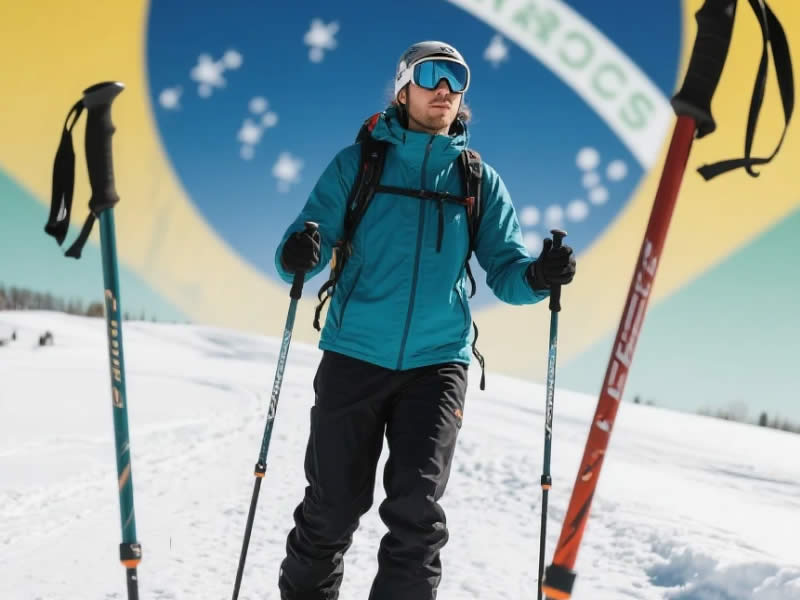
Key differences:
- Trekking poles – Adjustable length, carbide tips for rock and mud, small baskets, wrist straps for load transfer. Designed for walking on varied terrain.
- Ski poles – Fixed length, steel tips for ice, large snow baskets, angled grips. Designed for snow.
In Brazilian winter:
- Trekking poles – Work on muddy, rocky, or icy trails. Use carbide tips for grip, add snow baskets if walking on snow. Adjustable length allows you to shorten for ascents and lengthen for descents.
- Ski poles – Only useful on deep snow (rare in Brazil). Not suitable for rocky or muddy terrain – steel tips wear down and large baskets catch on rocks. Fixed length is a disadvantage on hilly terrain.
Verdict: For Brazilian winter hiking, trekking poles are the right choice. If you are hiking in the rare snowy peaks of the South (e.g., São Joaquim, Urubici), use trekking poles with snow baskets. Ski poles are for skiing – not for walking. The only exception is if you are doing backcountry skiing or ski touring, but that is a specialist activity not typical for most Brazilian winter walkers.
1. Design differences – why they matter in Brazil
| Feature | Trekking Poles | Ski Poles |
|---|---|---|
| Length | Adjustable | Fixed |
| Tip | Tungsten carbide (grips on rock/mud) | Steel (grips on ice) |
| Baskets | Small or removable | Large snow baskets |
| Grip | Straight with wrist strap | Angled with glove-like strap |
| Purpose | Balance, knee protection, load transfer | Propulsion, turning in snow |
2. Why trekking poles are better for Brazilian winter
a. Adjustable length – Brazilian winter trails have steep ascents and descents. You need to shorten poles for ascents (better leverage) and lengthen them for descents (knee protection). Ski poles are fixed length and cannot be adjusted.
b. Carbide tips – Brazilian winter trails are often muddy or rocky. Carbide tips grip on rock and mud. Steel tips (on ski poles) are designed for ice and will wear down quickly on rock.
c. Small baskets – Brazilian trails are not snow-covered except in rare cases. Small baskets (or none) are sufficient. Ski poles have large snow baskets that catch on rocks and vegetation.
d. Wrist straps – Trekking poles have wrist straps that transfer load from your legs to your arms, reducing knee impact. Ski poles have angled grips with glove-like straps for a different motion.
3. When ski poles might be used in Brazil
- Backcountry skiing – If you are ski touring or backcountry skiing in the South (e.g., São Joaquim, Urubici), you will use ski poles.
- Cross-country skiing – A niche activity in Brazil, but some cross-country skiing is possible in the South.
For walking, trekking poles are the correct tool.
4. The rare snow exception
If you are hiking in the rare snow conditions of the South (e.g., Serra do Rio do Rastro, Morro da Igreja), you can use trekking poles with snow baskets. Snow baskets are available for most trekking poles and provide floatation in snow. You do not need ski poles for hiking on snow – trekking poles with snow baskets work perfectly well.
5. Common mistakes
- Using ski poles for hiking – A common mistake. Ski poles are not suitable for rocky or muddy terrain. The steel tips wear down, and the large baskets catch on rocks.
- Using trekking poles in deep snow without baskets – In deep snow, a trekking pole without a snow basket will sink. If you are hiking in snow, fit snow baskets.
6. Final verdict
For Brazilian winter hiking, trekking poles are the right choice. They are adjustable, have carbide tips for rock and mud, and can be fitted with snow baskets for the rare snowy conditions. Ski poles are only for skiing. If you are hiking in the rare snowy peaks of the South, use trekking poles with snow baskets. For the vast majority of Brazilian winter conditions, trekking poles are the correct tool. Happy hiking.




