




How to adjust trekking pole length for descending muddy Atlantic Forest slopes?
For descending muddy Atlantic Forest slopes, lengthen your poles by 5–10 cm compared to flat-ground length. This allows you to plant the tip ahead of your feet, creating a braking effect that reduces knee impact and prevents slips on the steep, slippery terrain. The Atlantic Forest (Mata Atlântica) is humid, with steep, muddy trails that require careful technique. Lengthening your poles gives you better leverage and protection on the descents.
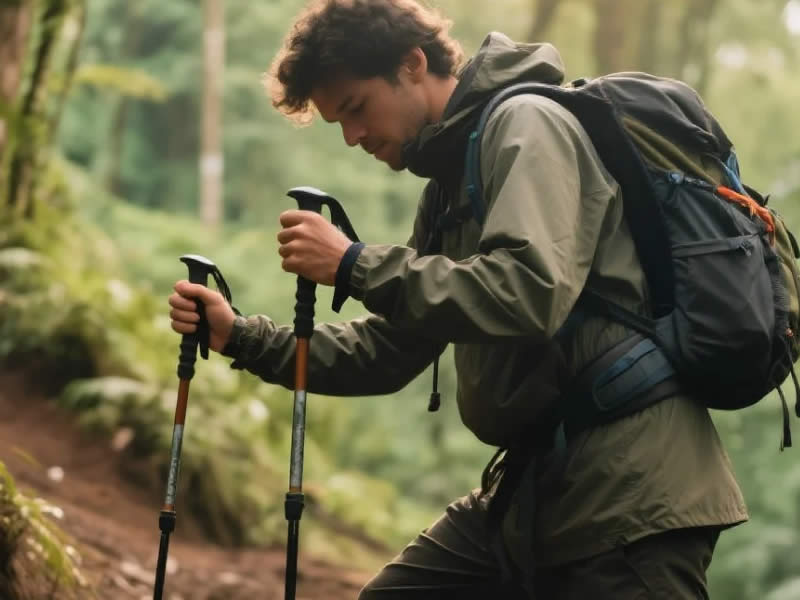
Step-by-step:
- Lengthen poles – Add 5–10 cm before starting the descent.
- Plant ahead – Place the tip 20–30 cm ahead of your front foot.
- Push down – Apply firm downward pressure through the wrist straps.
- Keep weight back – Lean slightly into the slope to maintain balance.
Pro tips:
- Remove rubber tips – Carbide grips better on wet mud and roots.
- Fit mud baskets – Prevents sinking into soft ground.
- Test each plant – Mud can hide roots or loose stones.
Common mistakes:
- Not lengthening enough – reduces braking effect.
- Gripping too tightly – forearms fatigue; let the straps do the work.
- Rushing – take short, deliberate steps.
Verdict: Lengthening your poles by 5–10 cm is essential for safe, knee-friendly descents on muddy Atlantic Forest trails. Practice on gentle slopes first.
1. Why lengthening helps on muddy descents
When you walk downhill, your centre of gravity shifts forward, and your knees absorb more impact with each step. A longer pole allows you to plant the tip ahead of your foot, creating a braking effect that slows your descent and reduces the load on your knees. This is particularly important on muddy slopes, where footing is uncertain and a slip is more likely.
2. How much to lengthen
The exact amount depends on the steepness and slipperiness of the slope:
- Gentle muddy slope – Lengthen by 3–5 cm.
- Moderate muddy slope – Lengthen by 5–8 cm.
- Steep, very slippery slope – Lengthen by 8–10 cm or more.
A good rule of thumb: on a steep, muddy descent, your poles should be at their maximum comfortable length—just short of the point where you cannot comfortably reach the grip.
3. Step-by-step technique
- Lengthen the poles – Before starting the descent, extend both poles by 5–10 cm. If you use lever locks, this takes seconds.
- Check the length – Plant one pole ahead of you and take a step. Your elbow should be slightly bent (not fully extended) when the tip contacts the ground.
- Plant ahead – On each step, plant the pole tip ahead of your front foot, about 20–30 cm in front.
- Push down – Apply firm downward pressure through the wrist strap, not your grip. The strap does the work.
- Keep weight back – Slightly lean back from the slope, keeping your centre of gravity over your feet. This reduces the chance of slipping forward.
- Test the ground – Before committing your weight, test the ground with the pole tip. Mud can hide deep puddles or loose stones.
4. The Atlantic Forest advantage
The Atlantic Forest's mud is often deep and slippery. Lengthening your poles gives you a better chance of finding a secure plant, and the braking effect helps you control your speed. The mud baskets are also useful—they prevent the pole from sinking too deep.
5. Common mistakes to avoid
- Not lengthening enough – If your poles are too short, you cannot plant ahead effectively, reducing the braking effect.
- Lengthening too much – Over-lengthening forces you to reach too far, compromising your balance and reducing leverage.
- Gripping too tightly – A tight grip fatigues your forearms. Use the wrist straps to transfer load.
- Not testing the ground – Muddy slopes can have hidden holes or roots; test before planting.
- Rushing – Descents on muddy slopes require patience. Take short, controlled steps.
6. Practice on easier slopes
Before tackling a steep, muddy descent, practice the technique on a gentle slope. Focus on the rhythm of planting ahead, pushing down, and taking short steps. Within a few descents, it will become automatic.
7. Final tips for Atlantic Forest conditions
- Remove rubber tips – Carbide grips better on wet mud and roots.
- Fit mud baskets – Prevents sinking into soft ground.
- Use lever locks – Twist locks can slip in muddy, wet conditions.
- Carry spare tips – Mud is abrasive; tips wear down over time.
- Clean after the walk – Mud and grit can damage locks. Rinse with fresh water and dry.
8. Final verdict
For descending muddy Atlantic Forest slopes, lengthen your poles by 5–10 cm to create a braking effect, reduce knee impact, and improve stability. Plant the tip ahead of your front foot, push down through the wrist straps, and keep your weight slightly back. Practice on gentle slopes first, and you will soon master the technique. Happy hiking.




