




How to use trekking poles to save energy on the Serra dos Órgãos traverse?
To save energy on the Serra dos Órgãos traverse, use a steady alternating rhythm (left pole with right foot) and push through the wrist straps – never grip tightly. Shorten poles by 5–10 cm on steep ascents (better leverage) and lengthen by 5–10 cm on descents (braking, knee protection). On long, undulating sections, maintain a consistent cadence to distribute effort between legs and arms. The key to energy efficiency on this demanding traverse is rhythm, technique, and correct pole length. Practice on shorter sections before tackling the full traverse.
1. Why the Serra dos Órgãos traverse is demanding
The Serra dos Órgãos traverse (Travessia Petrópolis–Teresópolis) is one of Brazil's classic treks. It covers approximately 30 km over 3 days, with steep ascents and descents, rocky terrain, and exposed ridges. The cumulative elevation gain is significant, and the trail is often wet and slippery. Efficient pole use can save energy and protect your knees.
2. The alternating rhythm – your energy-saving foundation
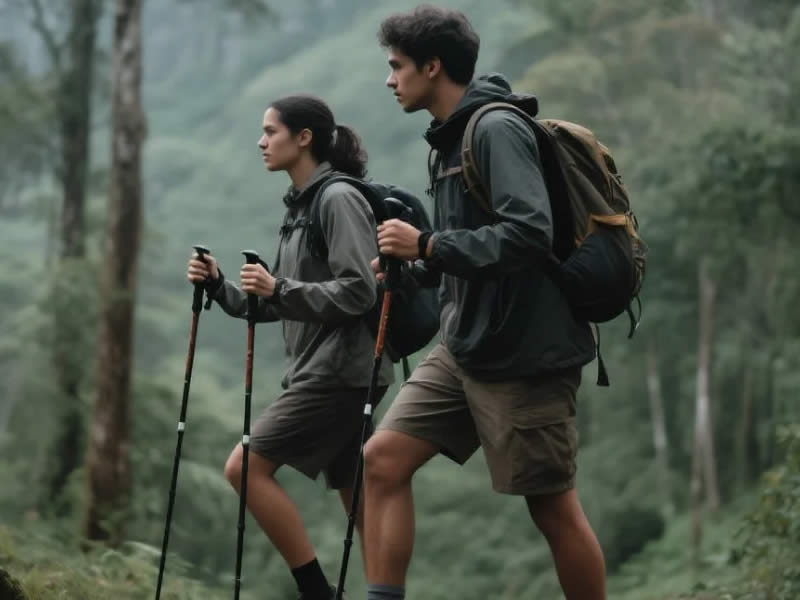
The most efficient way to walk with poles is the alternating rhythm: left pole with right foot, right pole with left foot. This mimics your natural arm swing and distributes the effort across your upper body. On the long, undulating sections of the traverse, this rhythm maintains a steady pace and reduces leg fatigue.
3. Wrist straps – the key to load transfer
Your wrist straps are not just to stop you dropping the pole. They are the primary mechanism for load transfer.
- Adjust the strap – The strap should sit across the base of your palm (the fleshy part between your wrist and palm).
- Push through the strap – When you plant the pole, the force should go through the strap, not your grip. Your hand should be relaxed.
- Relax your grip – A tight grip fatigues your forearms. Use the straps to take your weight.
4. Adjust length for the terrain
On the Serra dos Órgãos traverse, you will encounter a variety of terrain. Adjusting your pole length saves energy:
- Steep ascents – Shorten by 5–10 cm. This gives you better leverage and saves your legs.
- Steep descents – Lengthen by 5–10 cm. This allows you to plant ahead, creating a braking effect that reduces knee impact.
- Undulating sections – Use your flat-ground length. If the terrain is constantly changing, you may need to adjust frequently.
5. The double-plant for power
On very steep sections, use the double-plant:
- Plant both poles together on the ground ahead.
- Push down simultaneously as you step up.
- This gives you a powerful upward thrust, transferring effort from your legs to your arms.
6. Common energy-wasting mistakes
- Gripping too tightly – This fatigues your forearms and reduces efficiency.
- Poles too long/too short – Incorrect length reduces leverage and increases fatigue.
- Planting too far ahead – This turns your pole into a brake, not a propellant.
- Ignoring the straps – If you are not using the straps, you are missing the main benefit.
- Rushing – A steady rhythm is more efficient than stop-start.
7. Pro tips for the traverse
- Spare tips – The abrasive rock wears down tips. Carry spares.
- Mud baskets – Useful on the wet sections.
- Hex key – For adjusting lever locks if they loosen.
- Take breaks – Use your poles for support when resting.
- Stay hydrated – The traverse is exposed; dehydration increases fatigue.
8. Final verdict
On the Serra dos Órgãos traverse, efficient pole use can save significant energy. Use the alternating rhythm, push through the wrist straps, adjust your length for the terrain, and relax your grip. Practice on shorter sections before tackling the full traverse. With the right technique, your poles will help you complete the traverse with less fatigue and more enjoyment. Happy hiking.




