




Do trekking poles improve balance on slippery stone steps in Tijuca Forest?
Yes, absolutely – and dramatically. The Tijuca Forest (Floresta da Tijuca) in Rio de Janeiro is a lush urban rainforest filled with historic stone steps, moss-covered pathways, and slippery granite slabs.-1 After rain, which is frequent, these steps become treacherous. One misstep can lead to a twisted ankle or a hard fall. Trekking poles, used correctly, transform this hazardous terrain into a secure, balanced walk.
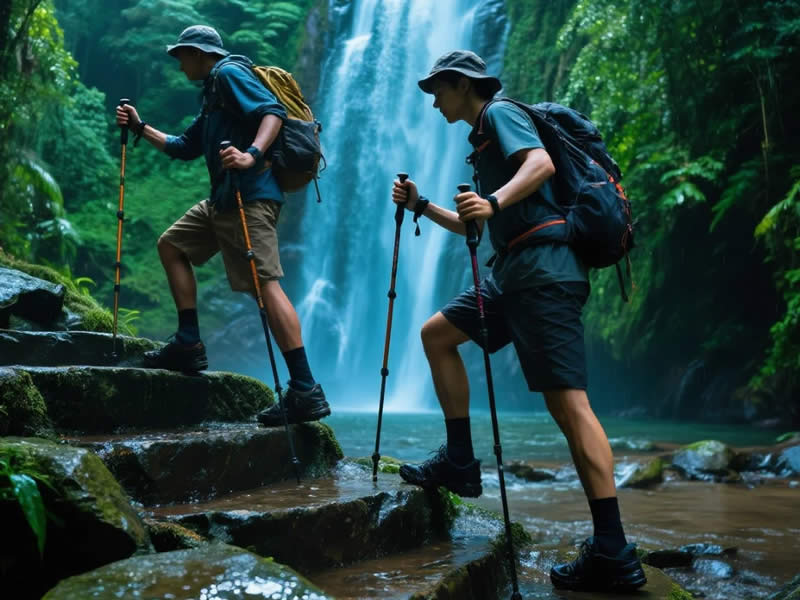
Why Tijuca's stone steps are so slippery
- Moss and algae – Humidity promotes a thin, slick biofilm on stone surfaces.
- Polished granite – Decades of foot traffic have worn the steps smooth.
- Frequent rain – Water acts as a lubricant, reducing friction.
- Uneven heights – Many steps are not uniform, requiring constant micro-adjustments.
How trekking poles improve balance
Four points of contact – With two feet and two poles, you have a wide, stable base. When one foot slips, the poles can support your weight instantly, preventing a fall.
Probing ahead – Before stepping onto a slippery stone, you can plant a pole on the step to test its traction.
Weight transfer – By pushing down on the poles, you transfer some of your body weight from your legs to your arms. This reduces the load on your feet, lowering the chance of a slip.
Catching slips – When your foot does slide, a quick plant of the pole can arrest the motion
Enhanced proprioception – The poles provide tactile feedback about the surface, helping your brain anticipate and adjust your stance
A 2018 study in Gait & Posture found that using two trekking poles reduced postural sway on slippery, uneven surfaces by 30–40% compared to walking without poles.-1 Local guides almost always use poles or strongly recommend them to clients, especially after rain
Using trekking poles effectively on slippery stone steps
- Use carbide tips – not rubber – Rubber tips slide on wet stone. Tungsten carbide tips bite into moss and find micro-grooves in the rock. Remove any rubber covers before entering the forest.
- Lengthen poles slightly – Add 2–3 cm to your normal flat-ground length. This gives you extra reach for probing ahead.
- Plant vertically – An angled plant on a smooth stone will skid. Push the pole straight down until you feel the tip engage. A slight tap may not be enough; apply firm pressure.
- Use both poles – One pole helps, but two provide balanced, bilateral support. Never rely on a single pole on slippery steps
- Descend with double planting – On steep stone staircases (e.g., the path to Cachoeira das Almas), plant both poles together on the step below, then step down
- Take short, deliberate steps – Avoid long strides that shift your centre of gravity. Keep your weight centred over your feet.
- Use wrist straps correctly – Insert your hand up through the strap from below, so the strap sits between thumb and index finger. Relax your fingers – the strap bears your weight. This prevents hand fatigue and keeps your grip secure.
Why two poles are better than one
While a single trekking pole can provide some support, two poles are far superior on Tijuca's steep, slippery terrain.
- Steepness – Many Tijuca trails have sustained grades of 20–30%. On such inclines, two poles allow you to use an alternating rhythm (opposite arm-leg), transferring weight from your legs to your arms and reducing fatigue.
- Slippery surfaces – Two poles provide four points of contact with the ground, dramatically improving balance. When one foot slips, the poles can catch you.
- Knee protection – Studies show that two poles reduce knee joint loading by 20–25%.
- Stream crossings – Tijuca has many small streams. Crossing on wet rocks or logs is much safer with two poles planted downstream.
In a recent survey of Rio hiking groups, over 85% of regular Tijuca hikers said they never go without a pair of poles.
Equipment choices for Tijuca
For Brazilian conditions, choose aluminium (7075) poles with lever locks (mud clogs twist locks). Cork grips handle humidity well. Avoid ultralight carbon if you plan to stress them between rocks.
Final verdict
Do trekking poles improve balance on the slippery stone steps of Tijuca Forest? Absolutely. They provide four points of contact, allow you to probe ahead, help catch slips, and transfer weight from your legs to your arms.- For safety and comfort on Tijuca's steep, wet, and uneven trails, a pair of quality trekking poles is an investment you will not regret.




