




How to use trekking poles on flat vs steep Brazilian mountainous terrain?
On flat Brazilian terrain, use an alternating diagonal stride (left pole with right foot) with a short, relaxed arm swing. Set poles so elbows are at 90° when tips touch the ground. Push through wrist straps, not your grip. Adjust tips – rubber for hard-packed dirt, carbide for sand or grass.
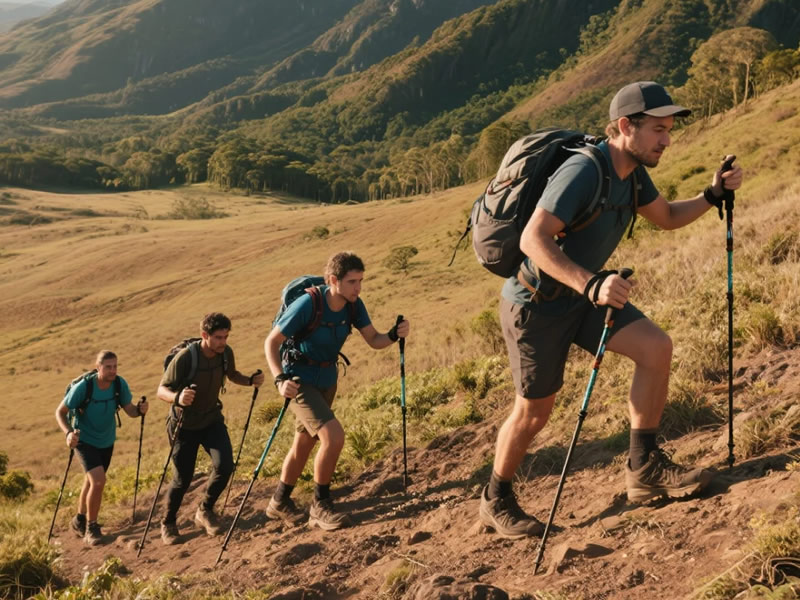
On steep Brazilian mountainous terrain, adapt your technique:
- Ascents: Shorten poles by 5–10 cm for better leverage. Use a double plant (both poles together) on very steep sections.
- Descents: Lengthen poles by 5–10 cm for braking. Plant ahead and push down through straps to protect knees.
- Rhythm: Maintain a steady, controlled cadence.
Brazil-specific tips:
- Lever locks beat twist locks in mud and humidity.
- Cork grips handle sweaty hands better than foam.
- Spare carbide tips are essential for abrasive quartzite trails.
Verdict: Adjust length, rhythm, and technique to match the terrain. Happy trails!
1. Why terrain matters in Brazil
Brazil's landscape is incredibly diverse—from the flat, wetland trails of the Pantanal to the steep, rocky peaks of the Serra do Mar. Using the same technique on flat and steep terrain is inefficient and can lead to fatigue or injury. Adapting your pole use to the terrain is the key to comfort, efficiency, and safety.
2. Flat terrain – rhythm and efficiency
On flat ground, the goal is to maintain a steady, efficient rhythm that uses your upper body to assist your legs. The technique is simple but requires practice to perfect.
a. The alternating diagonal stride
Plant left pole as your right foot steps forward, and right pole as your left foot steps forward. This mimics your natural arm swing and spreads the workload across your body.
b. Pole length
Set your poles so your elbows are at 90° when the tip is on the ground. This is your baseline flat-ground length. For most walkers, this is around 120–125 cm.
c. Rhythm
Aim for a consistent cadence—around 60–70 plants per minute per pole. Count "left, right, left, right" to find a steady rhythm. A consistent rhythm reduces mental effort and helps you maintain a steady pace over long distances.
d. Planting position
Plant the pole close to your body—level with your heel or slightly ahead. Avoid reaching too far forward, which wastes energy and disrupts your rhythm.
e. Energy transfer
Push down through the wrist strap, not your grip. Your hand should be relaxed; the strap transfers the load to your arms and shoulders.
f. Adjusting for Brazilian flat terrain
- Hard-packed dirt: Use rubber tips to reduce noise and save carbide.
- Sand or grass: Remove rubber tips and use carbide for grip.
- Muddy patches: Keep carbide tips and plant deliberately.
3. Steep terrain – ascents
a. Shorten your poles
Reduce your pole length by 5–10 cm (compared to flat-ground length) on steep ascents. A shorter pole lowers your hands, giving you better leverage to push up the slope. Use a double plant on very steep steps: plant both poles together ahead of you and push down as you step up.
b. The double-plant technique
On very steep sections, use a double plant: plant both poles together on the step ahead, push down, and step up. This gives you a powerful upward boost.
c. Rhythm
On steep ascents, your cadence will naturally slow down. Focus on a steady, controlled rhythm, planting the poles with each step.
d. Brazilian ascents
Brazil's mountainous terrain (Serra do Mar, Serra da Mantiqueira) has steep, rocky ascents. Shortening your poles and using the double plant is essential for saving energy.
4. Steep terrain – descents
a. Lengthen your poles
Extend your poles by 5–10 cm on steep descents. A longer pole allows you to plant ahead of your feet, creating a braking effect that reduces knee impact.
b. Plant ahead
Plant the pole ahead of your feet and push down to brake your speed. This reduces the impact on your knees and helps you stay upright on loose ground.
c. Use a double plant on steep sections
On very steep, loose descents, plant both poles together and use them as a brake.
d. Brazilian descents
Brazil's descents can be long and punishing. Lengthening your poles and using them as brakes is the most effective way to protect your knees.
5. Comparison table – flat vs steep
| Aspect | Flat Terrain | Steep Terrain (Ascents) | Steep Terrain (Descents) |
|---|---|---|---|
| Pole length | Fixed (90° elbow) | Shorten by 5–10 cm | Lengthen by 5–10 cm |
| Rhythm | Alternating diagonal stride | Double plant on steep steps | Braking, short steps |
| Planting position | Close to body | Ahead of feet | Ahead of feet |
| Energy use | Steady, rhythmic | Power push | Braking, knee protection |
| Adjustments | Minimal | Frequent | Frequent |
6. Brazil-specific tips
- Lever locks – Lever locks are more reliable than twist locks in the mud and humidity of Brazilian trails.
- Cork grips – Cork grips are more comfortable than foam in Brazil's heat and humidity.
- Spare tips – The abrasive quartzite and granite of Brazilian mountains wear down carbide tips quickly. Carry spares.
- Mud baskets – Useful on wet sections to prevent the pole from sinking.
- Hex key – For adjusting lever locks if they loosen under load.
7. Common mistakes to avoid
- Not adjusting length – Walking with the same length on ascents and descents is inefficient.
- Gripping too tightly – A tight grip fatigues your forearms. Use the wrist straps.
- Planting too far ahead – Overreaching wastes energy and reduces stability.
- Rushing – On steep terrain, a steady pace is safer and more efficient.
8. Final verdict
On flat Brazilian terrain, use a steady alternating rhythm with fixed pole length. On steep ascents, shorten your poles and use a double plant for power. On descents, lengthen your poles and use them as brakes. Adjust your length, rhythm, and technique to match the terrain. With the right technique, you can walk more efficiently, protect your knees, and enjoy Brazil's stunning landscapes. Happy trails.




