




Can trekking poles be used as a clothesline at jungle campsites?
Yes – trekking poles make a lightweight, two‑point clothesline at jungle campsites. Extend both poles fully, plant them firmly in the ground (or wedge between rocks), string a 2–3 m paracord between them, and hang wet socks, shirts, or towels. It's a simple, pack‑saving hack that keeps damp gear off the ground, away from mud and insects.
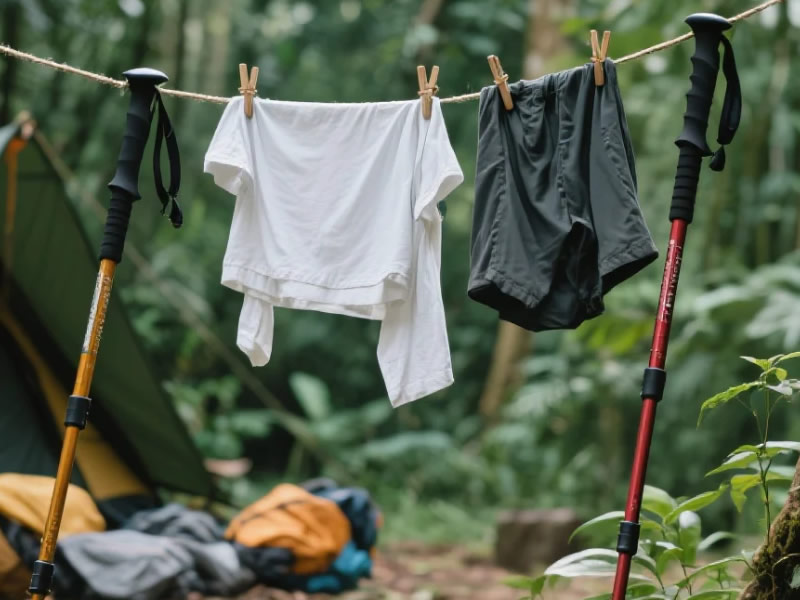
Jungle‑specific tips:
- Choose open ground – avoid ant trails or termite mounds.
- Protect the shaft – pad the contact point with a cloth or tape to stop abrasion.
- Keep it low – a lower line is more stable in sudden wind.
- Don’t overload – heavy, sopping clothes can bend a pole.
Pro tip: In high humidity (Amazon, Atlantic Forest), nothing dries fast—but a line keeps damp gear off the ground, away from insects and mud. Collapse the poles before you pack them away. For a single pole, tie one end to a tree and the other to your pole.
1. Why a trekking‑pole clothesline works
In the jungle, humidity is high, and everything stays damp. A clothesline is essential for drying socks, base layers, towels, and even rain gear. But carrying a dedicated line adds weight. Your trekking poles are already in your hands—they make a perfect two‑point support for a lightweight line.
2. How to set up your pole clothesline
- Extend both poles – Set them to their maximum length (or whatever height you need).
- Plant them firmly – On soft ground, push the tips in until they are stable. On hard or rocky ground, wedge them between rocks or use a log as a counterweight.
- String the line – Tie a length of paracord (2–3 m) between the poles. Use a taut‑line hitch or clove hitch to secure the cord.
- Hang your gear – Drape wet clothes over the line. Heavier items (towels, trousers) in the middle; lighter items (socks) at the ends.
- Pack away – When dry, collapse the poles and stow the line.
3. Jungle‑specific considerations
- Insects – Avoid hanging clothes over ant trails or near termite mounds. A line keeps clothes off the ground, away from crawling insects.
- Rain – If rain is forecast, hang the line under a tarp or large leaf canopy.
- Wind – A low line is more stable in sudden gusts. Use extra guy lines if the wind is strong.
- Mud – Keep the line off the ground to prevent mud splashes.
- Wildlife – Don't hang food or anything with a strong scent – it attracts animals.
4. Protecting your poles
- Pad the contact point – The cord can abrade the shaft coating. Wrap a cloth, tape, or a rubber band around the shaft where the cord touches.
- Don’t over‑tighten – A very tight line can put excessive lateral force on the poles, potentially bending or stressing them.
- Avoid overloading – A line full of heavy wet clothing can topple the poles or bend them. Keep the load light – a few socks and a shirt is fine.
5. Alternatives
- Natural supports – If there are trees at your campsite, tie the line between them.
- Single pole – If you only have one pole, tie one end of the line to a tree, rock, or log and the other to the pole.
- Dedicated line – For very wet conditions, a dedicated lightweight clothesline (e.g., a length of bungee cord with hooks) adds only a few grams.
6. Final tips for jungle campsites
- Use a taut‑line hitch – This knot allows you to adjust the tension of the line easily.
- Keep it low – A low line is easier to reach and more stable in wind.
- Collapse before packing – Never leave poles extended when you pack them – they can bend or break.
- Rinse after use – If the line gets muddy, rinse it and dry it before packing.
7. Final verdict
Yes – trekking poles are a practical, lightweight clothesline at jungle campsites. They keep your gear off the ground, away from mud and insects, and save you from carrying an extra piece of gear. With a little care (pad the contact points, don't overload), they are a versatile camp hack. Happy camping!




