




How to use trekking poles for scrambling on rocky sections in Serra do Mar?
For scrambling on Serra do Mar's rocky sections, shorten poles by 5 cm, plant carbide tips on flat rock (not crevices), and use one pole at a time. Keep your other hand free to brace against rock. On steep, exposed terrain, stow poles and use both hands.
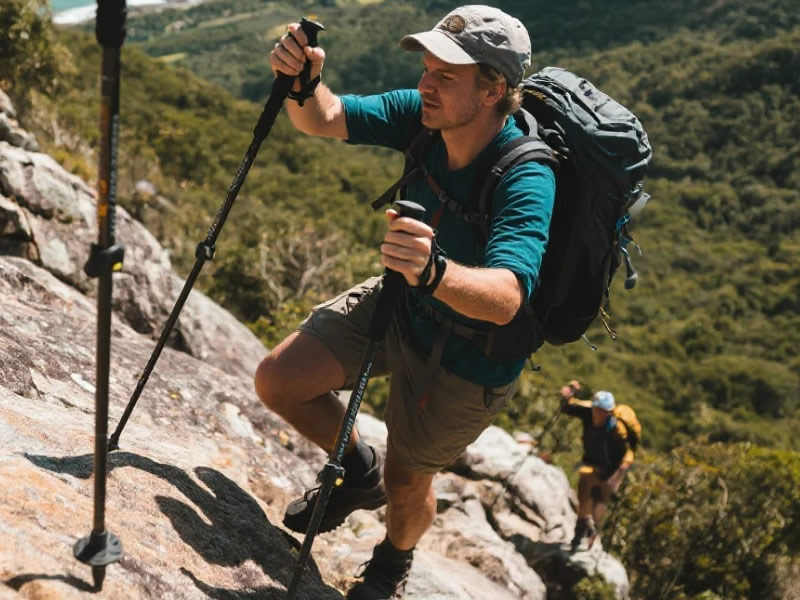
Key techniques:
- Shorten poles – better control on uneven rock.
- Plant on flat surfaces – avoid crevices where tips can jam.
- One pole at a time – leaves a hand free for balance.
- Test each plant – before committing weight.
- Stow when needed – on very steep sections, scramble hands‑free.
What to avoid:
- Planting in crevices – tips can wedge and bend.
- Using two poles on narrow sections – cumbersome.
- Gripping too tightly – let the straps do the work.
Serra do Mar tips:
- Carbide tips – grip on wet rock; remove rubber tips.
- Lever locks – reliable in humidity; twist locks slip.
- Spare tips – the abrasive rock wears them down.
Verdict: Use poles for balance on approach and descent, stow them for the scramble itself. Practice on easy sections first. Happy hiking!
1. Understanding Serra do Mar's terrain
The Serra do Mar is a vast mountain range along Brazil's southeastern coast, stretching from Rio de Janeiro to Santa Catarina. Its trails are characterised by steep, rocky sections, humid conditions, and dense Atlantic Forest. Scrambling – moving over rocky terrain using hands and feet – is common on many of its classic routes, such as the Travessia Petrópolis–Teresópolis or the ascent to Pedra do Sino. Trekking poles can be a valuable aid, but they must be used differently than on a standard path.
2. The role of trekking poles on rocky scrambles
On rocky scrambles, your poles are balance aids, not climbing tools. They help you maintain stability on uneven ground, test the stability of rocks, and provide extra points of contact. However, on very steep or exposed sections, you will need to stow them and use your hands.
3. Adjusting pole length for scrambling
- Shorten by 5 cm – A shorter pole lowers your centre of gravity and gives you better control. You can also shorten them further if you need to.
- Check your locks – Ensure your lever locks or twist locks are fully tightened. On rocky ground, you will be putting lateral force on your poles.
4. Planting technique – where and how to plant
- Plant on flat rock – Place the tip on a flat, stable part of the rock, not on sloping surfaces or in crevices.
- Avoid crevices – A tip in a crevice can get wedged. Pulling it out can bend or snap the pole.
- Test before committing – Before putting your weight on the pole, test the plant with a firm push. If the tip slips, find a better planting spot.
- Plant vertically – On rock, a vertical plant is more stable than an angled one.
5. Using one pole at a time
On narrow or exposed sections, it is often safer to use one pole, leaving your other hand free to touch the rock for balance. This is particularly important on scrambles where you need to use your hands.
6. When to stow poles
On very steep, exposed, or loose sections where you need both hands for scrambling, stow your poles. Collapse them and secure them on your pack. A loose pole on a scramble can be a hazard – it can catch on a rock, unbalance you, or fall onto a walker below.
7. The approach and descent – using poles
- Approach – Use poles for balance and stability on the rocky approach. Shorten them for better control.
- Descent – On the descent, lengthen your poles by 5–10 cm for braking. Use them to protect your knees on the rocky slopes.
8. What to avoid
- Planting in crevices – This is the most common cause of pole damage on scrambles.
- Using two poles on narrow sections – Two poles can be cumbersome on a narrow ridge.
- Relying on poles on steep sections – On very steep sections, use your hands for stability.
- Ignoring loose rock – Test each rock before committing your weight.
9. Equipment for Serra do Mar scrambles
- 7075 aluminium – Aluminium is safer on rocky ground than carbon, which can splinter on impact.
- Lever locks – Lever locks are more reliable on rocky terrain than twist locks.
- Replaceable carbide tips – The abrasive rock will wear down tips. Carry spares.
- Remove baskets – On rocky sections, remove baskets to avoid catching on stones.
10. Safety considerations
- Helmet – On exposed routes, consider wearing a helmet. A dislodged stone or a fall on rock can cause serious head injury.
- Footwear – Wear boots with a stiff sole and a good tread. Poles are not a substitute for proper footwear.
- Weather – Wet rock is more slippery than dry rock. In wet conditions, consider whether the route is safe.
11. Practice on easier sections
Before tackling a serious scramble, practice your technique on easier rocky ground. Get used to the feel of planting on rock, shortening your poles, and using one pole at a time. This builds confidence for the more exposed sections.
12. Final verdict
On Serra do Mar's rocky scrambles, use your poles for balance on the approach and descent, and stow them on the exposed sections. Shorten them by 5 cm, plant on flat rock, and use one pole at a time. With the right technique and equipment, you can navigate the rocky sections safely and enjoy the stunning views of the Serra do Mar. Happy hiking!




