




How to store trekking poles in your backpack when hiking through dense jungle?
In dense jungle, stow poles securely to avoid snagging on vines and roots. The key is a fast, tangle‑free stow that keeps poles accessible but out of the way. Use side pockets, front daisy chains, or running vest holders, and always collapse them fully. For jungle-specific needs, add rubber tip covers and stow before thick sections—anticipate overgrown patches rather than fighting them mid‑trail. A running vest with front pole holders (Salomon, Osprey) is ideal for quick transitions.
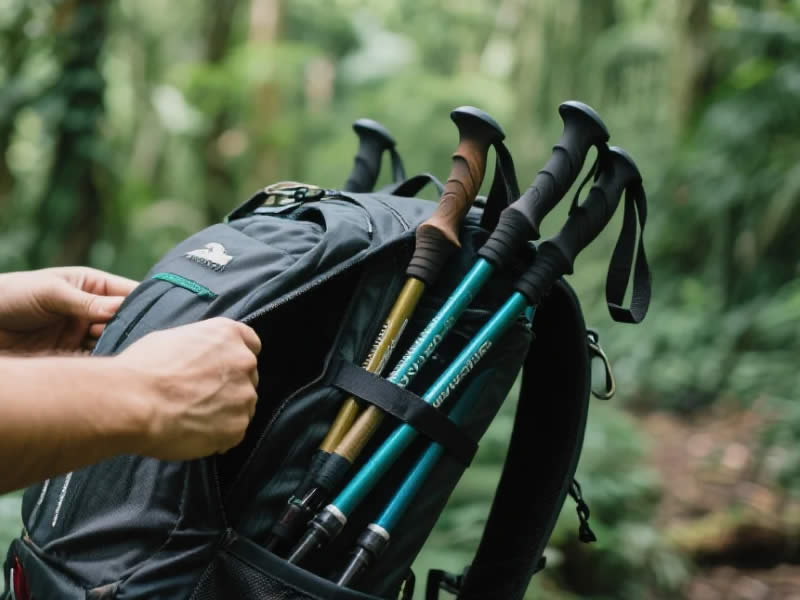
Quick stow methods:
- Side pocket: Collapse poles, slide into a stretchy side pocket (tip down, handle up), and secure with the top compression strap.
- Front daisy chain: Use the pack's webbing loops and bungees to hold poles vertically against the front or side.
- Running vest holders: For fast jungle sections, front‑mounted elastic toggles keep poles ready for quick deployment.
1. Why jungle storage is different
Hiking through dense jungle—whether in the Amazon, the Atlantic Forest, or Southeast Asia—is a different experience from open trails. Vegetation is thick, and vines, roots, and branches can snag on loose gear. You need to move quickly and efficiently. Your poles need to be stored securely, but they also need to be accessible for when the trail opens up.
2. The key to jungle stowage: anticipation
The most important skill is anticipation. Before you enter a thick section, stow your poles. Don't wait until you are fighting vegetation—you will get tangled and frustrated. Collapse your poles fully, stow them securely, and move through the section. When the trail opens up, redeploy them.
3. Quick stow methods
a. Side pocket – The most common method. Collapse your poles to their minimum length. Slide them into a stretchy side pocket (tip down, handle up). Secure with the top compression strap. This is easy and keeps the poles accessible. It is suitable for most jungle sections where you need to stow and deploy frequently.
b. Front daisy chain – Many packs have daisy chain webbing loops on the front or side. Slide the collapsed poles through two or three loops, and secure them with a bungee cord. This keeps the poles vertical and out of the way. It is a good method for longer jungle sections where you won't need your poles for a while.
c. Running vest holders – If you are moving fast through jungle, a running vest with front-mounted elastic toggles (e.g., Salomon, Osprey) is ideal. The poles are held vertically on your chest, easy to reach and quick to deploy. This is the most efficient method for fast jungle hiking.
d. Ice axe loop – Some packs have an ice axe loop on the lower side and a strap at the top. Place the handle through the loop and secure the shaft. This is a good method for a single pole.
4. Jungle‑specific tips
- Rubber tip covers – Always use rubber tip covers when you stow your poles. The carbide tips can pierce your pack fabric or snag on your clothing. This is essential in jungle conditions.
- Collapse fully – Shorten the poles to their minimum length. A longer pole is more likely to snag on vines.
- Keep them secure – A loose pole can catch on lianas and trip you. Ensure they are firmly attached.
- Stow before thick sections – Anticipate overgrown patches and stow your poles before you enter them.
- Use lever locks – Lever locks are faster to collapse and redeploy than twist locks.
- Check for snags – Before you start moving, check that no part of the pole or strap is loose and likely to snag.
5. The “drop and stow” technique
When you need to stow your poles quickly (e.g., because you've suddenly entered a thick section), use the “drop and stow” technique:
- Collapse the poles – Shorten them to their minimum length.
- Stow them – Slide them into your side pocket or front daisy chain.
- Secure them – Tighten the compression strap or bungee.
- Move – Continue hiking without stopping.
6. Deploying your poles
When the trail opens up, redeploy your poles just as quickly:
- Grab the handle – Reach down and pull the pole out.
- Extend the pole – Flick it out to your preferred length.
- Lock it – Close the lever lock or twist lock.
- Walk – Continue with your poles.
7. What to avoid
- Stowing too late – If you wait until you are in thick vegetation, you will struggle to collapse and stow your poles.
- Leaving tips exposed – Uncovered carbide tips can damage your pack and snag on gear.
- Loose poles – A loose pole can catch on a vine and trip you.
- Forgetting to collapse – A pole that is partially extended is more likely to snag.
8. When not to stow poles
In very dense jungle, you may decide to keep your poles in your hands and use them to push aside vegetation. This can be useful, but it is tiring. If you are going to do this, shorten your poles to keep them close to your body.
9. Final verdict
Storing trekking poles in dense jungle requires a fast, tangle‑free method. Use side pockets, front daisy chains, or running vest holders. Always collapse them fully, use rubber tip covers, and stow them before you enter thick vegetation. With the right technique, you can move quickly and safely through jungle terrain, keeping your poles accessible and your pack snag‑free. Happy trekking!




