




How to use trekking poles for pulling yourself up on steep jungle root climbs?
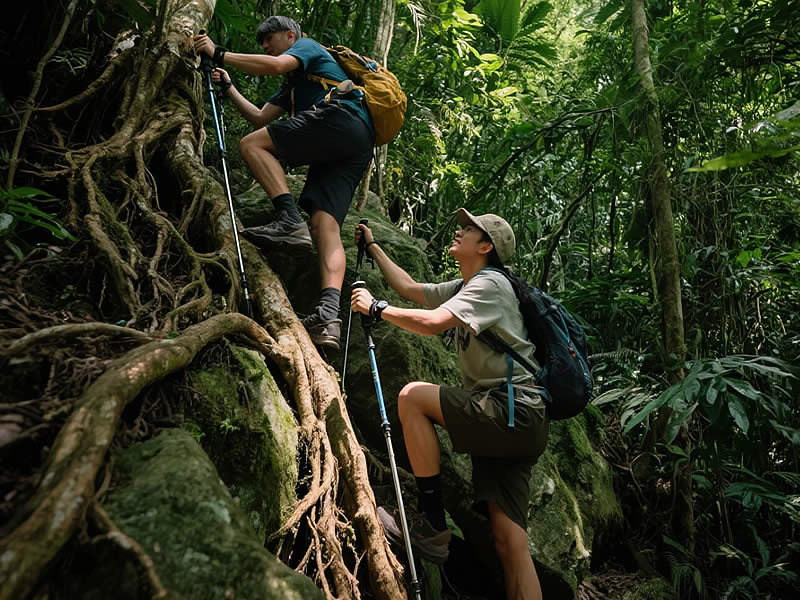
For steep jungle root climbs, shorten poles by 10–15 cm to keep your hands low for maximum leverage. Use a double plant: place both carbide tips on the step ahead, push down through the wrist straps (not your grip), and step up—this transfers effort from your legs to your arms. On very high root steps, use one pole as a push and the other for balance. In the Amazon or Atlantic Forest, roots are often slick and muddy—use sharp carbide tips and avoid planting into crevices where the tip could jam.
1. Why jungle root climbs are different
Jungle trails—whether in the Amazon, the Atlantic Forest, or Southeast Asia—are a unique challenge. The path is often a maze of exposed tree roots, slick with mud and moisture. The roots are irregular, steep, and can be waist‑high. Standard pole techniques—designed for gradual slopes—don't work here. You need a technique that gives you power, stability, and safety on these steep, rooty ascents.
2. Equipment preparation for jungle climbs
- Shorten your poles – Reduce your pole length by 10–15 cm compared to your flat‑ground setting. A shorter pole lowers your hands, giving you better leverage to push up the slope. It also reduces the risk of the pole catching on roots.
- Check your locks – Ensure your lever or twist locks are fully tightened. A slipping lock on a steep root climb is dangerous.
- Carbide tips – Use sharp carbide tips. Rubber tips have no grip on muddy roots.
- Mud baskets – On very muddy sections, a small mud basket prevents the pole from sinking into soft ground.
3. The double‑plant technique for root climbs
The double‑plant is the most effective technique for steep root climbs. It gives you maximum power and stability.
- Approach the root – Walk up to the root with your poles in a neutral position.
- Plant both poles – Place the two carbide tips on the step ahead of you, about shoulder‑width apart. The poles should be vertical or slightly angled backward.
- Engage the wrist straps – Push your hands up through the straps so they sit across the base of your palms. The straps should bear your weight, not your grip.
- Step up with one foot – Lift your right foot onto the root. As you do this, keep the poles planted.
- Push down – Simultaneously push down through both straps, straightening your arms. This upward thrust reduces the weight your leg has to lift.
- Bring the other foot up – Once your right foot is on the root, bring your left foot up to join it.
- Recover – Lift the poles, place them on the next root, and repeat.
4. Using one pole on very high steps
On very high root steps (above knee height), the double‑plant can be awkward. In these cases, use one pole:
- Push pole – Use one pole to push down and help you step up.
- Balance pole – Use the other pole for balance.
5. Common mistakes to avoid
- Poles too long – If your poles are not shortened enough, you lose leverage. Shorten more than you think you need.
- Gripping too tightly – A tight grip fatigues your forearms. The straps should do the work.
- Planting in crevices – The tip can get wedged between roots, bending or snapping the pole. Plant on flat, stable parts of the root.
- Rushing – Steep root climbs require patience. Move slowly and deliberately.
- Leaning forward – Keep your back straight. Leaning forward strains your spine.
6. Safety on slick roots
- Test each plant – Before committing your weight, test the plant with a firm push. If the tip slips, find a better planting spot.
- Use sharp tips – A blunt tip will skid. Replace worn tips.
- Avoid moss – Moss is slippery; plant on exposed root or soil.
- Watch your footing – Roots are irregular; place your foot carefully.
7. Technique for muddy roots
Mud makes roots even more treacherous. On muddy roots:
- Shorten your poles – For better control.
- Plant deliberately – Push the tip into the mud to find a secure hold.
- Take short steps – Short steps reduce the chance of slipping.
- Use mud baskets – Prevent the pole from sinking into deep mud.
8. Strengthening the muscles used
This technique heavily engages your arms, shoulders, and core. If you are planning a jungle trek, consider training these muscle groups:
- Triceps – Triceps dips or push‑ups.
- Shoulders – Shoulder presses or overhead carries.
- Core – Planks and deadlifts.
9. Pro tips for jungle root climbs
- Practice on easy roots – Before tackling a steep root climb, practice the double‑plant on a low root.
- Keep your back straight – This reduces strain on your spine.
- Take breaks – On long, steep sections, take breaks and use your poles for support.
- Stay hydrated – The jungle is humid; drink water regularly.
- Watch for snakes – Always tap ahead with your pole before grabbing a root.
10. Final verdict
On steep jungle root climbs, the double‑plant technique is your most effective tool. Shorten your poles, plant both tips ahead, push down through the straps, and step up. This technique transfers load from your legs to your arms, saving your energy and protecting your knees. Practice on easier roots before tackling the steep sections. With the right technique, you can conquer the jungle's steep root climbs with confidence and safety. Happy climbing!




