




How to fix a twisted trekking pole section after a hard fall?
A hard fall on rocky terrain, a misstep between boulders, or an unexpected weight shift—and suddenly your trekking pole looks like a pretzel. One section is visibly twisted, the locking mechanism won’t engage, and you’re miles from the trailhead. Your first instinct might be to grab both ends and wrench it back into shape. Stop right there. That single action could turn a repairable pole into a dangerous splinter. This guide explains exactly what to do when a pole section twists, when to attempt a fix, and—most importantly—when to accept that replacement is the only safe option.
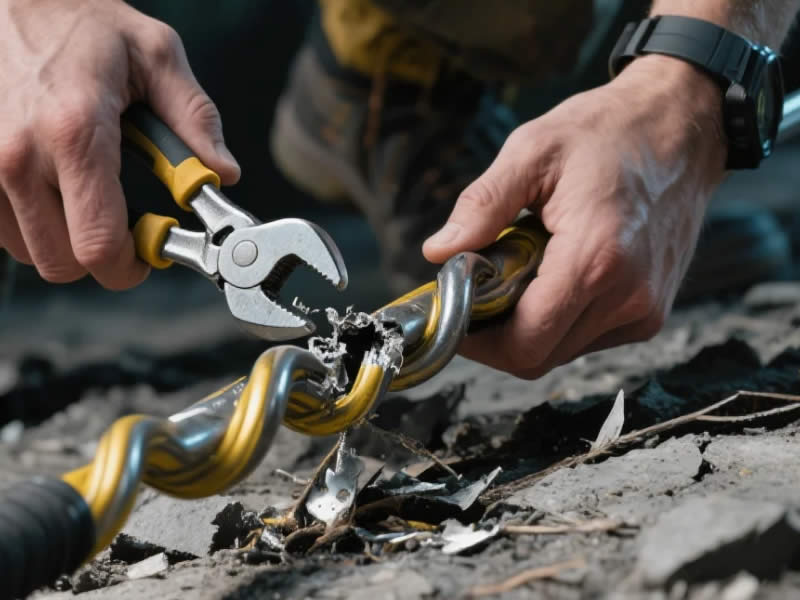
Why twisted sections are different from bends
A bend is a smooth curve in the tube; a twist is a rotational deformation where the cross‑section of the tube is no longer round. Twist usually occurs at the overlapping joint area—the weakest point—because the inner and outer tubes are locked under high compressive force. When you fall, the pole absorbs lateral torque, and the aluminium or carbon fibre yields plastically. Unlike a simple bend, a twist often damages the internal locking expander or the cam mechanism, because the misalignment puts uneven pressure on those parts.
Aluminium alloys can sometimes tolerate minor straightening, but carbon fibre is anisotropic—it has directional strength. Once twisted, carbon fibres delaminate internally, and any bending or twisting back will cause micro‑cracks that propagate under load. The pole may look fine but shatter without warning on your next descent.
Immediate assessment: can it be saved?
Before attempting any repair, answer these three questions:
- Is it aluminium or carbon? – If carbon, skip to the replacement section below. Do not attempt any straightening.
- Is the twist less than 10°? – A slight rotational offset (barely visible) might be temporarily manageable. Severe twisting (obvious deformation) is not repairable.
- Does the locking mechanism still work? – If the clamp or twist‑lock won’t tighten evenly, the internal parts are likely damaged, and no amount of tube straightening will fix that.
If you have aluminium and the twist is mild, you can try a cautious trail fix—but only as a last resort to get you out. Never treat it as a permanent solution.
Temporary field fix (aluminium only, extreme caution)
This method is for emergency use only. It reduces the pole’s strength by at least 30–50%.
- Remove the lower section – Separate the twisted section from the rest of the pole.
- Use padded pliers or a vice – Wrap the tube with several layers of thick cloth or rubber to prevent scratching. Grip the section near the twist, not at the very end, to avoid creating a new bend.
- Apply gentle, gradual torque – Twist slowly in the opposite direction, no more than 5° at a time. Stop and inspect for cracks after each turn. If you hear any crunching or see surface fractures, stop immediately.
- Check roundness – After straightening, roll the section on a flat surface. If it wobbles, the tube is still out of round—do not use it.
- Reassemble and test – Lock the pole at your normal length. Apply body weight gradually. If it slips, creaks, or feels unstable, abort and use the pole as a single walking stick.
Critical warning: Do not use heat (like a camp stove) to soften aluminium—it anneals the metal, destroying its temper and making it dangerously soft. Also, never try to straighten carbon fibre; it will shatter.
Why replacement is the only wise choice
For any twist beyond slight, or for any carbon pole, the correct fix is section replacement. Most quality trekking pole brands—Black Diamond, Leki, Komperdell, MSR—sell individual replacement shafts for their models. The cost is typically $20–40 per section, far cheaper than a new pair and infinitely safer than a bodged repair.
Here’s how to do it properly:
- Identify your pole model – Check the branding and model name. Look for a part number near the grip or on the lower section.
- Order the correct spare – Buy from the manufacturer or authorised dealer. Some brands offer universal replacement sections, but exact match is best.
- Disassemble the old section – Remove the locking expander (for twist‑locks) or the lever‑cam assembly. Transfer these parts to the new section if they are undamaged. If the twist damaged the internal components, order those too.
- Install the new section – Follow the manufacturer’s instructions. Usually, you slide the expander into the new tube, insert the inner section, and adjust tension to factory spec.
- Test thoroughly – Before your next hike, extend the pole to your usual length and put full body weight on it multiple times. Check that the lock holds without slipping.
When to scrap the entire pole
If your pole uses a non‑replaceable, bonded construction (common in some budget models) or if the twist has warped the upper section (which is often glued to the grip), replacement may not be feasible. In that case, retire the pole entirely. You can still use it as a tent pole or a tarp support, but never for weight‑bearing hiking.
Also, if the fall caused a visible crack in the aluminium or a whitish stress mark on carbon, the structure is compromised—even a new section won’t fix the grip or the wrist strap attachment if they are damaged.
Prevention: how to avoid twisted poles in the first place
- Adjust lock tension correctly – Over‑tightened locks create high stress points that twist more easily during falls. Tighten just enough to hold.
- Use poles with lever‑locks – Twist‑locks are more prone to rotational damage because they rely on an internal expander. Lever‑clamps often allow the tube to rotate slightly without permanent twist.
- Avoid planting poles in deep crevices – When stepping over rocks, place the tip firmly on solid ground. A sideways slip is the main cause of twisting torque.
- Inspect after every fall – Even if it looks fine, check for play. Catching a minor twist early lets you replace the section before it fails unexpectedly.
Final verdict
The honest answer to “How to fix a twisted trekking pole section after a hard fall?” is: you usually don’t fix it—you replace it. A temporary on‑trail straightening is a risky gamble that should only be attempted on aluminium with very minor twist, and even then, only to get you back to civilisation. For carbon poles, zero tolerance—replace or retire.
Your trekking poles are your balance and your safety. They take your full weight on steep descents and protect your knees. Don’t compromise that with a cheap, dangerous repair. Invest in a new section, sleep soundly, and hike confidently.




