




What is the difference between Brazilian medical walking sticks and trekking poles?
The key difference lies in purpose and design: a medical walking stick is a rehabilitation and mobility aid for indoor and short outdoor use on flat surfaces, while trekking poles are a sports and stability tool designed for varied, uneven terrain. Medical sticks provide one extra point of contact, whereas a pair of trekking poles provides two, creating a more stable four-point base. Trekking poles are fully adjustable, have ergonomic grips with load-transferring straps, use sharp carbide tips for grip on mud/grass/rock, and are lighter. Medical sticks are typically fixed-length, have basic handles without straps, use rubber ferrules for indoor/pavement use, and are heavier.
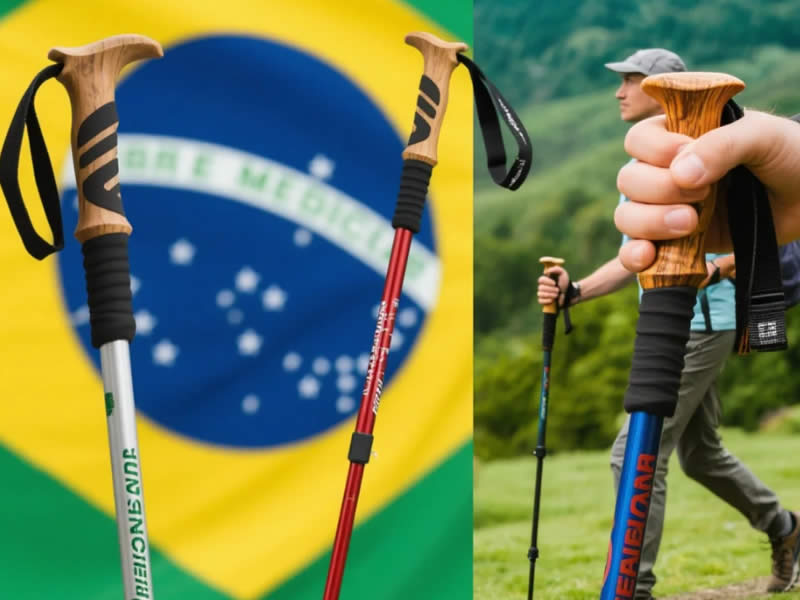
When to choose which:
- Medical walking stick – for indoor walking, short local errands, or support on one side only.
- Trekking poles – for outdoor walking on uneven ground, reducing knee/hip strain, and engaging your upper body.
For Brazilian adults with balance issues, two trekking poles are often a better choice for outdoor walking, while a single medical stick is more practical for indoor and short, flat outings. Always consult your doctor or physiotherapist before switching.
1. Purpose and primary use
The fundamental difference is the intended use:
- Medical walking stick – Designed for rehabilitation, mobility assistance, and indoor or short outdoor use. It is a medical aid to compensate for weakness, injury, or balance issues.
- Trekking poles – Designed for outdoor walking, hiking, and sports. They are a tool for stability, knee protection, and energy efficiency on varied terrain.
A medical stick is used by someone who needs support on one side. Trekking poles are used in pairs to distribute weight evenly and improve balance.
2. Number of points of support
| Feature | Medical Walking Stick | Trekking Poles |
|---|---|---|
| Points of contact | 1 | 2 (in a pair) |
| Stability | Moderate | High – four-point base |
| Balance on uneven ground | Low | High |
| Weight distribution | Uneven | Even |
A single medical stick provides one extra point of contact. Two trekking poles provide two extra points, creating a stable, four-point base. This is a critical difference for balance on uneven ground.
3. Adjustability
- Medical walking stick – Typically fixed-length or with limited adjustment (e.g., a pin-and-hole mechanism). It is set to your height and left.
- Trekking poles – Fully adjustable (usually 110–135 cm). You can shorten them for ascents and lengthen them for descents. This adaptability is essential for varying terrain.
4. Grip and strap design
- Medical walking stick – Basic rubber, plastic, or wooden handle. No wrist strap. You grip the handle and support your weight directly.
- Trekking poles – Ergonomic grips (cork, foam, or rubber) with a wrist strap. The strap sits across the base of your palm, transferring your weight to the strap, not your grip. This reduces hand strain and allows a relaxed grip.
5. Tip and base
- Medical walking stick – A single rubber ferrule (tip) designed for indoor and pavement use. It provides grip on hard, flat surfaces. Not suitable for muddy, grassy, or rocky ground.
- Trekking poles – Sharp tungsten carbide tips for grip on rock, mud, and grass. Rubber tips can be added for pavement use.
6. Weight
- Medical walking stick – Heavier, often made of wood, steel, or basic aluminium. Can be 300–500g.
- Trekking poles – Lighter, typically 200–280g per pole (for aluminium). Carbon poles are even lighter. Reduced weight reduces arm fatigue on long walks.
7. Material
- Medical walking stick – Wood, steel, or basic aluminium.
- Trekking poles – 7075 or 6061 aluminium, carbon fibre, or titanium.
8. When to choose which
Choose a medical walking stick if:
- You walk mostly indoors (home, shops, hospital).
- You need support on one side only (e.g., after a hip replacement).
- You walk on flat, even surfaces.
- You need a simple, low‑maintenance aid.
Choose trekking poles if:
- You walk outdoors on uneven ground (parks, trails, hills).
- You have balance issues and want a stable four‑point base.
- You want to reduce knee and hip strain.
- You want to engage your upper body for a more efficient walk.
- You want adjustable poles for varied terrain.
9. The Brazilian context
In Brazil, medical walking sticks are often prescribed by doctors or physiotherapists and are available in pharmacies or through the SUS (Unified Health System). Trekking poles are sold in sporting goods stores (Decathlon, Adventure Sport) and online (Mercado Livre). For older adults with balance issues, two trekking poles are often a better choice for outdoor walking on uneven trails or pavements, while a single medical stick is more practical for indoor and short, flat outings.
10. Transitioning from medical stick to trekking poles
If you are using a medical stick and want to switch to trekking poles:
- Consult your physiotherapist – They can advise on the correct length and technique.
- Start on flat ground – Practice the alternating rhythm (left pole with right foot).
- Use two poles – A pair of poles is more stable than a single stick.
- Adjust the length – Set the poles so your elbows are at 90° when the tips are on the ground.
- Use rubber tips – On pavement, use rubber tips to protect the carbide and reduce noise.
11. Final verdict
Medical walking sticks and trekking poles are designed for different purposes. A medical stick is a simple, one‑sided mobility aid for indoor and short outdoor use. Trekking poles are a pair of adjustable, ergonomic, and versatile tools for outdoor walking on uneven ground. For Brazilian adults with balance issues, two trekking poles are often a better choice for outdoor walking, while a single medical stick is more practical for indoor and short, flat outings. Always consult your doctor or physiotherapist before making a switch. Happy (and safe) walking!




