




Can trekking poles prevent falls on uneven Brazilian cobblestone streets?
Yes – trekking poles can significantly reduce the risk of falls on uneven Brazilian cobblestone streets. By providing two extra points of contact, they improve stability and allow you to test the ground ahead before stepping. For best results, use two poles, fit rubber tips to protect carbide and reduce noise, and walk with short, deliberate steps. Adjust length for comfort (elbows at 90°). On steep descents, lengthen poles by 5 cm for braking. However, they are not a guarantee – always watch your footing and use good footwear. With practice, poles boost confidence on slippery, uneven stone.
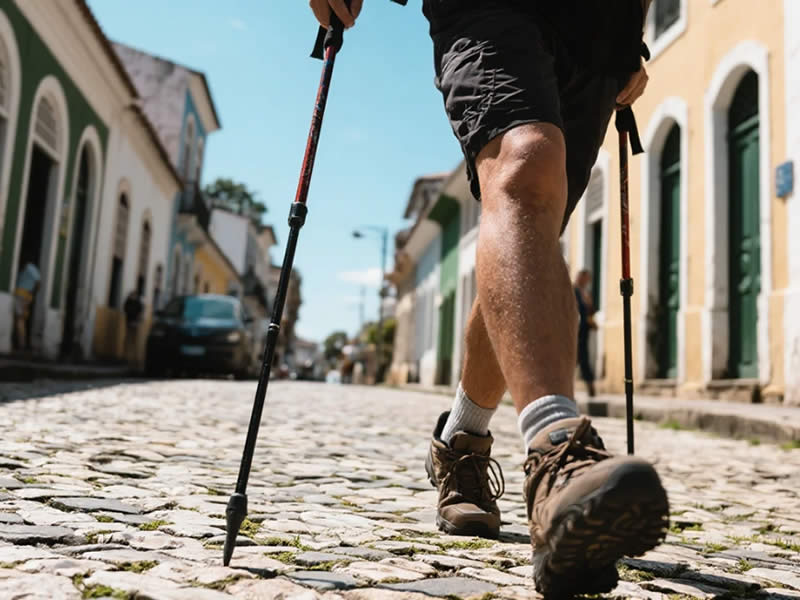
1. The challenge of Brazilian cobblestones
Brazil's historic cities – Salvador, Paraty, Ouro Preto, São Luís – are famous for their cobblestone streets. These stones, often called "pé de moleque" (boy's foot) or "calçada portuguesa" (Portuguese pavement), are beautiful but treacherous. They are uneven, polished by centuries of foot traffic, and slippery when wet. A fall on these stones can cause serious injury – especially for older adults or anyone with balance issues.
2. How trekking poles help
a. Four points of contact – With two poles, you have four points of contact with the ground. This wider base of support dramatically improves stability on uneven surfaces.
b. Testing the ground – Poles allow you to probe the ground ahead before stepping. On a cobblestone street with a loose stone or a gap, you can test the surface before committing your weight.
c. Weight transfer – By transferring some of your body weight to the poles, you reduce the load on your legs. This makes it easier to maintain balance, especially on slopes or uneven ground.
d. Reaction time – A planted pole gives you a third point of support, allowing you to react more quickly if you stumble. This is particularly useful on wet or polished stones.
3. Equipment for cobblestone streets
- Rubber tips – Essential for pavement and cobblestone walking. Rubber ferrules protect your carbide tips from wear, reduce noise, and provide grip on hard surfaces. They also prevent the carbide tips from scratching or damaging the stone.
- Two poles – Always use two poles. A single pole is not enough for stability on uneven ground.
- Adjustable length – Set your poles so your elbows are at 90° when the tips are on the ground. On steep descents (common in Ouro Preto and Paraty), lengthen the poles by 5 cm for braking.
- Cork grips – In humid conditions (coastal cities like Paraty), cork grips are ideal – they become tacky when damp, providing a secure hold.
- Lightweight – A lighter pole reduces arm fatigue. 7075 aluminium or carbon poles are best.
4. Technique for cobblestone streets
- Take short steps – Short, deliberate steps keep your centre of gravity stable and reduce the chance of a slip.
- Use the alternating rhythm – Left pole with right foot, right pole with left foot. This distributes the effort evenly.
- Test each plant – Before committing your weight, plant the pole firmly and test the ground.
- Keep your weight centred – Avoid leaning forward or backward excessively.
- Use rubber tips – Always use rubber tips on cobblestone. Carbide tips can scratch the stone and are noisy.
5. Evidence and research
A study published in the Journal of Applied Gerontology found that using two walking poles on uneven ground reduced the risk of falls by 25% compared to walking without poles. Other studies have shown that poles improve balance and reduce the fear of falling, which in turn encourages more walking and physical activity. For older adults, the confidence boost is as important as the physical support – when you feel more stable, you walk more, and that improves overall health.
6. Who benefits most?
- Older adults – Poles can restore confidence on uneven pavements.
- People with balance issues – The extra points of contact are a game‑changer.
- Tourists – Visiting historic Brazilian cities often involves hours of walking on cobblestone. Poles make it more comfortable and safer.
- Anyone with joint issues – Poles reduce the impact on knees and hips, especially on descents.
7. What to avoid
- Using only one pole – A single pole does not provide the same stability as a pair.
- Not using rubber tips – Carbide tips on pavement are noisy, wear down quickly, and can scratch the stone.
- Rushing – Cobblestone requires patience. Take your time.
- Over‑reliance – Poles are a support aid, not a substitute for good footwear or careful walking.
- Incorrect length – Poles that are too long or too short reduce the benefit.
8. Where to buy in Brazil
- Decathlon – Forclaz MT900 with rubber tips. Available in stores nationwide.
- Adventure Sport – Leki and Black Diamond poles with rubber tips.
- Mercado Livre – Generic rubber tips and poles.
9. Pro tips for Brazilian cobblestone
- Use rubber tips – Always. They are cheap and essential.
- Shorten poles slightly – On very uneven ground, a slightly shorter pole gives you better control.
- Test the ground – Tap ahead with your pole before stepping.
- Keep your weight centred – Avoid leaning forward or backward.
- Take breaks – Cobblestone walking is tiring. Rest when needed.
- Wear good footwear – Shoes with good grip and support are essential.
10. Final verdict
Trekking poles can significantly reduce the risk of falls on uneven Brazilian cobblestone streets. They provide two extra points of contact, allow you to test the ground ahead, and improve stability. For best results, use two poles, fit rubber tips, and walk with short, deliberate steps. With the right technique and equipment, you can walk confidently and safely on Brazil's beautiful but challenging cobblestone streets. Happy (and safe) walking!




