




What height adjustment is best for older adults using trekking poles?
For older adults, the standard rule applies: set poles so your elbows are at a 90° angle when the tips are on the ground. However, a slightly shorter length (2–3 cm) can improve balance and reduce arm strain for those with reduced strength or a stooped posture. On flat ground, this is your correct length. For ascents, shorten by 5 cm; for descents, lengthen by 5 cm. Mark the correct length on the pole with tape for easy adjustments. Always use two poles for stability. If you have a stooped posture, a slightly longer pole may help you stand straighter – experiment and ask a physiotherapist for advice.
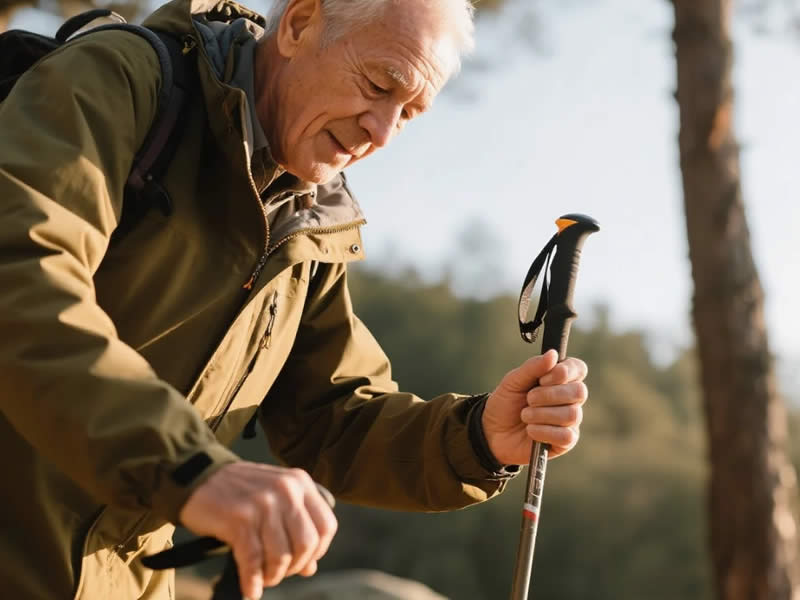
1. Why correct height is critical for older adults
For older adults, the correct pole height is essential for comfort, efficiency, and safety. If the poles are too long, you will have to reach up to plant them, causing you to lean back and strain your shoulders. If they are too short, you will hunch forward, putting strain on your back and reducing the support the poles provide. Incorrect height can also reduce the effectiveness of the poles in offloading weight from your knees and hips. For older adults, who may have reduced strength and balance, getting the height right is even more important.
2. The standard rule – elbows at 90°
The standard rule for adjusting trekking pole height is:
- Stand upright with the tip of the pole on the ground beside your foot.
- Adjust the pole until your elbow is at a 90° angle.
- This is your correct flat‑ground length.
This rule works for most people and provides a good balance of support and comfort. It ensures that your arm is in a strong, efficient position to push down through the strap.
3. Adjustments for older adults
While the 90° rule is a good starting point, some older adults may benefit from a slight adjustment:
- Slightly shorter (2–3 cm) – If you have reduced strength or balance issues, a slightly shorter pole lowers your centre of gravity, improving stability. It also reduces the reach required, which can be helpful if you have shoulder problems.
- Slightly longer (2–3 cm) – If you have a stooped posture, a slightly longer pole can help you stand straighter. The pole encourages you to lift your chest and open your shoulders. This can also help reduce back pain.
4. Adjusting for terrain
- Flat ground – Use your standard flat‑ground length (elbows at 90°).
- Ascents – Shorten the poles by 5 cm. This lowers your hands, giving you better leverage to push up the slope.
- Descents – Lengthen the poles by 5 cm. This allows you to plant the pole ahead of your feet, creating a braking effect that reduces knee impact.
5. How to check the length
- Stand upright – With the pole tip on the ground, check the elbow angle.
- Walk a few steps – The poles should feel comfortable, not straining your shoulders or back.
- Adjust as needed – A small adjustment of 1–2 cm can make a big difference. Don't be afraid to experiment.
6. Marking your poles
Once you have found the correct length for flat ground, mark it on the pole with a piece of tape or a permanent marker. This makes it easy to reset the length on the trail, especially if you need to adjust for ascents or descents. Mark both poles at the same point.
7. Common mistakes to avoid
- Poles too long – Strains shoulders, causes you to lean back.
- Poles too short – Strains back, reduces support, causes hunching.
- Not adjusting for slopes – Using the same length on ascents and descents is inefficient and can cause discomfort.
- Not checking the length regularly – Over time, the locks can slip; check the length before each walk.
8. The role of wrist straps
Correct height adjustment works best when combined with proper wrist strap use. The strap should sit across the base of your palm (not your wrist) and the strap should take your weight. When you push down on the pole, the force should go through the strap, not your grip. This reduces hand fatigue and improves efficiency.
9. When to consult a professional
If you have a stooped posture, balance issues, or significant arthritis, it is advisable to consult a physiotherapist or occupational therapist for personalised advice on pole height. They can also recommend specific exercises to improve your walking posture and balance.
10. A simple test
- Stand naturally – With the pole tip on the ground, your elbow should be at 90°.
- Walk a few steps – The poles should feel natural and comfortable.
- Adjust – If you feel strain in your shoulders or back, adjust the length by 1–2 cm and try again.
11. Final verdict
For older adults, the best height adjustment for trekking poles is the standard rule: elbows at 90° when the tip is on the ground. However, a slight adjustment (2–3 cm shorter or longer) may be beneficial depending on posture and strength. Always use two poles, adjust for ascents and descents, and mark your poles for easy reference. With the correct height, your poles will provide comfort, support, and confidence – making walking safer and more enjoyable. Happy (and safe) walking!




