




Can trekking poles improve walking posture and prevent back pain in Brazil?
Yes – trekking poles can significantly improve walking posture and help prevent back pain in Brazil. By transferring 15–20% of your body weight from your spine to your arms, they reduce lower back strain and encourage an upright stance, counteracting the forward lean that often causes back pain. For best results, use two lightweight poles with cork grips, set the correct length (elbows at 90°), and push through the wrist straps. For Brazilian conditions, cork grips are ideal – they become tacky when damp – and lever locks are more reliable than twist locks in mud and heat. Start on flat ground and practice the alternating rhythm. While poles help, they are not a cure – combine with core exercises, stay hydrated, and consult a physiotherapist for personalised advice.
1. The link between walking and back pain in Brazil
Brazil's diverse terrain – from the cobblestone streets of Salvador to the uneven trails of Chapada Diamantina – can be challenging for walkers. Without support, many people adopt a forward-leaning posture, which places strain on the lower back. Over time, this can lead to chronic back pain. The problem is compounded by Brazil's heat and humidity, which can cause fatigue and poor posture.
2. How trekking poles improve posture
a. Upright stance – When you plant a pole and push down, your arms and shoulders engage, which encourages you to lift your chest and straighten your back. This reduces the forward lean that causes lower back pain.
b. Load transfer – By transferring some of your body weight through the poles to your arms and shoulders, you reduce the compressive load on your spine. Studies show that using trekking poles can reduce lower back muscle activity by 10–15% on descents.
c. Core engagement – The alternating rhythm of pole planting (left pole with right foot) engages your core stabilisers, which support your spine and improve overall posture.
d. Reduced slouching – The poles act as a physical reminder to keep your chest open and your shoulders back, counteracting the slouching tendency that develops on long, tired walks.
3. How to use poles for posture improvement
a. Set the correct length – On flat ground, your elbows should be at 90° when the tip is on the ground. On ascents, shorten by 5–10 cm; on descents, lengthen by 5–10 cm.
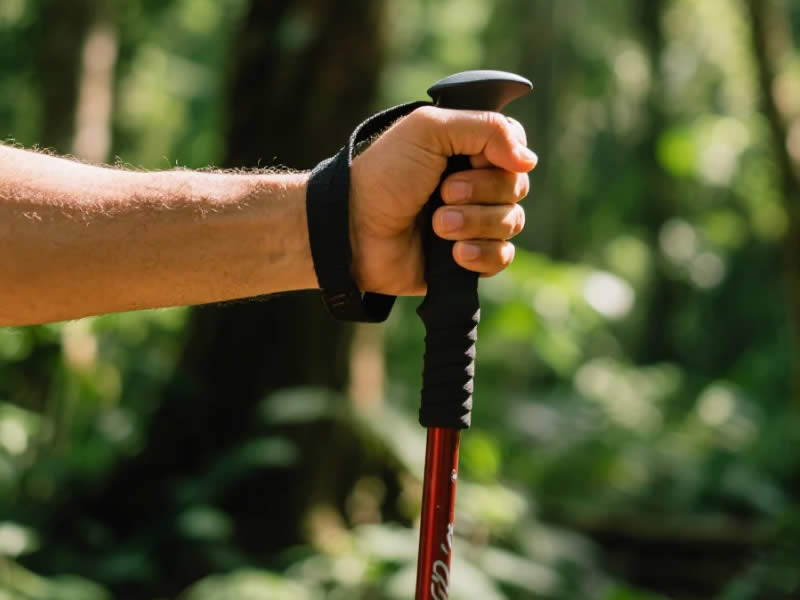
b. Use the wrist straps – The strap should sit across the base of your palm. Push down through the strap, not your grip. This transfers load to your arms and shoulders, reducing the strain on your lower back.
c. Maintain an upright chest – Focus on keeping your chest lifted and your shoulders back. The poles should support this posture, not replace it.
d. Engage your core – Gently tighten your abdominal muscles as you walk. This stabilises your spine and reduces the risk of back pain.
e. Relax your grip – A tense grip transfers tension up your arm and into your shoulders and neck. Keep your grip relaxed.
4. Why Brazilian conditions make cork grips ideal
In Brazil's heat and humidity, cork grips are the best choice. They become tacky when damp, providing a secure hold even with sweaty hands. Cork also conforms to your hand shape over time, reducing pressure points. Foam grips can become slippery when wet; rubber becomes uncomfortable in the heat.
5. Research and evidence
A 2018 study in the Journal of Applied Biomechanics found that using trekking poles reduced lower back muscle activity by 10–15% on descents. A separate study on backpackers found that pole users had significantly less lower back pain at the end of a multi‑day trek compared to non‑users. The benefits are most pronounced in walkers who use the poles with correct technique.
6. Additional tips for back pain prevention
- Strengthen your core – Core exercises (planks, bird‑dogs) support your spine.
- Lighten your pack – Every kilogram you carry increases the load on your spine.
- Take breaks – Rest your back and use your poles for support.
- Stretch – Gentle hamstring and hip flexor stretches can reduce back pain.
- Stay hydrated – Dehydration can worsen muscle pain.
- Use rubber tips on pavement – Reduces vibration and protects your carbide tips.
7. When to consult a professional
If you have chronic back pain, it is essential to consult a doctor or physiotherapist before starting to use trekking poles. They can advise on the correct technique, length, and whether poles are appropriate for your specific condition. They may also recommend specific exercises to improve balance and strength.
8. Equipment recommendations for Brazil
- Decathlon Forclaz MT900 – Best value. 7075 aluminium, lever locks, cork grips, replaceable tips. Available in Brazil (~R$400).
- Leki Makalu – Premium choice. Steel lower section, SpeedLock Plus, cork grips. Price: ~R$700–900.
- Cork grips – Ideal for Brazil's heat and humidity.
- Lever locks – More reliable than twist locks in mud and dust.
9. Pro tips for Brazilian walkers
- Start on flat ground – Practice on a smooth, flat surface before tackling uneven terrain.
- Use rubber tips on pavement – In Brazilian cities, use rubber tips on cobblestone and pavement.
- Keep your back straight – The poles should support you, not pull you forward.
- Take breaks in the shade – The heat can be intense; rest and hydrate.
- Use two poles – A single pole is not enough for stability.
10. Final verdict
Trekking poles can improve walking posture and help prevent back pain in Brazil. They transfer weight from your spine to your arms, encourage an upright stance, and engage your core. For best results, use two lightweight poles with cork grips, set the correct length, and push through the wrist straps. Combine pole walking with core exercises, stay hydrated, and consult a physiotherapist for personalised advice. With the right technique, you can walk longer and more comfortably with less back pain. Happy (and pain‑free) hiking!




