




Do professional Brazilian mountain guides use trekking poles?
Yes – most professional Brazilian mountain guides use trekking poles regularly. They rely on them for knee protection on long descents, stability on uneven terrain, and to test ground before stepping. On technical scrambles or glacier travel, they may switch to an ice axe. Guides prefer 7075 aluminium poles (e.g., Leki Makalu) with lever locks and steel lower sections – carbon is too brittle. They carry spare tips and often use poles as tent supports. For most hiking, guides consider trekking poles essential safety gear.
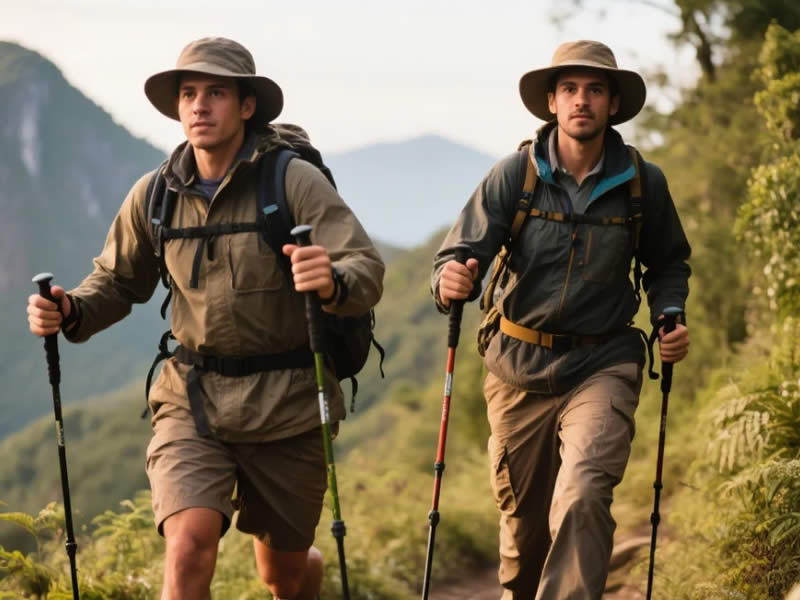
1. Why guides use trekking poles
a. Knee protection on descents – Brazilian mountain trails (Serra do Mar, Serra da Mantiqueira, Chapada Diamantina) have long, steep descents. Guides hike these routes regularly, often with heavy packs. Trekking poles reduce knee joint impact by 20–25% , which is essential for a career that involves daily hiking.
b. Stability on uneven terrain – Brazilian trails are rocky, muddy, and often slippery. Two poles provide four points of contact, improving balance and reducing the risk of falls—critical for guides leading groups.
c. Testing the ground – Guides use poles to probe the ground ahead. They test the depth of mud, the stability of a rock, or the firmness of a stream bed before committing their weight.
d. Fatigue reduction – By engaging the upper body, poles reduce leg fatigue. For guides who hike day after day, this is a significant advantage.
e. Tent support – On multi‑day treks, guides often use lightweight trekking‑pole tents. Their poles double as tent supports, saving weight and space.
2. What guides look for in a pole
a. 7075 aluminium – Guides prioritise durability. 7075 aluminium bends under impact but rarely breaks; a bent section can often be straightened. Carbon fibre is lighter but brittle—a side impact on a rock can cause it to splinter. In Brazil's rocky terrain, aluminium is the safer choice.
b. Steel lower section – The lower section of the pole is subjected to constant abrasion from rocks. A steel ferrule (found on the Leki Makalu) resists this wear much better than aluminium, extending the pole's life.
c. Lever locks – Lever locks (cam locks) are more reliable than twist locks, especially in mud, dust, and humidity. They are easier to operate with gloves and can be field‑adjusted with a hex key.
d. Cork grips – Cork grips are comfortable in Brazil's heat and humidity. They become tacky when damp, providing a secure hold even with sweaty hands.
e. Replaceable carbide tips – The abrasive rock on Brazilian trails wears down tips quickly. Guides carry spare tips and replace them regularly.
f. Repairability – Guides need poles that can be repaired in the field. They carry spare tips, hex keys, and sometimes spare sections.
3. The most common guide poles in Brazil
a. Leki Makalu – The gold standard. 7075 aluminium, steel lower section, SpeedLock Plus, cork grips. Used by many Brazilian mountain guides for its durability and repairability.
b. Decathlon Forclaz MT900 – The most popular pole among Brazilian hikers. Guides on a budget or those who work with lighter loads often use this pole. It offers 7075 aluminium, lever locks, cork grips, and replaceable tips at an affordable price.
c. Black Diamond Trail Pro – Another guide favourite. 7075 aluminium, FlickLock, comfortable foam/cork grip. Lacks the steel lower section of the Makalu, but still robust.
4. When guides don't use poles
- Technical scrambles (Grade 2+) – On scrambles where hands are needed for balance and support, guides stow their poles and use their hands.
- Glacier travel – On glacier terrain, an ice axe is essential for self‑arrest. Guides carry an ice axe and may not use poles.
- Very steep snow – On steep snow slopes, an ice axe is safer for arrest.
5. The guide's philosophy – reliability over weight
Guides choose reliability over weight. A broken pole on a remote mountain is not just an inconvenience—it can be a safety issue. Guides prioritise poles that are durable, repairable, and field‑adjustable. The weight saving of a carbon pole is not worth the risk of it snapping on a side impact.
6. Where guides buy their poles in Brazil
- Adventure Sport – Official importer of Leki and Black Diamond. Online and stores in São Paulo/Rio.
- Decathlon – Forclaz MT900. Physical stores nationwide and online.
- Mercado Livre – Generic and imported poles. Guides often buy spare parts here.
7. Pro tips from Brazilian guides
- Carry spare tips – The abrasive rock wears them down fast.
- Carry a hex key – For adjusting lever locks.
- Use rubber tips on road sections – To protect carbide tips.
- Inspect poles regularly – Check for bends, cracks, and worn locks.
- Clean poles after muddy walks – Mud and grit damage locks.
8. Final verdict
Professional Brazilian mountain guides use trekking poles extensively. They choose 7075 aluminium poles with lever locks, steel lower sections, and cork grips. The Leki Makalu is the most common guide pole, followed by the Decathlon Forclaz MT900. Guides prioritise durability, repairability, and reliability over weight. For most hiking, guides consider trekking poles essential safety gear—not just a comfort accessory. Happy (and guide‑inspired) hiking!




