




Can children safely use trekking poles on family hikes in Brazil?
Yes – children can safely use trekking poles on family hikes in Brazil with proper supervision and age-appropriate poles. Generally, children aged 6+ with sufficient coordination can start learning. Use lightweight, short poles (or adjustable poles that go down to 80–90 cm), fit rubber tips for pavement and hard surfaces, and practice the alternating rhythm (left pole with right foot). Supervise closely, start on flat, familiar ground, and treat poles as learning tools, not toys. For Brazilian parks, the Decathlon Forclaz MT900 (adjustable) or smaller children's models work well. Stop if they get tired or start swinging the poles.
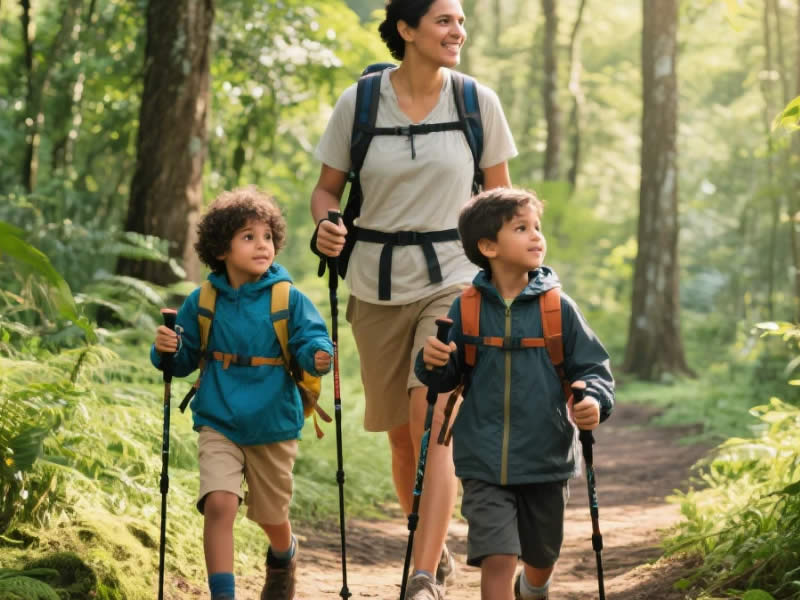
1. The benefits of trekking poles for children
a. Balance and coordination – Using two poles on uneven ground helps children develop balance and motor skills. The four-point contact (two feet + two poles) improves stability and reduces the risk of trips.
b. Posture – Poles encourage an upright stance, which is good for developing posture. Children are often prone to slouching; poles help them stand tall.
c. Confidence – On uneven, muddy, or rocky ground, poles can reduce the fear of tripping. They give children a sense of security, encouraging them to explore more challenging terrain.
d. Upper body engagement – Using poles actively engages the arms, shoulders, and core, turning a walk into a more complete physical activity. This can be particularly beneficial for children who spend a lot of time sitting.
e. Fun – For many children, using poles makes the walk feel like an adventure. They feel like they are doing something "grown‑up" and are more likely to enjoy the walk.
2. Guidelines for safe use
a. Age and maturity – There is no set age, but children need to be mature enough to understand that poles are walking aids, not toys. Generally, children aged 6+ can start learning, depending on their coordination and attention span.
b. Adult supervision – Always walk alongside your child, demonstrating the correct rhythm and grip. Start on flat, easy ground before tackling slopes. Supervision is essential until they are competent and safe.
c. Correct length – Adjust the poles so the child's elbows are at a 90° angle when the tip is on the ground. Many brands sell children's models or adjustable poles that go down to 80 cm. Using adult poles is dangerous and ineffective.
d. Rubber tips – On hard surfaces (pavement, indoors), fit rubber ferrules to prevent slipping and protect the carbide tips. Switch to carbide tips on soft ground (grass, mud) for grip.
e. Start on flat ground – Begin on a smooth, flat surface (a park path, a gym floor) to learn the rhythm and grip. Avoid slopes until they are confident.
f. Stop if tired – If your child gets tired, let them rest. Fatigue can lead to poor technique and increased risk of accidents.
3. Teaching the basics
a. The grip – Show them how to hold the pole with a relaxed grip. The strap should sit across the base of their palm, not their wrist. For children, simpler straps (loop‑through) are easier to manage.
b. The rhythm – Teach the alternating rhythm: left pole with right foot, right pole with left foot. This is the most efficient and natural rhythm. Start by walking without poles, then add the poles.
c. Planting – Show them how to plant the pole lightly, not to jab it. The pole should touch the ground gently.
d. Stowing – Teach them to collapse and stow the poles if they are not needed (e.g., on a flat, safe section). They should never run with poles.
4. Choosing the right poles
a. Children's models – Some brands sell children's trekking poles (e.g., Leki, Decathlon, Black Diamond). These are lighter, shorter, and have smaller grips.
b. Adjustable poles – Choose poles that can be adjusted as your child grows. Look for a minimum length of 80–90 cm.
c. Lightweight – A lighter pole is easier for a child to control. Aluminium is a good balance of weight and durability.
d. Lever locks – Lever locks are easier for children to operate than twist locks.
5. When to avoid poles
- Very young children (under 4) – Too young to understand the purpose and control the poles.
- Rough, steep terrain – If a child lacks confidence, using poles on steep ground can increase the risk of a fall.
- When they are tired – Fatigue impairs coordination.
- When they are not supervised – Always supervise children using poles.
6. Pro tips for Brazilian family hikes
- Start on flat, familiar ground – A park path (e.g., Ibirapuera, Parque do Ingá) is ideal.
- Use rubber tips – On pavement, use rubber tips to protect carbide tips and reduce noise.
- Keep sessions short – 15–20 minutes is enough for the first session.
- Make it fun – Let them practice the rhythm and use the straps correctly.
- Stop if they get tired – Fatigue can lead to poor technique and accidents.
- Use lightweight poles – Heavy poles cause arm fatigue.
- Supervise closely – Always walk alongside your child.
7. Equipment for children in Brazil
- Decathlon Forclaz MT900 – Adjustable, lightweight, cork grips. A good option for older children.
- Decathlon children's poles – Smaller, lighter poles designed for children.
- Leki children's poles – Premium option, available via Adventure Sport.
8. Final verdict
Children can safely use trekking poles on family hikes in Brazil with proper supervision and age‑appropriate poles. The benefits – improved balance, posture, confidence, and upper body engagement – are real and valuable. Start on flat ground, use lightweight, adjustable poles with rubber tips, and teach the alternating rhythm. Always supervise, and stop if the child becomes tired or starts swinging the poles. With the right approach, trekking poles can make family walks more enjoyable and adventurous for children, encouraging a lifelong love of walking. Happy (and safe) family hiking!




