




Can I use trekking poles to clear bushes and webs on Brazilian jungle trails?
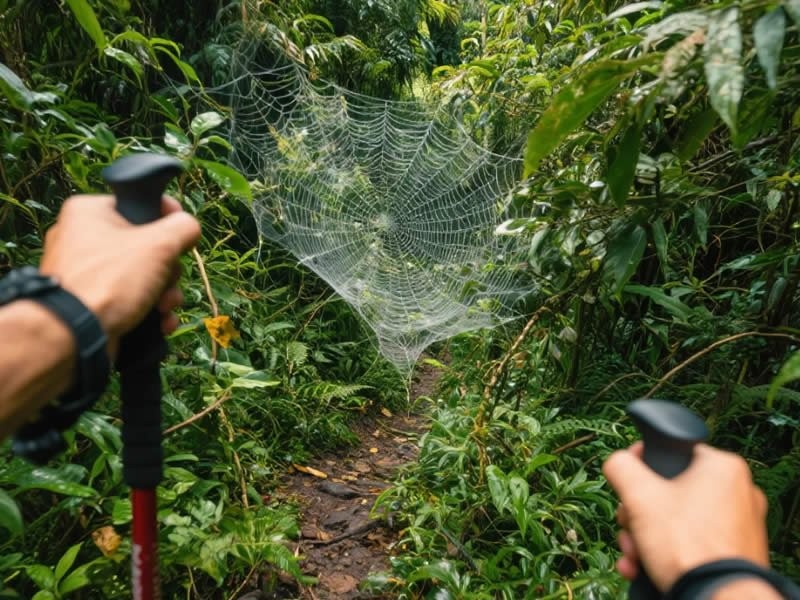
Yes – use the shaft, not the tip, to clear bushes and spider webs. Hold the pole in a horizontal or vertical sweep in front of you—a gentle figure‑eight motion clears webs without snagging. For dense overgrown sections, shorten your poles for better control. The carbide tip can hook and pull stubborn vines, but use it sparingly. In Brazil's Atlantic Forest or Amazon, check for snakes or spiders before sweeping – tap ahead with your pole to alert wildlife. Use the shaft for 95% of clearing; the tip is only for thick vines. After clearing, check the shaft for sap or webs and wipe clean.
1. Why clearing vegetation is a jungle skill
On Brazilian jungle trails—especially in the Atlantic Forest and the Amazon—vegetation can be dense. Vines, ferns, grasses, and spider webs can cover the path. Your trekking poles are already in your hands, making them the most convenient tool for clearing light vegetation and spider webs. Using your pole saves you from having to stop, reach for a separate tool, or use your hands. It also keeps you moving, maintaining your rhythm and pace.
2. The core principle: use the shaft, not the tip
The most important rule is to use the shaft, not the tip. The carbide tip is sharp and can snag on vegetation, get caught, or even break. The shaft is smooth and strong, ideal for pushing aside leaves, ferns, and grasses.
- Why the shaft? – The shaft is less likely to snag on vegetation and won't damage the plants as much. It also protects your carbide tip from unnecessary wear.
- When to use the tip – If you encounter a thick vine or branch that you can't push aside, you can use the tip to hook and pull it. But this is a last resort—use the shaft for 95% of clearing.
3. Clearing techniques
a. Horizontal sweep – Hold the pole horizontally in front of you, like a fencing foil. Sweep it from side to side to push back spider webs, ferns, and low branches. This is the most effective technique for clearing a wide path.
b. Figure‑eight motion – Hold the pole vertically and swing it in a gentle figure‑eight motion in front of you. This clears spider webs and light branches from head height. The figure‑eight motion clears a wider area than a simple sweep.
c. Vertical sweep – For tall ferns, raise the pole vertically and sweep it side to side. This is more effective than a horizontal sweep, which can get caught in the vegetation.
d. Pushing with two poles – On very overgrown sections, use two poles as a "fence" – hold them in a V-shape and push forward. This clears a wide path and keeps your hands protected.
4. Brazilian vegetation considerations
Brazil's trails are diverse, and the vegetation varies:
- Atlantic Forest (Mata Atlântica) – Dense, with many thorny plants (e.g., tucum palm, juçara). Watch for thorns – they can scratch your hands and arms. Wear gloves and long sleeves.
- Amazon – Very dense, with thick vines and large leaves. You will often need to push through vegetation. Watch for snakes – tap ahead with your pole to alert them before you push through.
- Cerrado – More open, but with tall grasses and thorny shrubs. A horizontal sweep is effective.
5. Protecting your poles
- Shorten poles – For better control, shorten your poles by 5–10 cm. A shorter pole is easier to manoeuvre in dense vegetation.
- Watch for thorns – Thorns can scratch the shaft coating. If you are pushing through thorny vegetation, be gentle to avoid scratching the anodised surface.
- Check the tip – After using the tip to hook a vine, check that the carbide tip is still secure.
- Rinse after use – Sap and mud can accumulate on the shaft. Rinse with water and dry.
6. Wildlife safety
- Tap ahead – Before you push through thick vegetation, tap the ground with your pole to alert snakes and other wildlife. This gives them time to move away.
- Watch your step – While pushing vegetation, keep your eyes on the ground. Snakes may be resting on the trail.
- Check for nests – Before sweeping, check for nests or resting animals. A sudden sweep could disturb or harm an animal.
- Brazilian spiders – Some Brazilian species (like the armed spider, Phoneutria) can be dangerous. If you see a large web, go around it rather than through it.
7. Common mistakes
- Using the tip for everything – The tip can snag on branches and get stuck. Use the shaft.
- Forgetting to shorten – A longer pole is harder to control in dense vegetation.
- Pushing too hard – If you can't push the vegetation aside, find a way around it or use a machete (if allowed). Don't force your pole – you could bend it.
- Not checking for wildlife – Always tap ahead before pushing through.
8. When to use a machete
In very overgrown sections, a machete (if allowed) is more effective than a trekking pole for clearing thick vegetation. However, in national parks, cutting vegetation is often prohibited. In these areas, your poles are your only option.
9. Final verdict
On Brazilian jungle trails, trekking poles are a practical tool for clearing bushes and spider webs. Use the shaft, not the tip, and use a horizontal sweep, figure‑eight motion, or vertical sweep. Shorten your poles for better control, and always check for wildlife before sweeping. With the right technique, you can move through overgrown sections efficiently and safely. Happy (and safe) hiking!




