




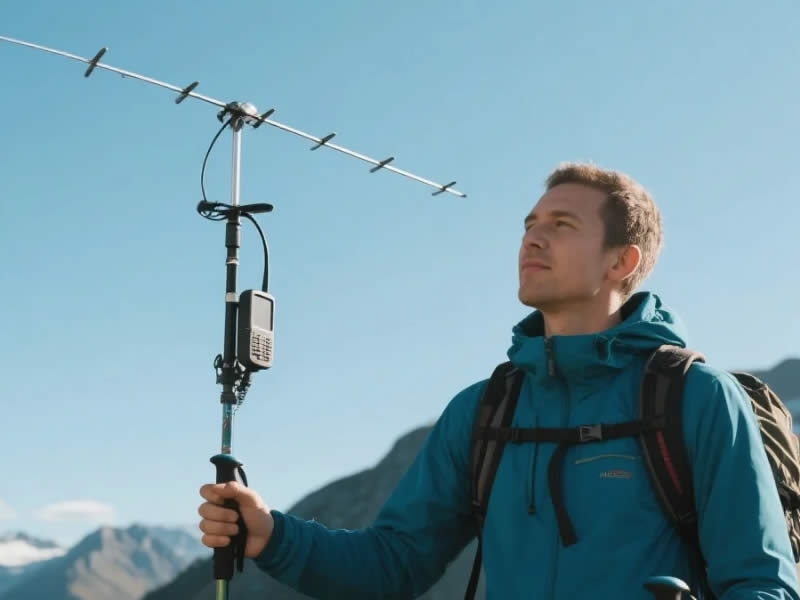
Can trekking poles be used as an emergency antenna for satellite devices?
No – a trekking pole cannot be used as an emergency antenna for satellite devices. Satellite devices (e.g., inReach, SPOT, ZOLEO) require a specific antenna design and impedance matching to communicate effectively. Using a metal pole as an antenna could damage the device, reduce signal strength, or interfere with its functionality. In an emergency, your best options are to find a clearing with a clear view of the sky, use the device's built‑in antenna as designed, carry a spare battery pack, or carry a dedicated external antenna if your device supports it. Never attach or connect your trekking pole to a satellite device – you risk damaging the device and losing your only means of communication.
1. The myth – why people think it might work
The idea of using a trekking pole as an emergency antenna comes from the "make your own antenna" hack, where people use metal objects to boost radio signals. In theory, a long metal pole could act as a conductor. However, satellite devices are not simple radios – they operate on specific frequencies (e.g., 1.6 GHz for Iridium, 406 MHz for PLBs) and require precise antenna design. Simply attaching a metal pole to the device does not create a functional antenna.
2. The reality – why it doesn't work
a. Antenna design – Satellite devices use a specific antenna design (e.g., a helical or patch antenna) that is tuned to the frequency of the satellite network. The antenna is designed to match the impedance of the device's transmitter. Connecting a metal pole – which has a different impedance – will cause a mismatch. This reduces the signal strength and can damage the transmitter.
b. Signal frequency – Satellite devices operate on very high frequencies (VHF/UHF). The length of an antenna must be a specific fraction of the wavelength (e.g., 1/4 wavelength). A trekking pole is not the correct length for these frequencies. It will not resonate and will not transmit effectively.
c. Ground plane – A quarter‑wave antenna requires a ground plane – a conductive surface that reflects the signal. A trekking pole does not provide a ground plane. The signal will be poorly radiated, reducing the chance of a successful transmission.
d. Damage risk – The transmitter in a satellite device is designed to work with a specific antenna. If you connect a mismatched antenna, the transmitter can be damaged by reflected power. This could permanently disable your device – the very thing you need in an emergency.
3. What to do in an emergency
In an emergency, your priority is to communicate – not to experiment with improvised antennas. Follow these steps:
- Find a clearing – Satellite signals require a clear view of the sky. Move away from trees, cliffs, and buildings.
- Use the device as designed – Hold the device with the antenna pointing towards the sky.
- Follow the device's instructions – Most devices have a built‑in "test" function to check signal strength.
- Conserve battery – Turn off non‑essential features (e.g., tracking, Bluetooth).
- Use the device's SOS function – If you have a PLB or inReach, press the SOS button.
4. Better alternatives for emergency communication
- Spare battery pack – A small power bank can recharge your device.
- External antenna – Some devices support external antennas (e.g., for marine use). Carry one if you are in a remote area.
- Satellite phone – For very remote areas, a satellite phone is a more reliable option.
- Two‑way communicator – Devices like the inReach allow two‑way messaging, which is more reliable than a PLB.
5. What about PLBs (Personal Locator Beacons)?
PLBs are designed to be simple and reliable. They have a built‑in antenna and are tested to work in real‑world conditions. Do not attempt to modify them. PLBs are designed for one‑way communication – they send a distress signal to satellites, which are relayed to rescue services. The antenna is integrated and cannot be replaced or modified.
6. The legal and safety implications
- Legal – Modifying or attaching anything to a PLB or satellite device may void its certification and warranty. In an emergency, a non‑functional device is a serious liability.
- Safety – In a life‑threatening situation, a damaged device could be the difference between rescue and tragedy. Do not risk it.
7. Pro tips for remote hiking in Brazil
- Carry a satellite device – In remote areas (Chapada, Pantanal, Amazon), a satellite device is essential.
- Check battery life – Before your trip, fully charge your device.
- Test your device – Send a test message before you leave.
- Know how to use it – Practice sending a message and using the SOS function.
- Carry a backup – A PLB and a two‑way communicator are a good combination.
- Tell someone your route – Leave a route plan with someone responsible.
8. Final verdict
Trekking poles cannot be used as an emergency antenna for satellite devices. The antenna design is specific to the frequency and requires precise matching. Connecting a metal pole could damage the device, reduce signal strength, and interfere with its functionality. In an emergency, use the device as designed, find a clear view of the sky, and follow the device's instructions. Carry a spare battery pack and know how to use your device. Your safety depends on reliable communication – do not improvise with your satellite device. Happy (and safe) hiking!




