




Do trekking poles help on the historical Gold Trail (Caminho do Ouro)?
The Caminho do Ouro (Gold Trail) is one of Brazil’s most fascinating historical hiking routes. Stretching approximately 120 kilometres from the colonial town of Ouro Preto in Minas Gerais down towards the coast (or the reverse direction), this path was once used by Portuguese colonisers to transport gold, gems, and supplies on the backs of mules and slaves. Today, it’s a treasured multi‑day trek for history buffs and nature lovers alike. But the trail’s romantic past belies a harsh physical reality: steep, uneven stone pavements, moss‑covered cobblestones, slippery river crossings, and relentless ascents and descents. If you’re planning to walk this historic route, a crucial question arises: do trekking poles actually help? The short answer is a resounding yes—and in this article, we’ll explain exactly why, which poles are best, and how to use them effectively on this unique terrain.
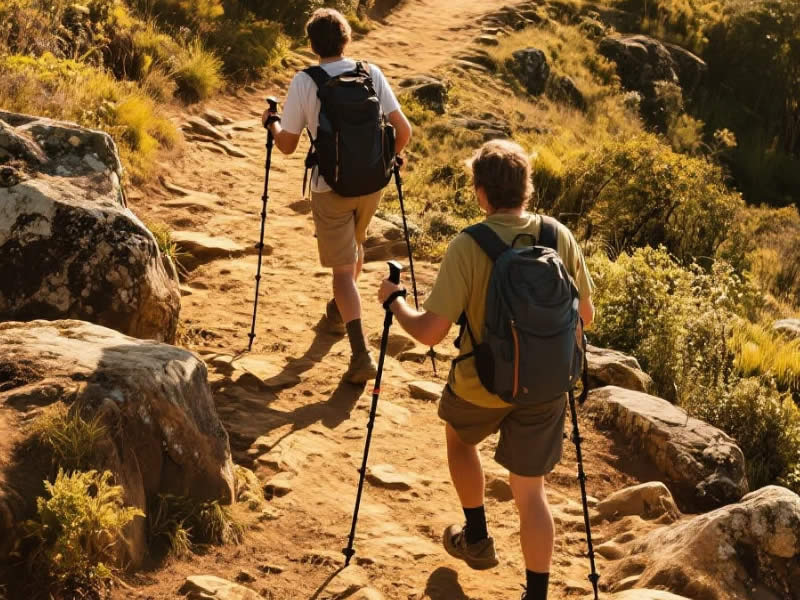
Understanding the Caminho do Ouro terrain
The Gold Trail is not a groomed park path. It follows ancient mule tracks, many of which are still paved with original irregular granite slabs. These stones, worn smooth by centuries of rain and use, become treacherously slick when wet—which is common in the region’s humid climate. The trail traverses rolling hills, cutting through Atlantic Forest remnants, crossing numerous streams, and featuring long sections of loose dirt, exposed roots, and sharp rocks. Elevation changes are constant: you’ll climb hundreds of metres to ridges and descend back into valleys several times each day.
This variety means that a single piece of gear must perform across mud, stone, gravel, and water crossings. Trekking poles, when properly chosen and used, excel in exactly this kind of mixed environment.
How trekking poles make a tangible difference
1. Knee protection on endless descents
The Gold Trail has more cumulative descent than many hikers expect. Each downhill step sends a shockwave through your knees, and after 15–20 kilometres a day, that adds up to significant joint fatigue. By planting poles ahead of your feet and pushing down, you transfer up to 30% of your body weight to your arms. This reduces the impact on your quadriceps and patellar tendons, allowing you to walk longer with less post‑hike soreness. For older hikers or those with previous knee issues, poles are not a luxury—they’re a necessity.
2. Stability on slippery cobblestones
The historic stone sections are the trail’s signature feature, but they are also its greatest hazard. Granite, when damp, becomes as slippery as ice. One misplaced foot can send you sprawling, potentially spraining an ankle or worse. Poles give you two extra contact points, allowing you to test each stone’s grip before you commit your full weight. On side‑slopes, you can keep both poles on the uphill side to brace against sliding downhill, dramatically reducing your fall risk.
3. Stream and river crossings
The trail crosses multiple watercourses, some with wooden bridges, others requiring careful rock‑hopping or wading. Poles help you probe the depth of murky water, maintain balance on slimy stones, and steady yourself against the current. When crossing with a heavy backpack, they are invaluable for preventing a soaking spill.
4. Assistance on steep ascents
On long, sustained climbs, poles let you engage your upper body—your arms, shoulders, and back—to help push you upward. This spreads the effort across more muscle groups, reducing leg fatigue and allowing you to maintain a steadier pace. Many hikers find they climb noticeably faster with poles than without.
5. Relief for your back and shoulders
If you’re carrying a 10–15 kg backpack (typical for multi‑day trips), the load can strain your spine and shoulders. Poles encourage a more upright posture and reduce the shock transferred through your legs up to your back, easing overall discomfort.
Which poles are best for the Caminho do Ouro?
Given the mixed terrain, you need a pole that is durable, adjustable, and easy to maintain. Here’s the ideal specification:
- Material: 7075‑T6 aluminium – carbon is lighter but can crack if it gets wedged between stones. Aluminium bends, which is safer on a trail where you’ll inevitably jam a pole into a crevice.
- Locking mechanism: Flick‑locks (cam levers) – twist‑locks can fail when fine granite dust infiltrates the expander. Flick‑locks are external, cleanable, and easily tightened with a small hex key.
- Grip: Cork – it absorbs sweat and stays comfortable over long, humid days. Foam extensions below the grip are useful for choking up on steep pitches.
- Tips: Carbide – for biting into stone and dirt. Bring a set of rubber ferrules for the few sections of smooth rock where carbide can skid.
- Baskets: Medium (5–6 cm) – the trail has mud but not deep bog; large baskets may catch on undergrowth. Removable baskets are ideal so you can take them off for rocky stretches.
- Weight: Under 280 g per pole – you’ll be swinging them for hours; lighter is better.
Top recommendations: Black Diamond Trail Pro, Leki Makalu (aluminium), or Decathlon Forclaz MT900. All offer reliable flick‑locks and cork grips.
Techniques specific to the Gold Trail
- On wet cobblestones: Lengthen your poles by 3–5 cm and plant them slightly wider than normal for a broader base. Use the rubber ferrules if you have them—they provide better traction on polished stone than carbide.
- On muddy sections: Shorten poles by 5 cm to keep your arms at a comfortable angle as you push through soft ground. Use the baskets to prevent the poles from plunging too deep.
- On long descents: Extend poles to full length (or slightly longer) to maximise braking effect. Keep your elbows close to your body and push down firmly with each step.
- When crossing a stream: Face upstream, use both poles to brace against the current, and move sideways or forward with a wide stance. Never plant a pole where you can’t see the bottom—probe first.
- On steep stair‑like stone steps: Collapse the poles and carry them in one hand; these sections often require using handrails or natural holds.
The verdict: essential or optional?
For the Caminho do Ouro, trekking poles are highly recommended for virtually every hiker. They are not absolutely mandatory—strong, experienced trekkers with excellent knees can complete the trail without them—but the vast majority of walkers, including local guides, strongly urge their use. The combination of slippery stone, constant elevation change, and long daily distances makes poles a practical investment in safety and comfort.
If you’re still unsure, consider this: many hikers who skip poles regret it by the second day, when their knees ache and their balance wavers on a wet slab. Conversely, almost no one regrets having brought them. They add modest weight to your pack (about 500 g for a pair) and they can be strapped to the outside when not needed—but the benefits they deliver far outweigh the minor hassle.
Final advice
Before your Caminho do Ouro trek, spend a few hours practicing with your poles on similar terrain—a local park with slopes and uneven paths will do. Learn to adjust the height quickly with one hand, and get used to the rhythm of planting and pushing. Pack a spare tip and a small repair kit (extra flick‑lock lever, hex key, and a file). And remember: on the Gold Trail, the history is under your feet, but the safety is in your hands—your poles are the silent partners that help you walk safely through centuries of stories.
So, to answer the question directly: yes, trekking poles help enormously on the historical Caminho do Ouro. They protect your knees, stabilise your steps, and make the journey more enjoyable. Don’t leave home without them. Bom caminho!




