




Are trekking poles useful for the Altarzinho Peak trail in Itatiaia?
Altarzinho Peak, standing at approximately 2,500 metres within the Itatiaia National Park on the border of Rio de Janeiro and Minas Gerais, is one of Brazil's most stunning and accessible high‑altitude hikes. Its name—"Little Altar"—comes from the distinctive shape of its summit block, which resembles a sacred pedestal. The trail to reach it is a classic of Brazilian mountaineering: a 4‑kilometre (one‑way) route that climbs through lush Atlantic Forest, then emerges into alpine meadows and finally tackles a steep, rocky crest. If you're planning this hike, the question of trekking poles is inevitable. The short answer is yes, they are extremely useful—but with some caveats. In this guide, I'll explain exactly where and how poles help, where they become a hindrance, and how to choose the right ones for this specific mountain.
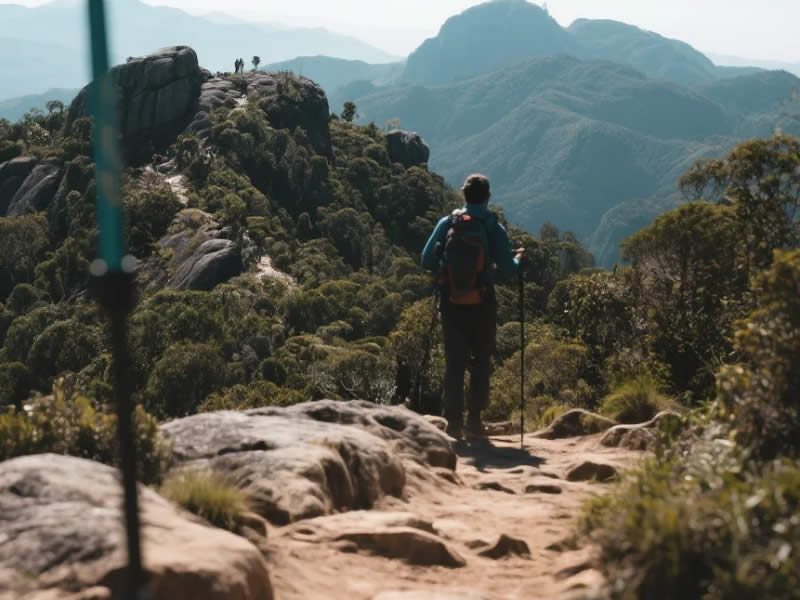
Understanding the Altarzinho trail
The trail starts at the park's access point (usually near the Abrigo Rebouças area) and ascends via a well‑marked path. The terrain can be divided into three distinct phases:
- Lower forest trail – A steep climb through dense Atlantic Forest, with muddy sections, exposed roots, and occasional small stream crossings. The ground is often wet and slippery.
- High‑altitude meadows and scree – Above the treeline, the trail opens onto grassy slopes interspersed with loose quartzite scree and small boulders. This section is exposed, windy, and often cold.
- The final rocky ridge – The last 100‑200 metres involve scrambling over large granite blocks, with some hands‑on sections to reach the summit.
Each phase presents different challenges—and poles are useful in different ways.
How trekking poles help on the Altarzinho trail
1. Knee protection on the descent
The descent from Altarzinho is deceptively punishing. What took you two hours to climb can take almost as long to descend—the knees absorb shock with every step, especially on the loose scree and rock steps. Poles allow you to offload 20‑30% of your weight to your upper body, significantly reducing the impact on your knee joints. For older hikers, or anyone with a history of knee issues, this is the most compelling reason to bring them.
2. Stability on wet, rooty forest sections
The lower part of the trail is often damp and covered in slick roots. A single misplaced step can lead to a twisted ankle. Poles give you two extra points of contact, allowing you to test the ground before you commit your weight. On steep, muddy slopes, they provide the added traction needed to keep you upright.
3. Braking on scree
The open section above the treeline is covered in loose, fist‑sized stones that shift underfoot. Descending through this scree without poles is like walking on marbles—your ankles work overtime. With poles, you can plant them ahead of you, lean back slightly, and let them act as brakes, allowing you to "ski" down more controlledly and with far less joint impact.
4. Support on moderate ascents
On the long, steady climbs, poles let you engage your upper body—your arms, shoulders, and back—to help push you upward. This spreads the effort, reducing leg fatigue and maintaining a sustainable pace. You'll climb faster and feel less drained when you reach the summit.
5. Stream crossings
The lower trail crosses a few small streams, often on slippery stones. Poles help you maintain balance and probe the depth of murky water.
Where poles become a hindrance
The final summit scramble
The last 100‑150 metres to the peak of Altarzinho involve genuine scrambling over granite boulders. You'll need both hands free to grip the rock, pull yourself up, and maintain balance. Here, poles are useless and even dangerous—they can get caught in crevices or knock against the rock, unsettling you. At this point, you must stow your poles on your backpack and complete the final section using your hands.
This is why collapsible poles (which fold down to 35‑40 cm) are ideal—they take up little space and can be quickly attached to the outside of your pack. Some hikers even leave their poles at the base of the rocky section, to collect on the way down (marking the spot), but this carries a small risk of losing them if the weather turns or another hiker moves them.
The verdict: are they worth it?
For the Altarzinho trail, trekking poles are highly recommended for the vast majority of hikers. The combination of muddy forest, slippery roots, loose scree, and a long descent means that poles provide safety and comfort that far outweigh the slight inconvenience of stowing them for the final scramble. If you have healthy knees and excellent balance, you could skip them—but even then, you'll likely be slower and more fatigued on the descent. Almost no one who brings poles regrets it.
Choosing the right poles for Altarzinho
- Material: 7075‑T6 aluminium – carbon is lighter but more fragile on the rocky upper sections; aluminium bends safely.
- Lock: Flick‑locks (lever‑locks) – reliable, easy to adjust, and can be tightened with a hex key.
- Grip: Cork – absorbs sweat and stays comfortable in humid conditions.
- Baskets: Medium (5‑6 cm) – the trail has mud but not deep bog; large baskets may catch on undergrowth.
- Tips: Carbide with sharp profile – essential for grip on wet roots and rock. Bring spare tips; the quartzite is abrasive.
- Weight: Under 280 g per pole.
Recommended models: Black Diamond Trail Pro, Leki Makalu (aluminium), or Decathlon Forclaz MT900.
Essential tips for this trail
- Adjust length: Shorten poles by 5‑7 cm for the steep ascent; lengthen them for the descent to maximise braking. On the scree, slightly longer poles give better leverage.
- Stow them correctly: Practice attaching the collapsed poles to your pack before you go—you'll need to do this quickly at the base of the rocky section.
- Use rubber ferrules on rock: If you have rubber tips, pop them on for the final rocky scramble to prevent carbide from scratching the granite (and to give better grip on smooth surfaces).
- Carry a repair kit: A small hex key and a spare flick‑lock lever can be a lifesaver if a lock fails.
What local guides say
Guides in the Itatiaia region unanimously recommend poles for Altarzinho. "Most of the trail is perfect for poles—it's just the last 100 metres where you don't use them," says José, a guide based in the park. "I've seen too many people struggling with knee pain on the descent. Poles are the simplest way to avoid that." He adds, "If you can, bring a pair you can fold and stash easily—that makes the scramble much more comfortable."
Final recommendation
Yes, trekking poles are highly useful on the Altarzinho Peak trail in Itatiaia. They protect your knees on the descent, stabilise you on wet roots and loose scree, and assist on the ascent. The only section where they are not needed is the final summit scramble—and with collapsible poles, that's a minor inconvenience, not a problem. For most hikers, the benefits far outweigh any downsides. So pack your poles, practice stowing them, and enjoy one of Brazil's most spectacular viewpoints—with knees that will thank you later. Bom trekking!




