




Can I use regular trekking poles for everyday beach fitness walking in Brazil?
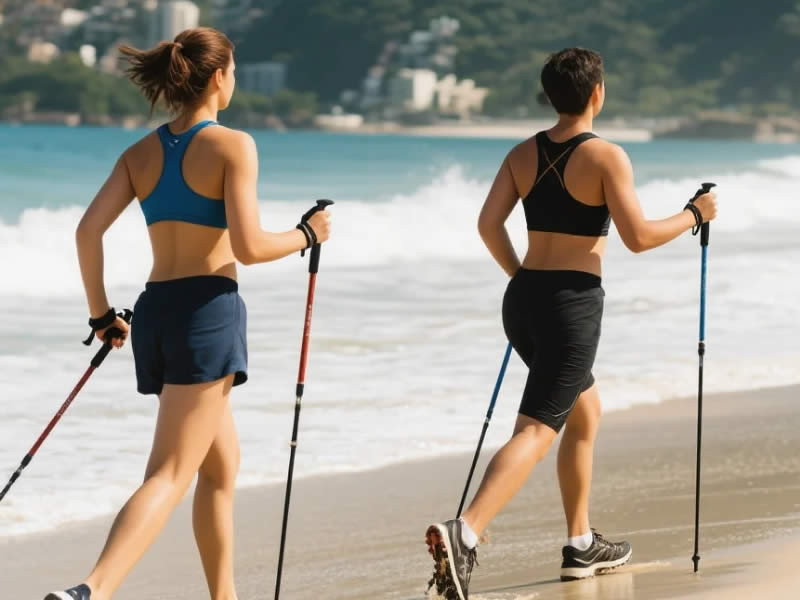
Every morning, along the coastlines of Rio de Janeiro, Salvador, Fortaleza, and Florianópolis, thousands of Brazilians and visitors take to the beach for their daily fitness walk. The rhythmic sound of waves, the gentle breeze, and the soft sand underfoot create a perfect setting for exercise. Many walkers use trekking poles to enhance their workout, improve posture, and protect their knees. But a common question arises: can I just use my regular mountain trekking poles for this, or do I need something special? The short answer is yes, you can use regular poles—but with important caveats. This article explains exactly what works, what doesn't, and how to adapt your poles for Brazil's beach environment.
Understanding your beach walking environment
Before we dive into pole specifications, it's crucial to understand the two distinct surfaces you'll encounter on any Brazilian beach:
- Wet, compacted sand – This is the strip along the waterline where waves lap the shore. The sand here is firm, almost like a packed dirt road. You can walk briskly without your feet sinking more than a few millimetres. This is where most fitness walkers go—it's fast, stable, and consistent.
- Dry, loose sand – Further up the beach, away from the water, the sand is powdery and deep. Your foot sinks 3‑5 cm with every step, making walking significantly harder. This zone is less crowded but requires more effort and puts more strain on your calves and stabilising muscles.
Your regular trekking poles will perform very differently on these two surfaces.
On wet, compacted sand: your regular poles work perfectly
If you stick to the firm sand near the waterline, your standard trekking poles are completely adequate. The tips have enough bite to grip the compacted surface, and the small baskets (typically 4‑5 cm) don't sink noticeably. You'll get all the usual benefits: improved posture, reduced knee impact, increased calorie burn, and a faster walking pace.
Recommended technique: Walk with the poles planted at a natural angle, just as you would on a hard trail. The rhythm is the same—plant, push, step—and the poles will respond predictably. This is the most common beach walking scenario, and regular poles handle it with no issues.
On dry, loose sand: modifications are essential
If you venture into the dry, soft sand, your regular poles will quickly become a source of frustration. The small baskets offer too little surface area, so the pole tip plunges deep into the sand with every plant. Instead of supporting you, the pole sinks like a stake, forcing you to yank it out with each step. The result is wasted energy, an awkward gait, and potential shoulder strain.
To make regular poles work on dry sand, you'll need one or both of the following:
1. Large sand/snow baskets (7‑9 cm)
These oversized baskets act like snowshoes for your poles, spreading the load over a larger area and preventing the tip from sinking. Most major pole brands sell compatible large baskets separately (e.g., Black Diamond "Powder" baskets, Leki "Mud" baskets, Decathlon's sand baskets). They're typically R$30‑80 per pair and clip on in seconds. This is the single most effective upgrade for beach walking.
Actionable advice: Buy removable large baskets before you start walking on dry sand. Keep them in your beach bag and swap them when needed. It's a modest investment that dramatically improves your experience.
2. Adjustable locking mechanisms: flick‑locks over twist‑locks
Fine beach sand is the enemy of twist‑locks. The abrasive particles infiltrate the internal expander mechanism, causing it to jam or slip. Even if you're walking on wet sand, salt spray can accelerate corrosion. Flick‑locks (lever‑locks) are much safer for beach use: they're external, easy to clean with a rinse or a blast of air, and they allow rapid length adjustment—which is useful when you move from the beach to the promenade or back to the water's edge.
If your regular poles have twist‑locks, be extra diligent about rinsing them after each use. Or consider upgrading to a flick‑lock system if you walk on sand frequently.
The corrosion and abrasion factor
Brazil's beach environment is harsh on equipment:
- Saltwater accelerates rust and corrosion on metal components.
- Sand is abrasive and will wear down tip threads, basket clips, and locking surfaces.
- Sun and heat degrade plastic and rubber parts over time.
This doesn't mean you can't use regular poles—it just means you must rinse them with fresh water after every beach walk. Pay special attention to the locking mechanisms, the basket attachment points, and the tip threads. Dry them completely before storing. This 2‑minute routine will extend the life of your poles significantly.
When regular poles are not suitable
There are a few scenarios where regular trekking poles are simply not the right tool for beach fitness walking:
- You have twist‑lock poles and walk daily on dry sand – The locks will wear out or fail prematurely.
- Your poles have fixed, non‑removable small baskets – Without the ability to swap to large baskets, they'll be useless on soft sand.
- Your poles are very heavy (over 300g each) – The extra weight becomes tiring on long beach walks. Lightweight poles are more suitable.
- Your poles have rubber grips – In the heat, rubber becomes sticky and uncomfortable; cork is far superior for tropical conditions.
If any of these apply, consider investing in a dedicated pair of beach‑friendly poles (lightweight aluminium or carbon with flick‑locks, cork grips, and large removable baskets). They don't have to be expensive—the Decathlon Forclaz MT900 is an excellent budget option.
Practical tips for beach walking with regular poles
- Walk on the wet sand – This is the simplest way to avoid the need for modifications. It's also easier on your knees and allows for a faster pace.
- Shorten your poles slightly – A shorter pole reduces the leverage that drives the tip downward, making it less likely to sink even on moderately soft sand.
- Plant with a lighter touch – Instead of stabbing the pole into the ground, place it gently and let it settle naturally.
- Rinse religiously – As emphasised, this is non‑negotiable for longevity.
- Carry a spare set of tips – The abrasive sand will wear them faster than mountain trails. Replace them when they become blunt.
The verdict
Yes, you can use regular trekking poles for everyday beach fitness walking in Brazil—as long as you walk on the firm, wet sand near the waterline. If you intend to walk on dry, loose sand, you'll need to add large sand baskets and ensure your poles have flick‑locks (or you'll be diligent about cleaning twist‑locks). With proper care—especially thorough rinsing after each use—regular poles can serve you well on the beach. However, if you're a daily beach walker, investing in a pair of lightweight poles with cork grips and large baskets is a worthwhile upgrade. Either way, the health benefits of beach walking with poles are undeniable. So grab your poles, head to the shore, and enjoy Brazil's beautiful coastlines—with your feet and your knees in good company.




