




How to stop trekking poles from sinking into deep moorland mud on Dartmoor?
Dartmoor National Park is a place of stark, wild beauty—ancient granite tors, sweeping grassy plains, and a sky that seems bigger than anywhere else in England. But beneath that beautiful surface lies one of the most challenging terrains a walker can face: deep, dark, and often bottomless moorland mud. Peat bogs, mires, and wet, spongy ground are part of Dartmoor's character, and they are the nemesis of trekking poles. You plant your pole for support, and it disappears into the black ooze, forcing you to yank it out with a sucking sound and a spray of mud. This isn't just annoying—it's tiring, it destabilises your rhythm, and it can even be dangerous. In this guide, I'll share the definitive methods to keep your poles on the surface, so you can stride across Dartmoor's bogs with confidence and efficiency.
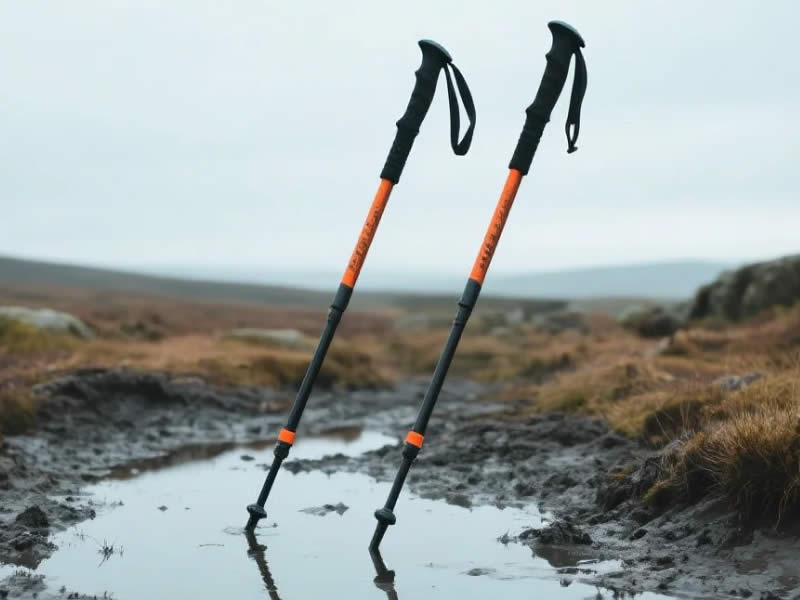
Why Dartmoor mud is uniquely challenging
The moorland mud of Dartmoor is not the same as the mud you might find in a forest or a muddy field. It is typically:
- Peaty and acidic – Composed of partially decomposed vegetation, it is dark, fine, and highly abrasive.
- Deep and unstable – The peat layer can be several metres thick, and the surface is often a floating raft of vegetation over a liquid slurry.
- Wet and waterlogged – Dartmoor receives high rainfall, and the water table is often just below the surface, making the mud consistently saturated.
- Clogging – The fine particles stick to everything and quickly clog moving parts.
A standard trekking pole with a small basket will punch straight through the surface crust and disappear up to the grip. This isn't just an inconvenience—it means you're not getting any support from the pole, and you're wasting energy pulling it out.
The golden rule: fit large mud baskets
The single most effective way to stop your poles from sinking is to fit large, purpose‑built mud baskets. These are typically 9 cm or more in diameter and are designed to spread the load over a wide area, preventing the tip from penetrating the soft surface. Think of them as snowshoes for your poles.
What to look for:
- Diameter: At least 9 cm. Some walkers use 10‑12 cm baskets for extreme conditions.
- Flexibility: A slightly flexible basket can bend over rocks and roots without breaking.
- Attachability: Choose baskets that are easy to clip on and off, so you can remove them when you reach firmer ground or rocky sections.
- Compatibility: Not all baskets fit all poles. Check your pole's diameter and basket attachment system before buying. Major brands like Black Diamond, Leki, and Komperdell offer universal baskets; Decathlon's baskets are also widely compatible.
Where to buy:
- Online: Amazon UK, Wiggle, and outdoor specialty sites.
- In-store: Decathlon, Cotswold Outdoor, and local outdoor shops in Devon.
Pro tip: Buy two sets—one for your current poles and a spare. They are surprisingly easy to lose or break on rocky sections.
Advanced solutions for extreme mud
Sometimes, even 9 cm baskets aren't enough. For the deepest, wettest bogs, consider these upgrades:
1. Mud discs or extender plates
These are large, flat circular discs that attach above the basket, effectively increasing the surface area to 12‑15 cm. They are often sold as "snow plates" or "mud discs" and are used by fell runners and mountain marchers. They are highly effective but can be cumbersome on hard surfaces.
2. DIY improvisations
If you're caught out without large baskets, you can improvise:
- Plastic bottle caps: Cut the top off a large PET bottle (about 5‑6 cm from the cap), drill a hole in the cap, and slide it over the pole tip. The wide plastic circle acts as a crude but effective basket.
- Cable ties: Attach a circle of stiff plastic (like a cut‑up ice cream tub) to the pole just above the tip using cable ties. This creates a temporary, wide base.
- Rubber bungs: If you have access to a rubber bung or a cork, you can fashion a temporary wide foot that increases the pole's surface area.
These are emergency solutions and won't last as long as proper baskets, but they can get you out of a tight spot.
Technique adjustments to reduce sinking
Even with the best baskets, your technique can make a big difference in how much the pole sinks and how easily you can retrieve it.
1. Plant vertically
Try to bring the pole down as vertically as possible, rather than at a shallow angle. A vertical plant puts the force directly downward, which is less likely to cause the tip to slice through the mud. A shallow angle increases the chances of the pole skidding across the surface and sinking sideways.
2. Pull up quickly
When you lift the pole, do so with a swift, vertical motion—don't twist or waggle. Twisting can enlarge the hole and make the next plant even less stable. A fast, straight lift minimises suction and reduces the effort required.
3. Shorten your poles
If you're walking through particularly deep bog, shorten your poles by 5‑7 cm. This reduces the leverage that drives the tip downward, making it less likely to sink deep. A shorter pole also makes the lifting motion easier.
4. Walk on the vegetation
Dartmoor bogs are often crisscrossed by tussocks of grass and rushes. These offer a firmer, more stable footing. Aim to plant your poles on these clumps rather than in the soft hollows between them. This technique, called "tussock hopping," is an acquired skill but it dramatically reduces the amount of sinking.
5. Probe before stepping
In the most uncertain terrain, use your pole as a probe. Push it into the ground ahead of you; if it sinks more than 20‑30 cm without resistance, that area is likely a deep bog and you should find an alternate route. This is a crucial safety technique on Dartmoor, where a misstep can lead to a full‑body immersion.
Maintenance after a Dartmoor slog
Dartmoor mud is acidic and highly abrasive. After a walk, pay special attention to your poles:
- Rinse thoroughly with fresh water—especially the locking mechanisms and basket attachment points. The fine peat particles will clog and corrode if left to dry.
- Dry completely before collapsing to prevent corrosion.
- Check the baskets for cracks and the tips for wear. Replace them as needed.
- Lubricate sparingly—a tiny drop of light oil on the flick‑lock lever can prevent sticking (but never on the sliding surfaces).
The verdict
Stopping your trekking poles from sinking into Dartmoor's deep moorland mud is achievable with the right combination of equipment and technique. The non‑negotiable element is large mud baskets (9 cm+) —they are the single most effective upgrade. For the most extreme bogs, consider adding discs or improvising with bottle caps. Adjust your planting technique to be more vertical and your lifting motion to be swift and straight. And always remember to walk on the tussocks and probe the ground ahead. With these strategies, you'll keep your poles on the surface, your stride efficient, and your Dartmoor crossing a pleasure rather than a battle. Happy trekking!




