




Are carbide tips or rubber tips better for slippery coastal slate paths in Cornwall?
The coastal footpaths of Cornwall are a hiker's dream. Stretching for over 300 miles along the rugged Cornish coastline, these trails offer spectacular views of craggy cliffs, hidden coves, and the endless Atlantic Ocean. But beneath your feet lies a challenging surface: slippery slate. This metamorphic rock, formed from ancient sediments, is notoriously slick when wet—and in Cornwall's maritime climate, it is wet more often than not. For trekkers using poles, a common question arises: should I use the carbide tip that came with my pole, or switch to a rubber ferrule? The definitive answer is carbide tips are generally better for slate, but there are nuances you need to understand. This article unpacks the reasons, the exceptions, and how to make the right choice for safety and performance.
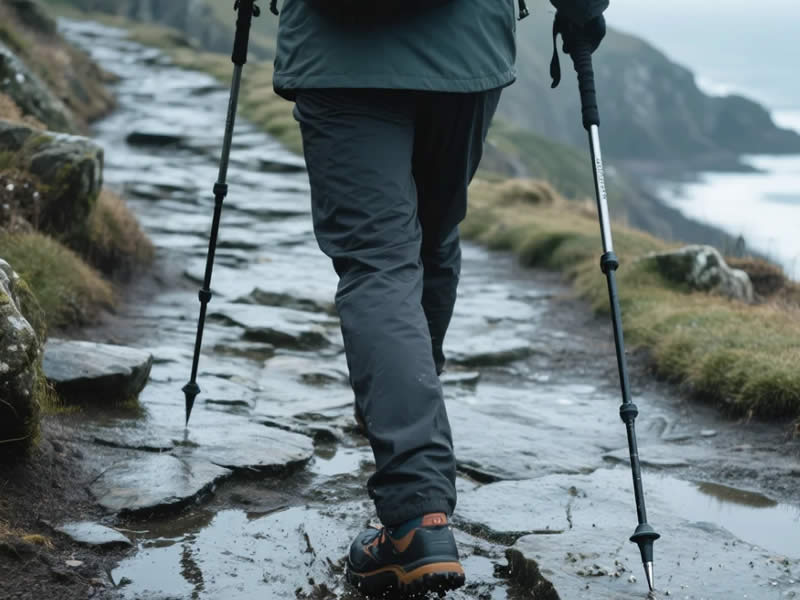
The science of grip on slate
Understanding why carbide outperforms rubber on slate requires a quick look at the properties of both surfaces.
Slate is a fine‑grained rock that fractures into smooth, flat sheets. On a microscopic level, its surface is relatively smooth and has low porosity. When water forms a thin film on it, the friction coefficient drops dramatically—it becomes as slippery as glass. The key to getting grip is to either:
- Penetrate the surface (as a carbide tip does, by creating tiny stress points that bite into the rock), or
- Maximise surface friction through a high‑friction material (like rubber) that can conform to the micro‑texture.
Carbide is an extremely hard, tungsten‑based compound with a sharp, pointed tip. When you apply pressure, the tip creates a high‑point load that penetrates the microscopic irregularities of the slate. It "bites" into the surface, providing a positive grip even on wet stone. This is why mountaineers and hillwalkers in wet, rocky terrain almost exclusively use carbide tips.
Rubber ferrules (the caps that fit over the carbide tip) are designed for walking on hard, non‑abrasive surfaces like pavements, tarmac, or indoor floors. They offer a soft, high‑friction grip on smooth, dry surfaces. However, on wet slate, they fail spectacularly. The water film acts as a lubricant between the rubber and the rock, and the rubber's soft compound skids across the surface, providing little to no grip. On damp slate, a rubber ferrule is more likely to slip sideways, which can lead to a sudden loss of balance and a potential fall.
The case for carbide tips on Cornwall's coastal paths
1. Reliable bite on wet rock
Cornwall's trails are often damp, even on seemingly dry days, due to sea mist and the high humidity. Carbide tips cut through the water film and grip the slate, offering predictable, reliable traction. This gives you confidence when planting your pole, especially on sections where the path narrows near a cliff edge.
2. Longevity on abrasive surfaces
Slate is sharp and can quickly abrade softer materials. Rubber tips wear down surprisingly fast on the rough, broken edges of coastal slate. Carbide, being far harder, lasts many times longer. While rubber tips may be cheaper to replace, the constant replacement cost and the risk of a worn, slippery tip make them a poor choice for regular use.
3. Effective on moss and vegetation
Slate paths are often partially covered with a thin film of algae or moss, which is extremely slippery. Carbide tips can penetrate this organic layer and reach the rock underneath, providing a grip that rubber simply cannot achieve.
When rubber tips can be useful
Despite the clear advantages of carbide, there are specific circumstances where rubber ferrules are a better choice:
1. Crossing paved or tarmac sections
Many Cornish coastal paths include short sections that cross roads, pass through villages, or use paved promenades. On these hard, dry surfaces, carbide tips are noisy, can cause damage (some pathways have restrictions), and they wear down faster. Rubber tips provide a quiet, scratch‑free, and more comfortable option for these sections.
2. Walking on very smooth, dry slate
If you encounter a perfectly smooth and exceptionally dry slate surface—rare in Cornwall, but possible during a heatwave—rubber can offer better grip than carbide. The rubber compound conforms to the smooth surface, increasing the contact area and providing a softer, more friction‑based grip.
3. Indoor use or car parking
If you're using your poles for urban Nordic walking or just walking from your car to the trailhead, rubber tips are the considerate and safe choice.
The hybrid approach: carry both
The most practical solution for the Cornish coastal path is to fit your poles with carbide tips and carry a pair of rubber ferrules in your pocket or pack. This allows you to:
- Use carbide for 95% of the trail where you need reliable grip on slate, mud, and grass.
- Pop on the rubber ferrules for the occasional pavement, road, or village section.
This hybrid approach gives you the best of both worlds: the safety of carbide where you need it, and the convenience of rubber where appropriate. Switching ferrules takes only a few seconds.
Local regulations and ethical considerations
In recent years, some conservation groups and local authorities have expressed concern about carbide tips marking or damaging rock surfaces, particularly on popular climbing routes and ancient footpaths. While Cornwall's coastal paths are generally tolerant of carbide, it's worth checking if any specific sections—especially those near Scheduled Monuments or nature reserves—have restrictions. Many organisations recommend using rubber ferrules on very fragile or historic stonework. When in doubt, use rubber on paved areas and stick to carbide on natural rock.
Test for yourself
If you're still uncertain, do a simple field test: find a damp, moderately angled slate slab and try walking on it with both a carbide‑tipped pole and a rubber‑tipped one. Plant each firmly and push down. You'll almost certainly notice the carbide tip holds solid while the rubber tip slides. This direct experience is far more convincing than any written advice.
Final verdict
Carbide tips are superior to rubber tips for walking on slippery coastal slate paths in Cornwall. They provide reliable bite, last longer on abrasive surfaces, and give you confidence on wet, mossy, and uneven terrain. Rubber ferrules are useful for hard, dry surfaces, but they are a safety hazard when used on wet slate. The best strategy is a hybrid approach: keep your carbide tips on for the trail and carry rubber caps for the odd road crossing. With this setup, you'll navigate Cornwall's stunning coastline safely and enjoyably. Happy walking!




