




Do rubber ferrules prevent trekking poles from slipping on wet tarmac and bridleways?
Trekking poles are remarkably versatile, but no single tip configuration is perfect for every surface. The choice between a bare carbide tip and a rubber ferrule (the protective cap that fits over the tip) has a huge impact on grip, noise, and wear. When the route mixes wet tarmac with muddy or gravel bridleways—a common scenario on long‑distance trails like the South Downs Way or the West Highland Way—walkers often wonder: will rubber ferrules keep me from slipping? The honest answer is it depends on the surface. On wet tarmac, rubber is usually better; on muddy or loose bridleways, carbide is vastly superior. This article unpacks the science, the practical trade‑offs, and the best strategy for mixed‑terrain walking.
The physics of grip: rubber vs. carbide
Grip is a function of friction. Friction depends on the nature of the two surfaces in contact and the normal force (how hard you press).
- Carbide tips are extremely hard and have a sharp, pointed profile. They work by penetrating the surface. On soft ground (mud, grass, dirt, gravel), the tip digs in and creates a positive mechanical lock. On hard, smooth surfaces (tarmac, rock, concrete), the tip cannot penetrate, and the contact area is very small. As a result, the carbide skids across the surface—especially when wet—offering little grip.
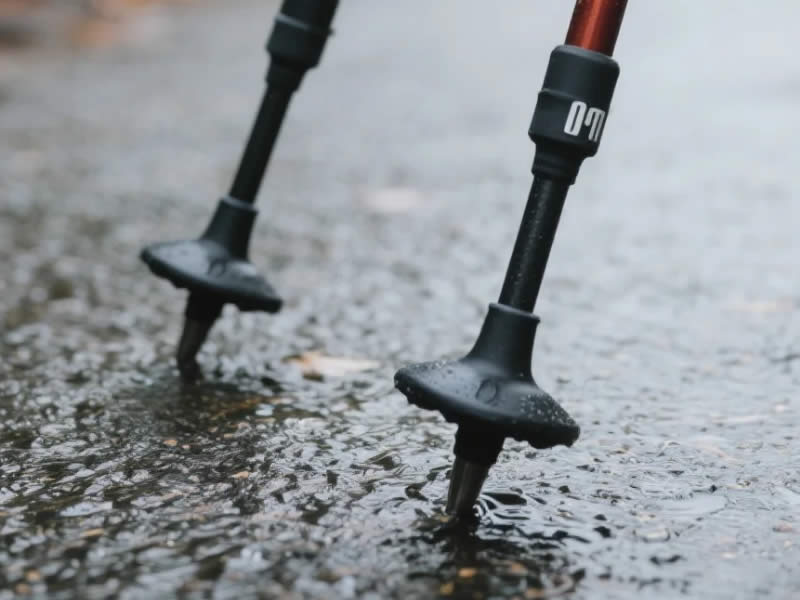
- Rubber ferrules are made of a soft, compliant compound. They work by conforming to the surface texture, increasing the contact area and providing high friction through adhesion. On hard, smooth surfaces, rubber offers superior grip—it's essentially like a car tyre on a wet road. On soft, uneven surfaces, the rubber cannot penetrate the mud or gravel, and it can become coated with a slick film of mud, reducing grip.
Wet tarmac: rubber wins
On wet tarmac, rubber ferrules are the clear winner. Here's why:
- Conformability: The soft rubber moulds to the microscopic texture of the asphalt, creating a large contact patch. This distributes the load and generates significant friction through molecular adhesion.
- Water displacement: The rubber compound is designed to displace the thin film of water on the tarmac, allowing direct contact between the rubber and the road.
- Quiet and non‑marking: Rubber ferrules are silent and won't scratch the road surface. They also protect your carbide tip from unnecessary wear (tarmac is abrasive and can blunt the tip).
In contrast, a bare carbide tip on wet tarmac is a disaster waiting to happen. The small, hard point cannot find purchase on the smooth, wet surface. It skids sideways with alarming ease, especially if you lean on it for support. Many a walker has taken a sudden, embarrassing fall on a damp road crossing simply because they forgot to switch to rubber.
Wet, muddy, or loose bridleways: carbide rules
Once you leave the tarmac and step onto a bridleway—which is often a mix of mud, gravel, loose stones, and compacted earth—the pendulum swings decisively in favour of carbide.
- Penetration: The sharp carbide tip punches through the surface layer, gripping the firmer ground beneath. On mud, it creates a positive bite; on gravel, it wedges between stones.
- Self‑cleaning: Carbide tips tend to shed mud as you plant and lift, maintaining their grip. Rubber ferrules, on the other hand, can pick up mud and form a slippery layer between the rubber and the ground, reducing friction.
- Durability: On abrasive bridleway surfaces (grit, stones), rubber ferrules wear down very quickly. A rubber cap that starts with a tread pattern can become smooth and useless in a matter of kilometres. Carbide tips, being much harder, last far longer.
Using a rubber ferrule on a muddy bridleway is not only ineffective but can be dangerous. The pole can slide sideways unexpectedly, just when you're relying on it for balance on a steep descent.
The hybrid approach: carry both and swap as needed
The most practical solution for the walker who faces both wet tarmac and bridleways on the same route is to carry both a pair of rubber ferrules and a set of spare carbide tips. Then:
- Fit rubber ferrules when you're walking on pavements, roads, or any hard, smooth surface.
- Remove them when you enter bridleways, trails, or any soft or uneven ground.
This swapping takes only a few seconds per pole. Some ferrules are designed with a quick‑release feature, making the change even easier. Keep the spare pair in a pocket or a small pouch on your pack strap.
Are there hybrid solutions?
Some manufacturers produce ferrules with a small carbide stud embedded in the rubber, aiming to combine the benefits of both. In practice, these tend to be a compromise: they offer moderate grip on both surfaces, but are not as good as the dedicated tip for either. They can also be expensive and harder to replace.
A better hybrid approach is to use rubber ferrules with a large surface area (some are shaped like a mushroom) that provide excellent grip on tarmac and still offer some traction on moderate bridleways. However, for anything beyond a gentle, well‑compacted path, it's still better to switch to carbide.
Maintenance and care
- Keep rubber ferrules clean: Mud and grit embedded in the rubber will reduce its grip on tarmac. Rinse them after a muddy section.
- Check for wear: A smooth ferrule is less effective than one with a tread pattern. Replace them when the tread is worn flat.
- Protect carbide tips: On tarmac, carbide wears down quickly. Use rubber ferrules to prolong the life of your tips.
The verdict
Do rubber ferrules prevent slipping on wet tarmac and bridleways? On wet tarmac, yes—they are significantly more effective than carbide. On muddy, loose, or uneven bridleways, they are not just ineffective but can be hazardous; carbide tips are the right choice. The best strategy is to carry both and swap them according to the terrain. A few seconds of attention to your tip configuration will keep you safe, stable, and confident, whether you're crossing a road or descending a muddy bridleway. Happy walking!




