




Are wider baskets necessary for the soft, peaty trails of the Yorkshire Moors?
The Yorkshire Moors are a landscape of stark beauty: sweeping heather, dramatic valleys, and skies that seem to stretch forever. But beneath that stunning exterior lies a walker's challenge: deep, soft, and often unpredictable peat. If you've ever tried to cross a peat bog on the North York Moors with standard trekking pole baskets, you'll know the sinking feeling—quite literally—when your poles plunge into the mire, leaving you struggling for support. The question is straightforward: are wider baskets necessary? The answer is a resounding yes. This guide explains why, how to choose the right baskets, and what else you need to consider for a safe and enjoyable crossing.
Understanding the Yorkshire Moors' peat terrain
The peat of the Yorkshire Moors is not the firm, compacted soil you might find on well‑drained hillsides. It is a saturated, spongy mass of partially decayed vegetation, formed over thousands of years in the region's cool, wet climate. This peat is often deep—sometimes several metres thick—and its surface is a fragile crust that can collapse under the weight of a walker or a pole. The ground is waterlogged for much of the year, making it unstable and unforgiving.
The key challenge for poles is load distribution. A standard trekking pole tip has a small contact area; when you plant it on soft peat, it concentrates the force into a tiny point, causing the pole to sink deep into the ground. You then have to expend energy pulling it out, and the pole provides little to no support. This is not just inefficient; it's tiring and can increase the risk of a fall or a twisted ankle.
How wide baskets solve the problem
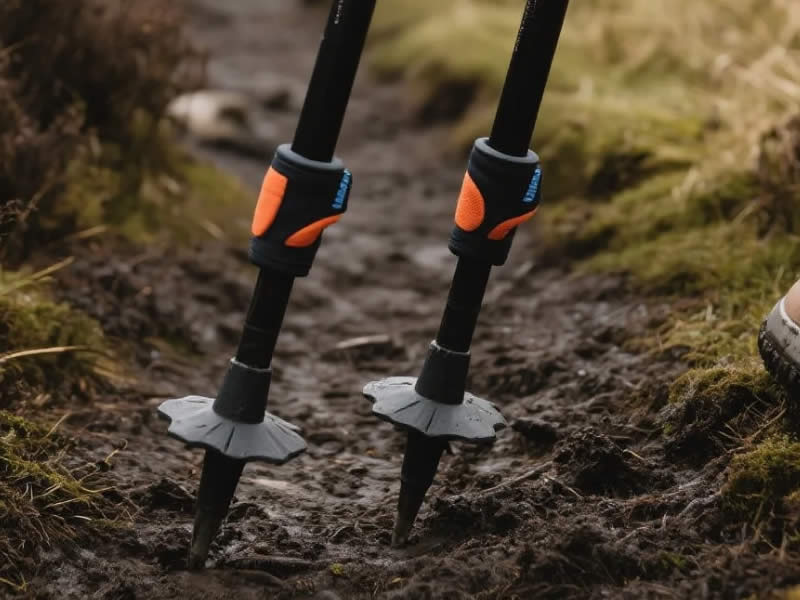
Wide baskets (typically 9‑12 cm in diameter) act like snowshoes for your poles. They spread the load over a larger surface area, preventing the tip from penetrating the peat. Instead of sinking, the basket sits on or near the surface, providing a stable platform that supports your weight and gives you the leverage you need to walk confidently.
The science of flotation
A standard basket of 5 cm has a surface area of about 19.6 cm². A 9‑cm basket has an area of 63.6 cm²—more than three times larger. This means the pressure on the peat is reduced by more than 70%, significantly reducing the chance of the pole sinking.
Self‑cleaning design
Not all wide baskets are created equal. For the Yorkshire Moors, you need baskets that are open‑weave or slotted, like Leki's "Mud" basket or Black Diamond's "Mud" basket. These designs allow the sticky peat to pass through as you plant and lift the pole, rather than building up inside a solid cup. A solid basket will quickly become clogged with mud, becoming heavy and ineffective. The slotted design self‑cleans to a significant degree, keeping the basket light and functional.
Choosing the right basket size
- 9‑10 cm baskets are the standard recommendation for the Yorkshire Moors. They offer excellent flotation on most peat bogs and are still manageable on firmer ground.
- 11‑12 cm "snow" baskets provide maximum flotation for the deepest, softest bogs. However, they can be cumbersome on heather or grass and may catch on rocks. They are best used as a dedicated pair for boggy sections, swapped out when you reach harder terrain.
- Removable baskets are essential. You'll want to take them off when you're on rocky or paved sections to avoid dragging and snagging.
Matching baskets with poles
Most major pole brands offer wide baskets compatible with their models:
- Black Diamond: Their "Mud" basket (9 cm) is a slotted design that fits all BD flick‑lock poles. They also offer a "Powder" basket (10 cm) for deeper snow and peat.
- Leki: The Leki "Mud" basket (9 cm) is a cross‑shape design that sheds mud effectively. It fits their SpeedLock and other compatible poles.
- Komperdell: Their "Mud" basket (9 cm) is robust and fits most Komperdell poles.
- Decathlon: The Forclaz MT900 accepts large "sand/snow" baskets (sold separately) that work well on peat.
If you have a generic pole, universal wide baskets are available from many outdoor retailers. Check that the basket's attachment system matches your pole (push‑button, twist‑on, or screw‑on).
Beyond baskets: the complete pole setup for the Moors
While wide baskets are the priority, the rest of the pole also matters:
Material: aluminium over carbon
The Moors hide rocks and roots beneath the peat. A carbon fibre pole can snap if it gets wedged; aluminium (7075‑T6) bends but rarely shatters, making it the safer choice.
Locking mechanism: flick‑locks only
Fine peat and grit will quickly jam twist‑locks. Flick‑locks (lever‑locks) are external, easy to clean, and reliable in wet, gritty conditions.
Grips: cork for wet hands
Cork grips absorb moisture and remain non‑slippery—ideal for the damp, cool climate of the Moors.
Tips: carbide, sharp and replaceable
A sharp carbide tip helps when you strike hidden rocks. Carry a spare set; peat is abrasive and wears tips down.
On‑trail technique for peat bogs
Having wide baskets is only half the battle. Your technique is equally important:
- Probe before you step: Use your pole to test the depth of the peat ahead. If it sinks more than 30 cm, find a firmer route (tussocks, vegetation, or higher ground).
- Plant vertically: A vertical plant reduces the chance of the tip skidding sideways on hidden roots or stones.
- Lift vertically: Pull the pole straight up—avoid twisting, which can enlarge the hole and destabilise the ground.
- Tap to shed mud: Every few minutes, tap the two baskets together to dislodge accumulated peat.
Maintenance after a day on the Moors
Peat is acidic and corrosive. After a walk:
- Rinse thoroughly with fresh water—especially the baskets, locks, and tip threads.
- Dry completely with the locks open to prevent corrosion.
- Inspect the baskets for cracks—they can break on hidden rocks.
- Apply dry graphite to the locks once dry to keep them smooth.
The verdict
Yes, wider baskets are absolutely necessary for the soft, peaty trails of the Yorkshire Moors. Standard baskets will sink and frustrate you; wide baskets will keep you stable, reduce fatigue, and allow you to enjoy the stunning landscape without fighting your gear. Choose slotted baskets of 9‑10 cm, preferably removable, and pair them with aluminium flick‑lock poles and cork grips. With the right setup and technique, you'll cross the Moors' bogs with confidence and ease. Happy walking!




