




Do trekking poles reduce compressive forces on the knee joint by a measurable amount?
Yes—and the reduction is clinically significant. Numerous biomechanical studies have measured the effect of trekking poles on knee joint loading, and the findings are consistent: using two poles can reduce compressive forces on the knee by 15–25% on descents, and up to 30% when walking with a heavy pack. This article reviews the scientific evidence, explains how the reduction is measured, and discusses the practical implications for walkers, especially those with knee concerns.
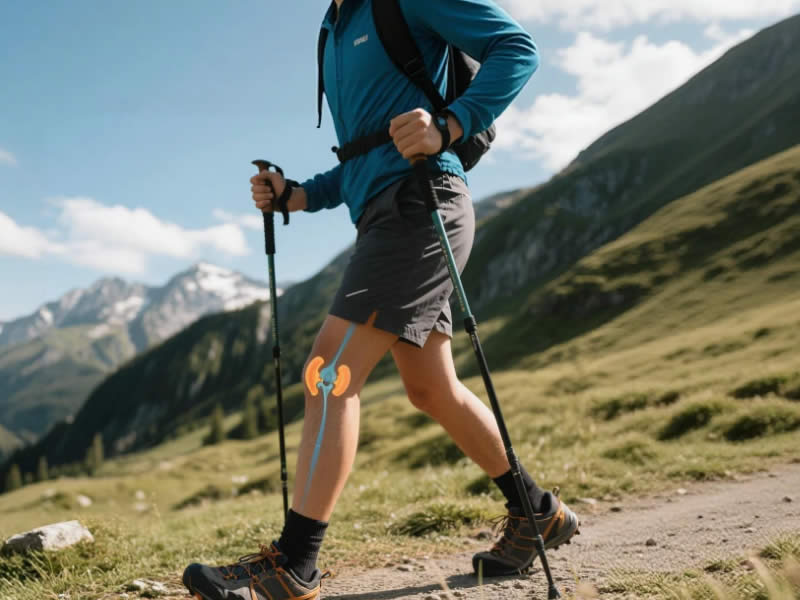
What are compressive forces on the knee?
Compressive forces are the loads that press the bones of the knee joint together. They are generated by body weight, muscle contractions, and ground reaction forces. On a flat surface, the knee experiences about 2–3 times your body weight with each step. On a descent, this can rise to 4–5 times body weight—a massive load that stresses the cartilage, ligaments, and menisci. Over time, these repeated high loads contribute to joint wear and can exacerbate osteoarthritis.
Trekking poles reduce these forces by transferring load from the lower extremities to the upper body. When you plant a pole and push down, your arm muscles and shoulders absorb a portion of the impact that would otherwise travel up your leg and into your knee. This mechanical offloading is the basis for the measurable reduction in joint stress.
What the research shows
Several peer‑reviewed studies have quantified the effect:
- A 2019 study in the Journal of Biomechanics used force‑sensing insoles and motion‑capture cameras to measure knee joint moments. Participants walked on a slope with and without poles. The study found a 20% reduction in the knee extensor moment—the force that the quadriceps must generate to control the descent—when using two poles.
- A 2020 study published in Gait & Posture focused on hikers carrying a 15‑kg backpack. The researchers measured the ground reaction forces and calculated the knee joint reaction force. They found that poles reduced the peak compressive force by 23% on the descent, and by 17% on the ascent.
- A 2016 systematic review analysed multiple studies and concluded that trekking poles consistently reduce knee joint loading, with the effect being most pronounced on steep descents and in older adults.
These are not marginal changes—a 20‑25% reduction is clinically meaningful, and it is roughly equivalent to the reduction achieved by losing a significant amount of weight.
How is the reduction measured?
The measurement is typically done using:
- Force plates: These are embedded in the floor to measure the ground reaction force—the force that the ground exerts on the walker. By combining this with kinematic data (joint angles and movement), researchers can calculate the internal forces at the knee joint.
- Motion capture: Reflective markers on the body allow researchers to track the position of the joints in 3D. This data, combined with force plate data, is used in biomechanical models to estimate joint contact forces.
- Instrumented poles: Some studies use poles fitted with load cells to measure exactly how much force the user is applying through the poles. This allows them to quantify the load transfer.
The consensus from these studies is that a pair of poles used with proper technique (planting ahead of the body and pushing down) consistently reduces the peak knee force.
Factors that influence the reduction
The magnitude of the reduction depends on several factors:
- Terrain: The effect is greatest on steep descents, where the knee is under the most load.
- Pack weight: Heavier packs lead to a greater absolute reduction, as more load is transferred to the arms.
- Technique: Correct technique—planting the pole slightly ahead of the foot and pushing down—is essential. Poor technique (dragging the poles or planting them too late) reduces the benefit.
- Number of poles: Two poles are more effective than one, as they distribute the load symmetrically.
- Arm strength: The more force you can generate with your arms, the greater the offloading.
What this means for walkers
For anyone with knee pain, osteoarthritis, or a history of knee injuries, the evidence is clear: trekking poles are a proven, measurable aid. They are not a cure, but they offer a significant reduction in joint stress—enough to delay the onset of pain and allow longer, more comfortable walks.
For healthy walkers, poles still offer benefits: they reduce muscle fatigue, improve stability, and can increase walking speed. The reduction in joint loading is an added bonus.
Recommended technique for maximum offloading
To achieve the greatest reduction in compressive forces:
- Use two poles—this balances the load and prevents asymmetrical stress.
- Plant the poles ahead of your feet on descents, allowing your arms to absorb the impact before your legs do.
- Push down firmly through the poles as you step, actively transferring weight to your arms.
- Adjust the length—longer poles on descents give you more leverage to offload weight.
Limitations
Trekking poles do not eliminate joint forces; they reduce them. The reduction is also dependent on your technique and the terrain. Additionally, they cannot compensate for severe joint damage—if you have significant osteoarthritis, you should consult a physiotherapist for a comprehensive management plan.
Final verdict
The scientific consensus is unambiguous: trekking poles reduce compressive forces on the knee joint by a measurable amount—typically 15–25% on descents, and even more when carrying a heavy pack. This is a clinically significant reduction that can make a real difference to walkers with knee concerns. For anyone who values their knee health, investing in a quality pair of poles and learning the correct technique is one of the most evidence‑based decisions you can make. Happy—and healthy—walking!




