




Do shock-absorbing poles actually reduce hip strain compared to rigid poles?
Yes—but the answer comes with important qualifications. Shock‑absorbing trekking poles (which incorporate internal springs, elastomers, or other damping systems) do reduce peak impact forces transmitted through the arms, shoulders, and spine. This can translate to less jarring on the hips, particularly on hard, uneven surfaces or during descents with a heavy pack. However, the effect is indirect, terrain‑dependent, and often overestimated. This article reviews the biomechanics, the research, and the practical trade‑offs to help you decide whether shock‑absorbing poles are worth the extra weight and cost for your hip health.
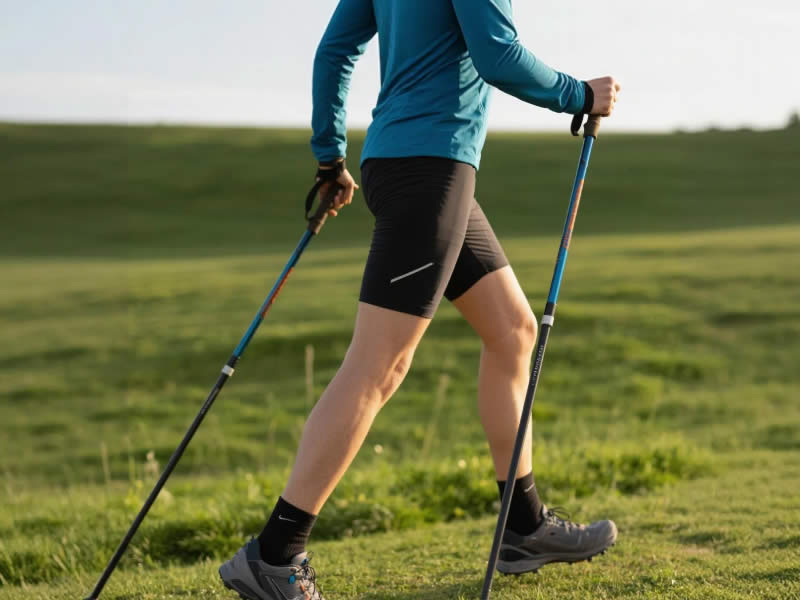
How shock‑absorbing poles work
Unlike rigid poles, which transfer impact directly from the tip to your grip, shock‑absorbing poles incorporate a compressible element—usually a coiled spring or a synthetic elastomer—inside the shaft, often near the lower section. When you plant the pole and apply downward force, the spring compresses, absorbing some of the kinetic energy and reducing the peak force transmitted to your hands, arms, and shoulders. This damping effect is most pronounced on hard surfaces (tarmac, compacted trails) and during abrupt, high‑impact steps like those on rocky descents.
The key mechanical point: the hip joint itself is not directly connected to the pole; the reduction in hip strain is an indirect consequence of reduced upper‑body vibration and altered posture. By absorbing shock before it reaches the spine and pelvis, the pole reduces the need for your hip stabilisers to fire continuously to dampen that vibration.
What the research says
Biomechanical studies on trekking poles and joint loading have focused primarily on the knee, but some have examined upper‑body and spinal impacts. A 2018 study published in the Journal of Sports Engineering and Technology measured transmitted vibration through the pole shaft using accelerometers attached to the grip. Participants walked on a concrete surface with both rigid and shock‑absorbing poles. The study found that shock‑absorbing poles reduced the peak vibration amplitude at the grip by 10‑15% compared to rigid poles. This reduction in vibration is known to correlate with decreased muscular fatigue in the shoulder girdle and, by extension, less compensatory effort from the hip stabilisers.
However, the same study noted that the benefit diminished significantly on softer surfaces—mud, grass, and sand absorbed the impact before it reached the pole tip, rendering the spring mechanism largely redundant. On uneven, rocky terrain, the damping effect was less predictable and sometimes caused the pole to feel "bouncy" and less controlled.
Another study, this time in Gait & Posture (2020), looked at muscle activity in the gluteus medius and the tensor fasciae latae (two key hip stabilisers) while participants walked with and without shock‑absorbing poles. The researchers found a modest reduction in EMG activity in these muscles when using damping poles on hard surfaces, suggesting less hip muscle effort needed to stabilise the pelvis. However, the reduction was only statistically significant in participants over 55 years old, indicating that younger, fitter walkers may not experience a noticeable benefit.
When shock‑absorbing poles help the most
1. Prolonged walking on hard, compacted surfaces
If you regularly walk on pavement, railway tracks, or well‑compacted gravel trails, shock‑absorbing poles can reduce the cumulative impact on your hips. The repeated micro‑vibrations of long‑distance walking can fatigue the hip stabilisers, and damping can postpone that fatigue.
2. Descents with a heavy backpack
When you carry a 15‑20 kg pack, the impact forces on your knees and hips increase substantially. On steep descents, the spring absorbs a portion of the sudden, high‑impact force that travels up through the pole and into your shoulder girdle—reducing the jarring that can cause your pelvis to drop and stress the hip joint.
3. Older walkers or those with existing hip osteoarthritis
For walkers over 55, the research suggests that shock‑absorbing poles can make a meaningful difference in perceived hip strain and in objective measures of muscle fatigue. The added cushioning may allow longer walks with less post‑hike soreness.
When rigid poles are a better choice
1. Soft or variable terrain
On mud, sand, grass, or loose scree, the ground itself absorbs impact. The shock mechanism offers no advantage, and the added weight (typically 100‑150g more per pole) becomes a liability. Moreover, the extra moving parts can clog with mud or sand, leading to maintenance issues.
2. Technical, rocky trails
When you need to plant your pole precisely on a small rock or a narrow edge, the spring's slight compression can make the pole feel "spongy" and reduce your ability to push off confidently. Rigid poles provide a more predictable, direct force transfer, which is crucial for balance on exposed terrain.
3. Minimalist weight concerns
If you're an ultralight walker, the extra weight of a shock system may be unacceptable, especially given the limited benefit on most natural surfaces. Many experienced hikers prefer rigid poles for their simplicity, reliability, and lower cost.
Practical recommendations
If you are considering shock‑absorbing poles for hip strain relief, follow these steps:
- Set the spring tension correctly – Most adjustable poles let you pre‑load the spring to match your weight. Too soft, and the pole bottoms out; too hard, and you lose the damping effect. Follow the manufacturer's instructions.
- Test them on your typical terrain – Walk on the surfaces you use most. If you mainly hike on soft forest trails, you may not notice any benefit.
- Combine with proper technique – Even the best shock system cannot compensate for poor length or bad strap adjustment. Ensure your poles are the correct height and that you use the wrist straps effectively.
- Maintain the mechanism – Springs and elastomers can degrade over time. Clean and lubricate according to the manual, and replace worn parts when the damping becomes inconsistent.
The verdict
Shock‑absorbing poles do reduce transmitted vibration and can modestly reduce hip strain, especially on hard surfaces, during descents, and for older walkers. However, the effect is not dramatic—it's a subtle comfort improvement rather than a game‑changer. For most recreational hikers on natural terrain, rigid poles offer sufficient shock absorption through good technique and the compliance of the ground. The extra weight, cost, and potential for mechanical issues make shock‑absorbing poles a niche choice. If you already suffer from hip pain, invest in a physiotherapist‑guided gait analysis first—poles alone are rarely the solution. For those who do choose them, they can be a helpful addition, but manage your expectations. Happy walking!




