




How to adjust pole length to prevent overreaching and lower back hyperextension?
Correct pole length is the most critical—and often most overlooked—factor in preventing overreaching and lower back hyperextension. A pole that is too long forces you to reach too far forward with each plant, leading to a backward lean that overarches your lumbar spine. Conversely, a pole that is too short encourages hunching, which can also stress the back. The solution is not a single "correct" length, but a dynamic adjustment strategy that changes with the terrain. This guide explains the biomechanics of pole length, provides a clear step‑by‑step adjustment protocol for different terrains, and explains why the wrist strap is as important as the pole itself.
The biomechanics of overreaching and hyperextension
When you walk with trekking poles, the length of the pole determines the angle of your arm and the position of your torso relative to your hips.
- Overreaching occurs when the pole is too long. As you plant the pole ahead of your body, you have to reach forward with your arm, which pulls your shoulder forward and causes your lower back to arch (hyperextend) to compensate. This arching compresses the facet joints of the lumbar spine and can lead to pain and stiffness.
- Stooping occurs when the pole is too short. You lean forward from the hips, rounding your upper back and putting strain on the lumbar discs. While this doesn't hyperextend the back, it creates a different but equally problematic load pattern.
The goal is a neutral, upright posture where your core is engaged, your pelvis is stable, and your shoulders are relaxed. This is the posture that protects your lower back and allows you to walk efficiently.
The "elbow 90°" rule: a starting point, not a fixed rule
The classic rule for pole length is to set the poles so that your elbow is at a roughly 90° angle when you stand upright with the tip on the ground. This provides a good baseline for flat terrain. However, this is only a starting point. For most walking, you need to adjust from this baseline:
- For a flat or gently rolling walk: The 90° angle is appropriate. It allows a natural arm swing, with the pole planted roughly level with your forward foot.
- For a steep ascent: You should shorten the poles by 5‑7 cm from the flat‑ground setting. This keeps your arms closer to your body, allowing you to push vertically up the slope without overreaching. If you keep them at the flat length, you'll be reaching too far forward, which can pull your back into an arch.
- For a steep descent: You should lengthen the poles by 5‑10 cm from the flat‑ground setting. This allows you to plant the pole ahead of your foot without having to lean forward excessively. A longer pole on a descent gives you a greater braking effect and allows you to keep your torso upright, preventing the backward lean that hyperextends the lower back.
The wrist strap: the forgotten adjustment
Even with the correct pole length, you can still overreach if you are gripping the handle too tightly. A tight grip causes your arm muscles to tense, which can pull your shoulder forward and stress your back. The wrist strap is designed to take the load off your grip.
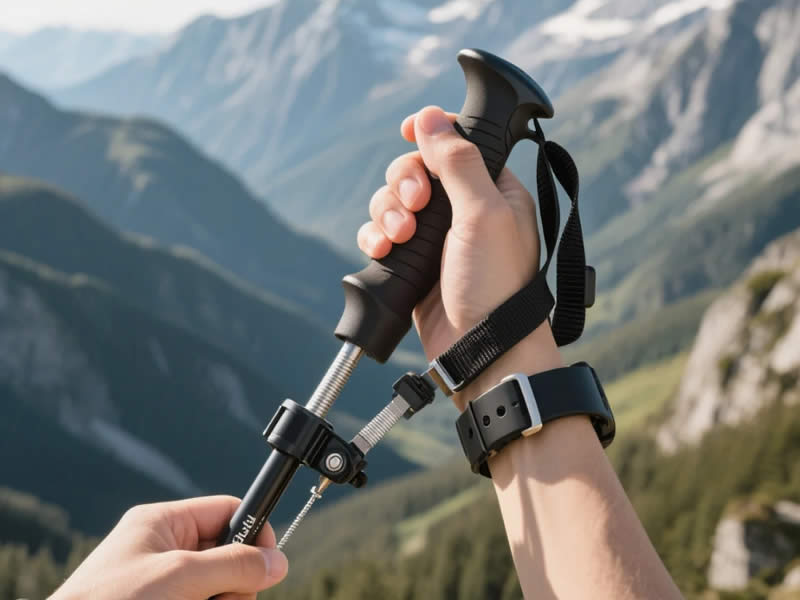
The correct technique: Put your hand up through the strap loop from underneath, then bring it down so the strap rests diagonally across the back of your hand (around the base of your thumb). Now, grip the handle loosely—just enough to guide the pole. The strap should bear the weight of the pole and the load of your push.
When the strap is correctly adjusted, you can relax your grip, and your arm swings more freely. This prevents the tension that can lead to overreaching, even if the length is not perfectly calibrated.
A practical step‑by‑step adjustment guide
Before you start: set your flat‑ground length
- Stand upright, wearing the shoes you'll walk in.
- Hold the pole with the tip on the ground beside your foot.
- Adjust the length until your elbow is at approximately 90°.
- Mark this length on the shaft with a permanent marker (or remember the setting).
On a gradual uphill
- Shorten the poles by 3‑5 cm from your flat‑ground mark.
- Your arms should remain close to your body. If you feel you are reaching forward, shorten them a little more.
On a steep uphill
- Shorten by 5‑7 cm from your flat‑ground mark.
- You should feel like you are pushing straight down, not reaching forward.
On a gentle downhill
- Lengthen by 3‑5 cm from your flat‑ground mark.
- Plant the pole slightly ahead of your foot. Your back should remain straight.
On a steep downhill
- Lengthen by 5‑10 cm from your flat‑ground mark.
- This is the most critical adjustment. A longer pole allows you to plant far ahead of your foot and push down, acting as a brake. Your torso can remain upright, and your back is protected from hyperextension.
On side‑slopes (traversing)
- Keep the pole on the uphill side shorter, and the pole on the downhill side longer. This compensates for the slope and keeps your torso level.
How to test if your length is correct
A simple test: walk for a few minutes with your current setting. Then, focus on your lower back.
- If you feel a stretch or ache in your lower back, you are likely overreaching (pole too long) or stooping (pole too short). Adjust the length by 2 cm and test again.
- If your shoulders feel tense, your grip may be too tight, or the straps may be incorrectly set.
- If your wrists feel strained, the pole is too long for the terrain—shorten it.
Common mistakes and corrections
- Mistake: Keeping the same length for all terrain.Correction: Adjust for uphills and downhills. A 5‑7 cm change is normal.
- Mistake: Gripping the handle tightly.Correction: Loosen your grip. The strap does the work. This also reduces shoulder tension.
- Mistake: Planting the pole too far ahead (overstriding).Correction: Plant the pole just ahead of your foot, not a full step ahead. This keeps your back in a neutral position.
Beyond length: the role of core strength
While correct length is essential, it works best when combined with a strong core. Your core stabilises your pelvis and protects your lumbar spine. Even with a perfectly adjusted pole, a weak core can allow your pelvis to tilt, leading to hyperextension. Include core‑strengthening exercises (planks, bird‑dogs, dead bugs) in your training.
The verdict
Adjusting pole length to prevent overreaching and lower back hyperextension is not a one‑size‑fits‑all process. The "elbow 90°" rule is a starting point, but you must dynamically shorten your poles for uphills (5‑7 cm) and lengthen them for downhills (5‑10 cm). Equally critical is the use of the wrist strap: a loose grip and a correctly adjusted strap will prevent the tension that causes overreaching. With these adjustments and a conscious effort to keep a tall, upright posture, your trekking poles will protect your lower back, not strain it. Happy—and pain‑free—walking!




