




Do trekking poles help distribute pack weight more evenly across the torso?
Yes—significantly. When you carry a loaded backpack, the weight is primarily borne by your shoulders and lumbar spine. This concentrated load creates pressure points on the trapezius muscles and the iliac crest, leading to fatigue, soreness, and even nerve compression over long distances. By planting a pair of trekking poles and pushing down, you transfer a portion of the pack's load from your lower body to your upper body, effectively redistributing the weight across a larger muscle mass. This article examines the biomechanics of load transfer, reviews the evidence, and provides practical guidance on maximising the offloading effect.
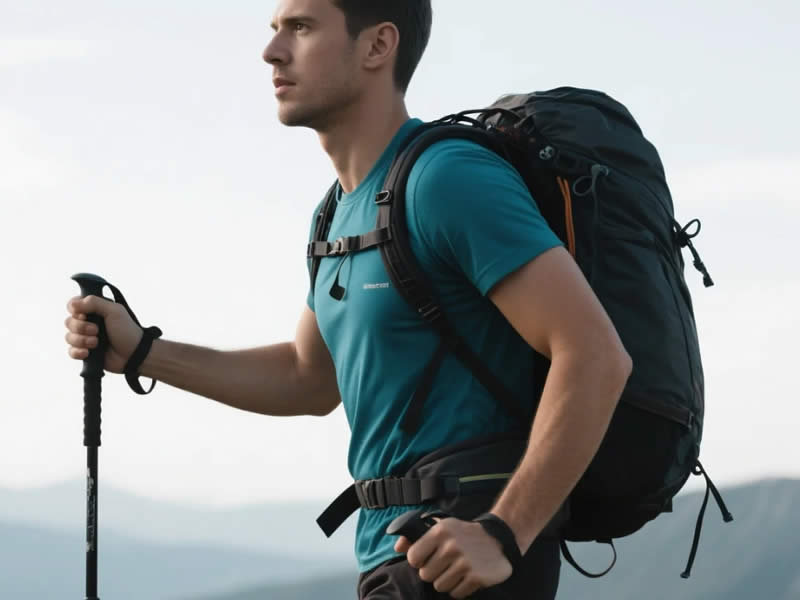
The problem: concentrated load on the shoulders and spine
When you wear a backpack, the weight is suspended from your shoulders and hips. The hip belt should carry about 70‑80% of the load, with the shoulder straps carrying the remainder. However, the hip belt transfers the load to the pelvis, and from there, the weight travels down through the legs. The shoulders and the upper back bear the brunt of any remaining load, creating pressure on the trapezius muscles and the clavicles. Over time, this concentrated pressure can cause:
- Trapezius fatigue: The trapezius muscles work isometrically to stabilise the shoulder straps, leading to aching and stiffness.
- Lumbar spine compression: The vertical load compresses the lumbar discs, which can exacerbate lower back pain.
- Nerve compression: The supraclavicular nerves can be compressed by heavy shoulder straps, causing tingling or numbness in the arms.
Trekking poles intervene in this cycle by creating an upward force that effectively "lifts" some of the load off the shoulders and spine.
How trekking poles redistribute the load
The biomechanics of the "push"
When you plant a trekking pole and push down, you generate a downward force through the pole. According to Newton's third law, the ground exerts an equal and opposite upward force through the pole and into your arm, shoulder, and torso. This upward force effectively counteracts some of the downward pull of the backpack.
Studies using force‑plate technology have shown that with each push, you can transfer approximately 5‑10 kg of load from your lower body to your upper body. This is not a fixed amount; it depends on your technique, the terrain, and how much force you apply. On a descent, where you naturally push down harder, the offloading effect is greater.
The role of the wrist strap
The wrist strap is essential for effective load transfer. When the strap is correctly adjusted, it bears the weight of the push, allowing you to transfer load directly through your arm and into your torso. Without a properly adjusted strap, you rely on your grip, which is weaker and less efficient. The correct technique is to put your hand up through the strap from underneath, then bring your hand down so the strap rests across the back of your hand. This allows you to push down with your whole arm while keeping a relaxed grip.
The effect on the lower back
By offloading weight from the shoulders, trekking poles indirectly reduce the load on the lumbar spine. The lower back is a common site of fatigue and pain, especially on descents where the pack's weight shifts forward. By keeping your torso more upright and reducing the downward pull, poles help to maintain a neutral spinal alignment, reducing compression on the lumbar discs.
The physiological benefits: more than just comfort
1. Reduced pressure on the trapezius
The trapezius muscles attach to the shoulder straps. By offloading weight to the arms, the straps are under less tension, reducing the isometric contraction required to stabilise the pack. This leads to less fatigue and a lower risk of trapezius strain.
2. Improved posture
When you push down on the poles, you engage your lats and core. This encourages a more upright posture, which reduces the tendency to lean forward (which is common with a heavy pack). A taller posture improves spinal alignment and reduces the risk of lower back pain.
3. Increased walking efficiency
By distributing the load across more muscle groups, poles allow you to walk more efficiently. Your legs do less work, your arms do more, and your overall energy expenditure is more evenly spread. This is particularly beneficial on long, undulating trails.
4. Enhanced proprioception
The extra points of contact provide tactile feedback, which helps you maintain balance and choose safer foot placements. This reduces the risk of falls, which is especially important when carrying a heavy pack.
Research evidence
A 2019 study in the Journal of Applied Physiology measured the metabolic cost of walking with a backpack and trekking poles. The researchers found that using poles reduced the vertical oscillation of the centre of mass, which correlated with a lower energy cost. Another study, using load‑cell‑equipped backpacks, found that poles reduced the peak pressure on the shoulder straps by up to 15% on a decline.
Practical technique to maximise the effect
1. Use two poles
Using two poles provides a symmetrical load transfer, preventing asymmetrical strain on your shoulders and spine.
2. Set the correct length
On flat ground, set the poles so your elbow is at roughly 90°. This is the most efficient angle for generating an upward force. For descents, lengthen the poles by 5‑10 cm to increase the braking effect and offload more weight.
3. Plant ahead, push down
Plant the pole slightly ahead of your foot and push down firmly. The push should be a deliberate, forceful action, not just a passive placement. The more you push, the more load you offload.
4. Master the wrist strap
As described above, the strap should bear the load. A loose grip and a well‑adjusted strap are essential for effective load transfer.
5. Engage your core
As you push down, brace your core. This helps transfer the load through your torso and prevents your lower back from arching.
Limitations and important caveats
1. Trekking poles are not a substitute for a properly fitted backpack
The most effective load distribution comes from a well‑adjusted hip belt, which should carry the majority of the pack's weight. If your pack does not fit well, poles can only do so much. Ensure your pack's hip belt sits correctly on your iliac crest and that your shoulder straps are not too tight.
2. They require upper body strength
If you have weak shoulders or wrists, you may not be able to generate enough force to offload a significant amount of weight. Build up gradually with shorter walks.
3. The effect is terrain‑dependent
The offloading effect is greatest on descents, where you naturally push down more. On flat terrain, the effect is more subtle.
The verdict
Trekking poles significantly help distribute pack weight more evenly across your torso by transferring load from your shoulders and lower back to your arms, shoulders, and core. With each push, you offload approximately 5‑10 kg of weight, reducing the pressure on your trapezius muscles and lumbar spine. The effect is most pronounced on descents and when combined with correct technique—proper length, a well‑adjusted wrist strap, and a deliberate push. However, they are a complement to, not a replacement for, a properly fitted backpack. When used correctly, they can transform a heavy, uncomfortable load into a more manageable, fatigue‑reducing experience. Happy—and lighter—walking!




