




Can trekking poles improve heart rate efficiency by engaging upper body muscles?
Yes—trekking poles can significantly improve heart rate efficiency by engaging the upper body muscles, increasing the metabolic demand and cardiovascular response at the same walking speed. When you use poles, your arms, shoulders, and back muscles contribute to propulsion, raising your heart rate compared to walking without poles at the same pace. Crucially, the extra cardiovascular work is accompanied by a reduction in perceived effort (RPE). You are working harder (higher heart rate) but feeling less effort, which is the definition of improved efficiency. This article examines the physiological mechanism, reviews the research evidence, and provides practical guidance for using poles to maximise your cardiovascular workout.
The physiological mechanism: why poles boost heart rate
1. Engaging a larger muscle mass
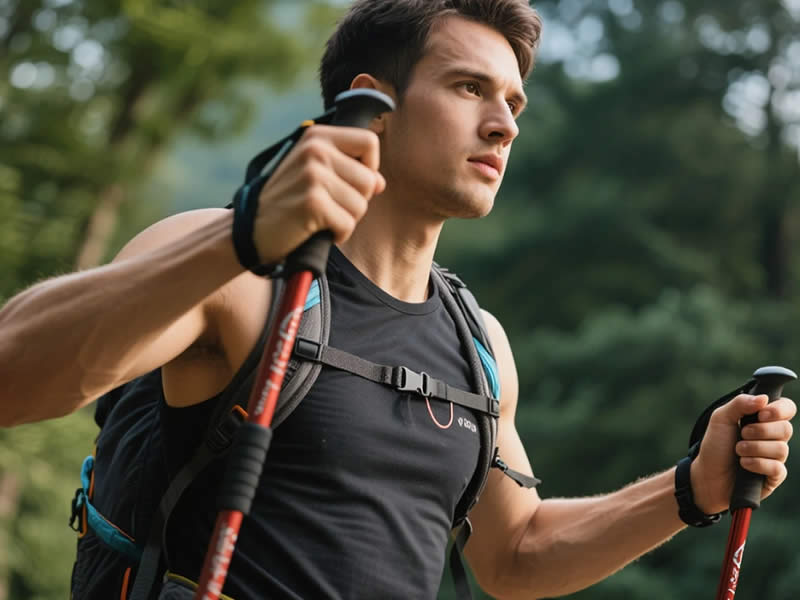
Walking without poles primarily uses the lower body muscles—the glutes, quadriceps, hamstrings, and calves. While these are large muscles, they are only a part of your total muscle mass. When you use poles, you recruit the upper body muscles—the latissimus dorsi, deltoids, pectorals, and triceps—to generate propulsion. This increases the total muscle mass engaged in the activity.
The heart rate response to exercise is proportional to the amount of muscle mass being used. Engaging more muscles means your heart has to pump more blood to supply oxygen to those muscles, which raises your heart rate. This is the fundamental physiological basis for the cardiovascular benefit of poles.
2. The "push" technique
The key to upper body engagement is the push—not just a passive planting of the pole, but an active, forceful push down and back. This push requires the contraction of the latissimus dorsi and the triceps, which are large, metabolically active muscles. The more you push, the more upper body muscle is activated, and the higher the heart rate response. As a source notes, "Poles help engage the core muscles, and your arms, shoulders, and upper back muscles are all engaged, raising the heart rate more."
3. Increased metabolic demand
The recruitment of upper body muscles increases the total metabolic demand of walking. Studies have shown that using trekking poles can increase caloric expenditure by 20‑40% compared to walking without poles at the same speed. This higher metabolic rate is reflected in a higher heart rate, which means your cardiovascular system is working more efficiently to deliver oxygen and nutrients to the active muscles.
What the research says
A 2020 study measured heart rate and perceived exertion in walkers using trekking poles on flat terrain. The researchers found that using poles increased heart rate by about 5‑10% compared to walking without poles at the same speed, while also reducing the rating of perceived exertion (RPE). This means participants were working harder (higher heart rate) but felt less effort, which is the definition of improved efficiency. The study concluded that poles are an effective tool for increasing cardiovascular demand without adding stress to the lower body.
Research on Nordic walking, which uses a similar pole technique but with a more pronounced arm swing, has shown even more substantial benefits. A 2018 meta‑analysis found that Nordic walking increased heart rate and VO₂ max (a measure of aerobic capacity) more than regular walking, while reducing the load on the knees. The key difference is the more forceful, continuous push of Nordic walking, which engages the upper body to a greater extent.
Perceived exertion: the paradox of feeling less effort while working harder
A key benefit of poles is the reduction in perceived exertion. Even though your heart rate is higher, the load is distributed across more muscle groups, so your legs don't feel as tired. This allows you to walk longer or at a faster pace without feeling more fatigued. The result is a more efficient cardiovascular workout.
As a meta‑analysis of over 40 studies on walking poles concluded, "Trekking poles can increase metabolic demand while reducing perceived exertion, making them a valuable tool for improving cardiovascular efficiency and reducing the risk of injury."
Practical guidance: maximising heart rate efficiency with poles
1. Use two poles for symmetrical engagement
Using two poles ensures that the upper body load is balanced, preventing asymmetrical strain and allowing you to maintain a consistent heart rate response.
2. Use the "push" technique
The key to upper body engagement is an active push. Plant the pole ahead of you and push down and back with each plant. This engages the lats, triceps, and deltoids, raising your heart rate.
3. Maintain a brisk cadence
Aim for a cadence of 120‑140 steps per minute. This rhythm ensures that your heart rate remains elevated and that you are consistently engaging your upper body. A quicker cadence also encourages a more efficient gait.
4. Focus on form
Keep your grip relaxed and use the wrist straps to bear the load. This allows you to focus on the push, rather than gripping the pole tightly, which can cause fatigue and reduce the effectiveness of the upper body engagement.
5. Vary the terrain
The heart rate benefit is most pronounced on flat or gentle terrain. On steep ascents, your heart rate is already high from leg work, and the poles have a smaller additional effect. For the best cardiovascular workout, include long, flat sections in your route.
Comparison to other cardiovascular exercises
The heart rate response to pole walking is similar to that of brisk walking or light jogging, but with much less impact on the joints. This makes it an excellent choice for individuals who want a high‑intensity cardiovascular workout without the risk of knee or ankle injury.
| Activity | Heart Rate Increase | Joint Impact | Upper Body Engagement |
|---|---|---|---|
| Walking (no poles) | Moderate | Low | Minimal |
| Walking (with poles) | Moderate‑High | Very Low | High |
| Nordic Walking | High | Very Low | Very High |
| Jogging | High | High | Minimal |
Important caveats
1. Not a replacement for high‑intensity exercise
While poles can raise your heart rate, they may not be sufficient for high‑intensity interval training (HIIT) or for individuals seeking maximum cardiovascular conditioning. They are a moderate‑intensity activity.
2. Requires proper technique
The cardiovascular benefit depends on upper body engagement. If you simply drag the poles or use them lightly, you won't get the same heart rate response. Actively push.
3. Medical considerations
If you have heart or respiratory conditions, consult your doctor before using poles for cardiovascular exercise. The increased heart rate may not be appropriate for everyone.
The verdict
Trekking poles can significantly improve heart rate efficiency by engaging the upper body muscles, increasing the metabolic demand and cardiovascular response at the same walking speed. Research shows that using poles can increase heart rate by 5‑10% while reducing perceived exertion, making them a valuable tool for improving cardiovascular fitness without adding stress to the lower body. For healthy walkers, poles are a proven way to increase caloric burn, improve cardiovascular efficiency, and enhance overall fitness, all while reducing joint strain. Happy—and efficient—walking!




