




Do trekking poles help with stability while fly fishing from a riverbank in the UK?
Yes—trekking poles significantly improve stability while fly fishing from a UK riverbank. The uneven, often muddy and slippery banks of British rivers (such as the Test, Usk, or Welsh Dee) can be treacherous, especially when wading, stepping back from the water's edge, or playing a fish. A trekking pole provides a stable third point of contact, reducing the risk of falls and giving the angler greater confidence to focus on their cast and the rising fish. This article explores the specific benefits, offers practical advice for use, and discusses the limitations of using a pole in a fishing context.
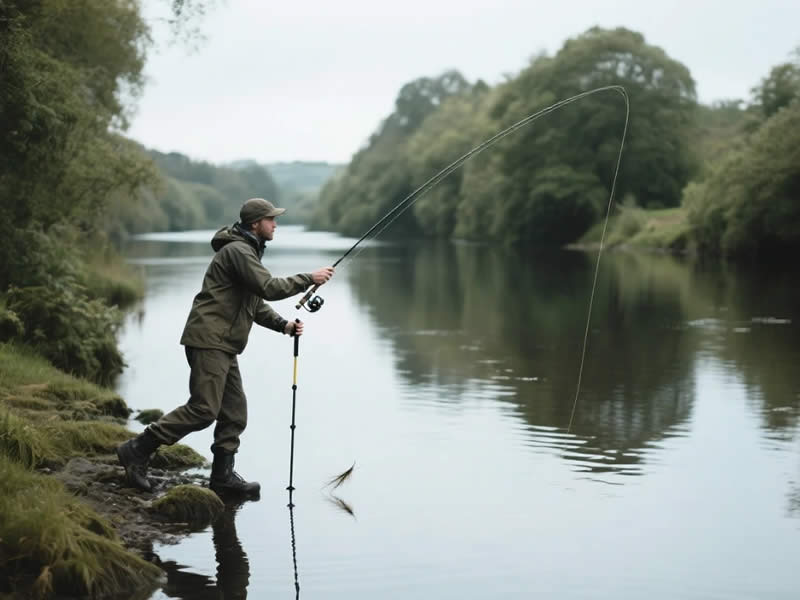
The UK riverbank hazard
UK riverbanks are rarely flat, stable platforms. They are often:
- Muddy: After rain, the clay soils of English rivers become slick, making footing treacherous.
- Unstable: Pebbles, stones, and tree roots create an uneven surface, especially on steep banks.
- Slippery: Wet grass and moss can be as slippery as ice, particularly when you are wearing waders or heavy boots.
- Collapsible: The edges of riverbanks can be undercut, and a step too close to the edge can result in a sudden, unexpected drop.
A fall on a riverbank can lead to a twisted ankle, a broken rod, or, worse, a fall into the river.
How a trekking pole helps
1. Provides a third point of contact
When you are standing on a riverbank, you have two feet on the ground. When you lean forward to cast, step onto a wobbly stone, or reach out to net a fish, your centre of gravity shifts. A trekking pole, planted firmly on the ground, adds a third point of contact. This creates a tripod effect, dramatically increasing your stability and reducing the risk of a sudden slide or fall.
2. Acts as a brace for casting and playing fish
When you are playing a fish—especially a strong, fighting fish like a salmon or a sea trout—you need to be able to move your rod hand freely to keep the line tight. A trekking pole behind you acts as a brace, taking some of your body weight and preventing you from leaning too far back and falling into the river.
3. Allows you to probe the ground ahead
Before stepping onto a stone or into a submerged hole, you can use the pole to test the firmness of the ground. A gentle probe with the tip can reveal if the ground is solid or if it is a soft, sinking patch of mud or a deep hole. This is especially useful when you are wading or when you are trying to find a safe footing on a rocky bank.
4. Supports you when landing a fish
When you lean forward over the water to net a fish, your weight shifts forward. A pole planted on the bank behind you acts as a counter‑balance, preventing you from toppling into the river. This is a significant safety benefit, especially on steep banks.
5. Reduces fatigue
Carrying a heavy camera bag or a fishing pack can be tiring. A trekking pole distributes some of the weight to the ground, reducing the load on your legs and allowing you to stand for longer periods without fatigue. This is particularly useful for stillwater anglers who stand for hours.
Practical considerations for fly fishing
Use one pole, not two
For fly fishing, you need one hand for the rod and one hand for the line. A trekking pole occupies the hand that would otherwise be holding the rod. The best approach is to use one pole—the non‑casting side—and keep your rod hand free. If you use two poles, you will have nowhere to put the second one when you need to use both hands for the rod.
Choose a pole with a rubber ferrule
The standard carbide tip of a trekking pole can scratch or damage the bank, and the metal can spook fish. A rubber ferrule (tip cover) is essential for bank use. It protects the bank, provides better grip on smooth stones, and is quieter when you plant it. A cork or rubber‑coated grip is also preferable, as it is more comfortable to hold for long periods.
Look for a folding or compact pole
If you are wading, you want a pole that can be easily collapsed and attached to your wading belt or pack when not in use. A folding Z‑pole or a 4‑section telescopic pole is ideal. It packs down small and can be quickly deployed when needed.
Alternatives: dedicated wading staff vs. trekking pole
A trekking pole is not a dedicated wading staff. Wading staffs are designed for underwater use: they are longer, have a larger, flatter base, and are designed to withstand the pressure of water flow and the weight of a fully wading angler.
- Trekking pole: Best for bank use, providing a stable, lightweight brace. Not suitable for deep water wading.
- Wading staff: Designed for wading in rivers and streams. They are stiffer, heavier, and have a wide base to prevent sinking into soft sediment.
Verdict: If you are wading in water deeper than your knees, use a dedicated wading staff. If you are on the bank, a trekking pole is a convenient and effective tool.
Safety tips for using a pole in fly fishing
- Secure the pole: When not in use, attach the pole to your wading belt or pack using a carabiner or a strap. It is easy to drop a pole in the water, and the current will carry it away.
- Do not use the pole as a net handle: The lock and tip of a trekking pole are not designed to support the weight of a net and a fish. Use a proper net handle.
- Check the lock: If you are using a telescopic pole, ensure the flick‑lock or twist‑lock is tight. A loose lock can cause the pole to collapse when you lean on it, causing a sudden fall.
- Be aware of overhead lines: When casting, be careful not to hook the pole tip or the line. Use a smooth, controlled motion.
Summary table: trekking pole vs. wading staff
| Feature | Trekking Pole | Wading Staff |
|---|---|---|
| Primary use | Bank stability, walking support | Underwater stability, wading |
| Length | Adjustable, typically 110‑145cm | Fixed or limited adjustment |
| Base | Small carbide tip or rubber ferrule | Wide, flat base (often with a flange) |
| Weight | Light (~250‑300g) | Heavy (~500‑800g) |
| Suitability for UK fishing | Excellent for bank work | Essential for wading |
The verdict
Trekking poles are a valuable tool for fly fishing from a UK riverbank. They provide essential stability on uneven, slippery ground, act as a brace for playing fish, and reduce the risk of a fall when landing a fish. Use a single pole on the non‑casting side, fit a rubber ferrule to protect the bank and reduce noise, and ensure the pole is securely stowed when not in use. However, for wading, a dedicated wading staff is a safer and more effective tool. For bank work, a good trekking pole is a smart addition to any fly fisherman's kit—it's one of the cheapest ways to improve safety and comfort on the water.




