




Are trekking poles useful for clearing spiderwebs on early-morning summer walks?
Yes—trekking poles are remarkably effective for clearing spiderwebs on early‑morning summer walks. They are long enough to reach webs that would otherwise hit your face, and they allow you to clear a path ahead without breaking your stride or slowing your pace. By extending your pole and sweeping it gently in a figure‑eight motion, you can collect the webs on the shaft, leaving the path clear for you and any walkers behind you. This article explores the technique, the benefits, and the etiquette of using your poles for this purpose.
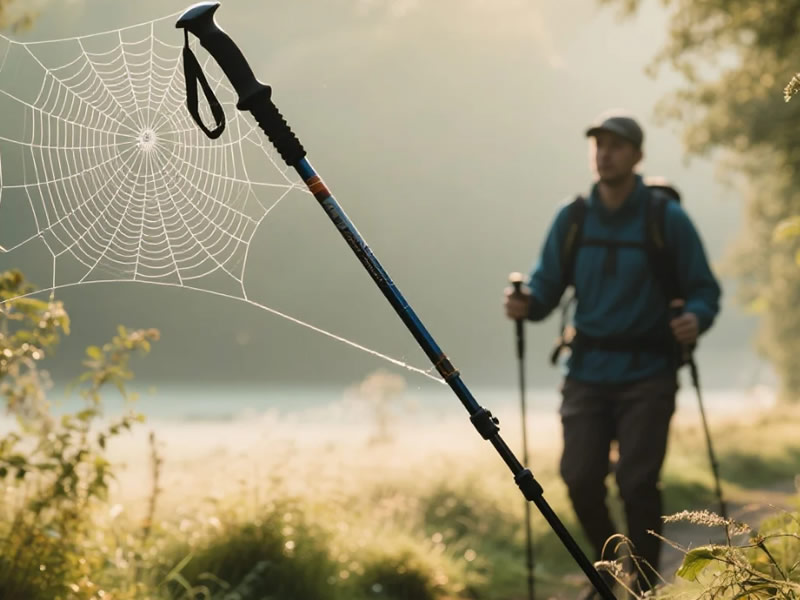
Why spiderwebs are a hazard on early‑morning walks
Summer mornings are prime time for spider activity. Overnight, spiders (especially orb‑weavers) have spun elaborate webs across paths, between bushes, and even across the trail at face height. By dawn, these webs are at their strongest and most visible—but they are still a nuisance for the early walker.
A face‑full of spiderweb is not just unpleasant; it can be startling, causing you to flinch or stumble on uneven ground. For those with arachnophobia, it can be a genuine source of anxiety. Clearing the path ahead with a pole allows you to tackle this issue proactively, before the web reaches you.
How to use a trekking pole for web clearing
1. Extend the pole fully
If your pole is telescopic, extend it to its full length. This gives you the maximum reach, allowing you to clear webs that are high above head height. A longer pole also means you can see the web before you walk into it.
2. Hold the pole horizontally
Hold the pole with both hands, like a broom, across your body. Swing it gently from side to side in a wide, sweeping arc. The shaft will collect any webs it encounters, gathering them like a lint roller.
3. Use a figure‑eight motion
A figure‑eight motion (a horizontal infinity symbol) is the most effective technique. It catches webs at multiple heights and covers a wider path. This motion also prevents the web from simply sliding off the end of the pole.
4. For low webs, point the tip down
If the web is low (ankle or knee height), point the pole tip downwards and sweep the ground. This clears webs that might otherwise catch on your boots or gaiters.
5. Check the pole regularly
After a few minutes of walking, you will notice a layer of sticky silk and tiny spiders accumulating on the pole. Flick it off gently—don't crush the spiders—or wipe it with a cloth. A clean pole is more effective.
Why use a trekking pole over other options?
1. It's always to hand
A trekking pole is already in your hand. You don't need to stop to pick up a stick; you just extend it and get sweeping.
2. It's long enough
The extended pole (typically 1.2‑1.5 metres) is longer than a walking stick or a branch you might find on the ground. This means you can clear webs that would otherwise hit your face.
3. It's precise
You can target webs with pinpoint accuracy. If you see a web ahead, you can angle the pole to catch it without affecting your walking rhythm.
4. It's reusable
A stick might be left behind; your pole is carried with you and is ready for the next section of the trail.
The etiquette of web clearing
1. Don't swing aggressively
A gentle, sweeping motion is effective and doesn't startle other walkers or the wildlife. A sudden, forceful swing can send a web flying onto a fellow walker.
2. Respect the spiders
Most spiders are harmless and are simply doing their job—controlling insect populations. When you clear a web, try to do it so that the spider falls to the ground safely, rather than being crushed by the pole. A gentle flick is sufficient.
3. Leave no trace
If you clear a web, try to leave the path as you found it. Avoid trampling the spider or disturbing the surrounding vegetation.
The environmental benefit
By using your trekking pole to clear webs, you are not just protecting your own face—you are also clearing the path for others. A well‑cleared trail is a more pleasant experience for the next walker. It also reduces the chance of someone else accidentally disturbing a spider's home.
A personal anecdote
I recall a summer walk in the Cotswolds where the trail was so thick with webs that it was like walking through a horror film. Every few steps, another web would hit my face. I switched from a single pole to using both poles as a "web clearing shield": one held horizontally across my chest and the other pointing forward. The webs collected on the poles, and I walked through the section without a single strand hitting my face. The poles were then cleaned by tapping them against a tree, and I was ready to move on.
When not to use a pole for web clearing
- In extreme heat: The resin on the web can become sticky, and the pole can pick up a lot of debris. It's best to use a separate cloth to wipe it clean.
- On a steep, slippery descent: Focus on using the poles for balance, not for web clearing.
- If you have a fear of spiders: Using a pole to touch a web can be even more frightening than walking into one. If you have arachnophobia, it's best to walk with a friend who can do the clearing, or simply avoid early‑morning walks.
The verdict
Trekking poles are not just useful—they are the ideal tool for clearing spiderwebs on early‑morning summer walks. They are long enough to reach high webs, can be swept in a precise figure‑eight motion, and are always to hand. A few gentle sweeps can keep you and the path ahead clear of webs, allowing you to enjoy the beauty of a summer morning without the annoyance of a face‑full of silk. It's a small investment of effort that pays big dividends in comfort. So next time you head out at dawn, extend your pole and become the master of the trail.




