




Can I use trekking poles to help pitch a tarp over a picnic table in the rain?
Yes—trekking poles are an excellent tool for pitching a tarp over a picnic table in the rain. They provide a quick, lightweight, and packable solution that eliminates the need to carry dedicated poles or seek out perfectly positioned trees. For a campsite picnic table, a well-pitched tarp using your poles can transform a damp, unusable area into a dry cooking and dining space. This article provides a step-by-step guide to the most effective methods, explains the critical factors for stability in wet conditions, and offers safety advice.
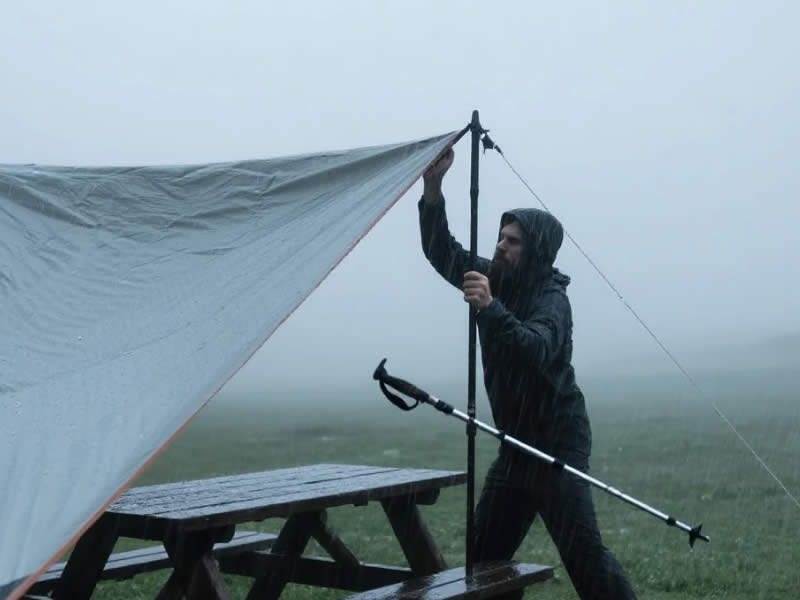
Why this is a great idea
Picnic tables are often in the middle of open fields, far from convenient trees. Carrying separate, heavy poles to support a tarp defeats the purpose of lightweight camping. Your trekking poles are already in your hand—they are the ideal height (typically 1.1-1.4m) for creating a shelter that allows you to stand or sit comfortably. In the rain, the ability to quickly erect a tarp over a table is a game-changer for comfort.
Method 1: The A-Frame (two poles)
This is the simplest and most stable method for a rectangular picnic table.
Setup
- Positioning: Place one trekking pole at each end of the table (or at opposite corners), roughly in line with the table's centre.
- Height: Extend both poles to the same height—around 1.2-1.4 metres. This gives you enough clearance to stand under the tarp.
- Ridge Line: Run a cord (a lightweight guy line) from the top of one pole to the top of the other. This ridge line will support the tarp's centre. The poles are now just holding the ends of the ridge line, not supporting the tarp's full weight.
- Drape the tarp: Drape your tarp over the ridge line. Adjust it so the overhangs are roughly equal on each side.
- Anchoring: Secure the four corners of the tarp to the table itself, to the ground (using pegs), or to heavy objects on the table (like a backpack or a water container). If using the table, loop a short bungee cord or guy line around the table leg.
Why it works
The ridge line carries the majority of the tarp's weight, preventing the poles from being pushed sideways by a wet, heavy tarp. The poles only need to provide vertical support, which they are designed to do.
Method 2: The Lean-to (single pole + picnic table)
This method uses the table itself as one of the supports and uses a single pole to create a sloped roof.
Setup
- Pole placement: Place one pole on the windward side of the table (to block the rain) or on the upwind side.
- Height: Extend the pole to about 1.2 metres.
- Tarp placement: Drape the tarp over the pole so that one half of the tarp hangs over the table and the other half slopes down to the ground. The high point is at the pole; the low point is at the back of the table.
- Anchoring: Secure the high side of the tarp to the pole and the low side to the ground (with pegs) or to the table's legs.
Why it works
This is a quick, minimalistic setup for a single person. It provides a dry area over the table and a windbreak, but it is less spacious than the A-frame.
Method 3: The "Tarp as a tent" (four poles – if you have them)
If you have four poles (or share poles with a friend), you can create a four-post shelter that completely covers the table and the surrounding area.
Setup
- Poles: Place a pole at each corner of the tarp.
- Height: Extend all poles to the same height (around 1.4m).
- Drape the tarp: Pull the tarp taut over the four poles.
- Anchoring: Secure the corners to the ground with pegs.
This is the most stable and spacious setup but requires the most gear.
Critical factors for pitching in the rain
1. Water run-off
The tarp must be angled so that water runs off, not pools. A flat, horizontal tarp will collect water, become heavy, and eventually collapse. The A-frame (with a ridge line) naturally provides this angle. For a lean-to, ensure the slope is steep enough (at least 20°) for water to run off.
2. Pole stability in soft ground
In the rain, the ground is soft. The carbide tip of a trekking pole can sink, causing the pole to tilt and the tarp to sag. To prevent this:
- Place a small flat stone or a piece of wood under the tip to distribute the load.
- Shorten the pole slightly to compensate for the sinking.
3. Tarp tension
A wet tarp is significantly heavier than a dry one. Adjust the guy lines (or bungee cords) to maintain tension as the tarp gets wet. A sagging tarp will collect water and can collapse. Check the tension after 5-10 minutes and tighten if necessary.
4. Wind
Rain is often accompanied by wind. Position the tarp so that the open sides are not facing the wind. Use pegs to secure the tarp to the ground, even if it's over the table.
Safety warnings (critical in the UK)
1. Lightning hazard
Do not use metal trekking poles in a thunderstorm. A metal pole acts as a lightning rod. If you hear thunder or see lightning, collapse your poles and seek shelter in a building or a vehicle. A carbon fibre pole, while not as conductive, can still be a danger in a strike.
2. Weight loading
A tarp loaded with rain can be very heavy. A standard silnylon tarp (e.g., a lightweight 3x3m tarp) is fine, but a heavy, thick tarp (e.g., a canvas tarp) can put too much stress on the pole's locking mechanism. Use a lightweight tarp.
3. Fire hazard
Never place a tarp near an open fire. Wet tarps can drip water onto a fire, creating a steam burn hazard. Also, the tarp could catch fire.
Aftercare: drying and cleaning
After a wet pitch, your poles may be wet and muddy. Wipe the shafts clean with a cloth, extend the poles, and leave the locks open to allow them to dry thoroughly. A dry pole is a happy pole.
Summary table: method comparison
| Method | Poles Needed | Stability | Space | Speed of Setup | Best For |
|---|---|---|---|---|---|
| A-frame | 2 | High | Spacious | Medium | Groups, extended rain |
| Lean-to | 1 | Moderate | Compact | Quick | Solo, quick shelter |
| Four-pole | 4 | Very High | Very Large | Medium | Groups with multiple poles |
| Ridge line + 1 pole | 1 | Moderate | Moderate | Quick | Solo with a ridge line to a tree |
The verdict
Trekking poles are an outstanding tool for pitching a tarp over a picnic table in the rain. The A-frame method, using two poles and a ridge line, is the most stable and practical for most campers. A single pole can also be used for a quick lean-to shelter. By considering water run-off, pole stability, and tension, you can create a dry, comfortable space to cook and eat, even in the worst British summer weather. Just remember to avoid using metal poles in a lightning storm and to dry your gear afterwards.




