




Can trekking poles be used as a makeshift clothesline between trees in a campsite?
Yes—trekking poles can be used as a makeshift clothesline support between trees, but they are not ideal as the line itself. The primary role of the poles should be to hold up a separate cord (paracord or guy line), not to bear the tension of the line themselves. Using the poles as the direct line is a common mistake that can easily bend the shaft or damage the locking mechanism. This article explains the safe way to use your poles for drying clothes, the risks to avoid, and the better alternatives available.
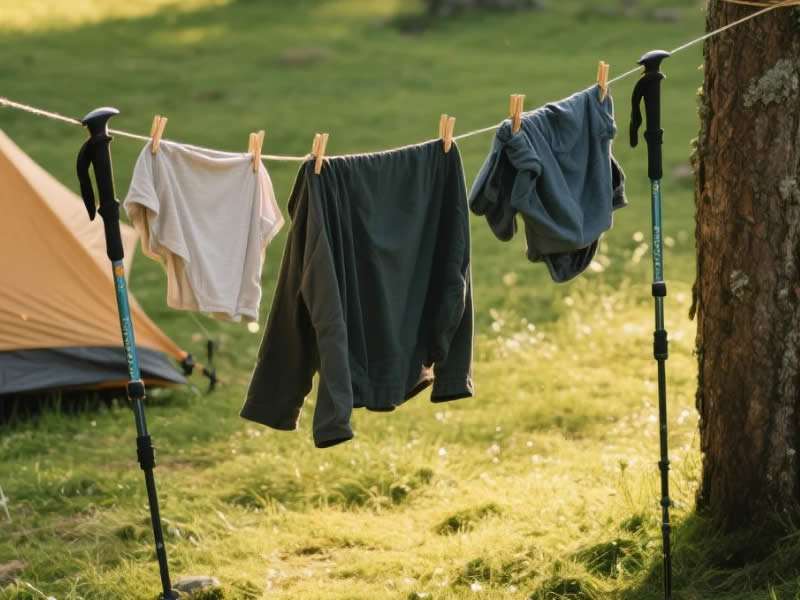
The safe method: poles as supports, not as the line
The most common error is to tie a cord directly to the pole's shaft and string it between two trees. This places a lateral (sideways) force on the pole—the same force that bends poles. Instead, you should use the poles as vertical supports that hold a separate line.
Step‑by‑step setup
- Find two trees: Choose two trees that are roughly 3‑5 metres apart, at a comfortable height for hanging clothes (around 1.5‑2 metres).
- Prepare your line: Use a length of paracord or a dedicated lightweight clothesline. Do not use the pole itself as the line.
- Attach the line to the trees: Tie one end of the cord around one tree (using a tree‑friendly strap or a wide webbing to protect the bark). Then, run the cord to the other tree.
- Use the poles to lift the line: Place one pole against each tree, with the handle touching the trunk. Tie the cord to the pole's handle or wrist strap, then lift the pole to raise the line. The pole acts as a vertical support, holding the line at the desired height.
- Secure the poles: The poles are not anchored to the ground; they are held in place by the tension of the cord. Ensure the cord is tight enough to hold the poles upright but not so tight that it bends them.
Alternative: Single‑pole clothesline
If you only have one tree (or a sturdy post), you can use a single pole:
- Plant the pole vertically in the ground (or against a rock).
- Tie one end of the cord to the tree and the other end to the pole's handle.
- The cord slopes down from the tree to the pole, creating a line that slopes for water run‑off.
The critical risks (what can go wrong)
1. Bending the pole
The biggest risk is lateral force. If you tie a line directly to the pole and pull it tight, the pole will be subjected to a sideways pull. This can:
- Bend aluminium poles: The shaft will bow, and if the force is strong enough, it may bend permanently.
- Snap carbon fibre poles: Carbon is brittle under lateral stress; a sudden pull can cause a splintering fracture.
2. Damaging the locking mechanism
Flick‑locks (lever‑locks) are designed for vertical compression, not lateral tension. A strong sideways pull can:
- Loosen the cam: The screw can back out, causing the pole to collapse.
- Crack the plastic lever: Repeated tension can stress the plastic housing.
3. Sinking into soft ground
If you are using the pole as a vertical support, the tip may sink into soft earth, causing the line to sag. This is particularly a problem on damp campsites. Use a stone or a wide base to distribute the load.
Better alternatives
1. A dedicated clothesline
A lightweight nylon clothesline with built‑in loops (e.g., the Sea to Summit Clothesline) costs less than £10 and is specifically designed for this purpose. It clips onto trees, has loops for hanging clothes, and can be tensioned without any risk to your poles.
2. Use the trees directly
If the trees are the right distance apart, you can tie the line directly to the trunks using a tree‑friendly strap (a wide webbing to protect the bark). This is the simplest and safest method.
3. Use a fallen branch
A fallen branch can be wedged between two trees or leaned against a trunk. It's free, and if it breaks, you haven't lost anything.
Camping etiquette
1. Protect the trees
When tying a line to a tree, never use a thin cord directly around the trunk. The friction can damage the bark, potentially killing the tree. Use a wide webbing strap (e.g., a 1‑inch webbing) to distribute the load.
2. Leave no trace
Remove the line and poles when you leave. Do not leave a line tied around a tree when you depart.
3. Check for wildlife
If you are drying clothes, check that the line is not near a bird's nest or a bat roost.
Summary table
| Method | Pros | Cons |
|---|---|---|
| Poles as vertical supports + separate line | Lightweight, uses existing gear | Risk of lateral force on poles |
| Dedicated clothesline | Purpose‑built, safe for trees | Extra gear to carry |
| Direct tree line | Simple, no extra gear | Requires webbing for tree protection |
The verdict
Using trekking poles as a clothesline support between trees is possible but risky. The safest approach is to use the poles as vertical supports for a separate cord (paracord or a dedicated line), rather than using the poles themselves as the line. This avoids the lateral force that can bend or snap a pole. A dedicated lightweight clothesline is a far better investment—it is cheap, light, and designed specifically for the task. If you must use your poles, treat them gently, use a separate line, and never tie the cord directly to the shaft under tension. Your poles will last longer, and your clothes will stay dry.




