




What is the correct length of trekking poles for a 9-year-old climbing Snowdon?
For a 9‑year‑old climbing Snowdon, the correct pole length typically falls between 80 and 95 cm. This is a guideline, not a fixed rule—the optimal length depends on the child's height, arm length, and walking style. The most reliable method is to adjust the poles so that, when the child stands upright with the tip on the ground, their elbow is at a comfortable 90° angle. This article explains the step‑by‑step adjustment process, terrain‑specific modifications, and practical considerations for a safe and enjoyable climb.
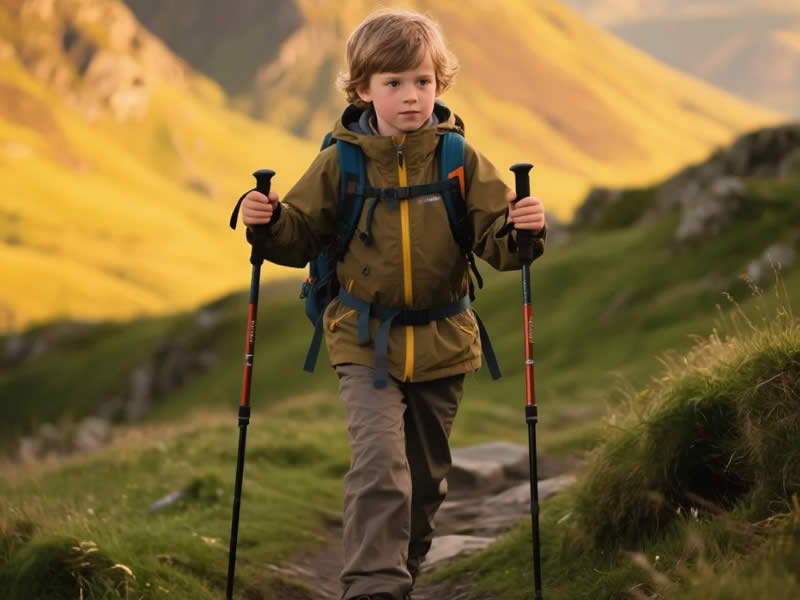
Why correct pole length matters for a child
A correctly adjusted pole provides stability, reduces strain on the knees (especially on descents), and helps the child maintain a steady rhythm. An incorrectly adjusted pole can cause:
- Shoulder fatigue: A pole that is too long forces the child to reach upwards, straining the shoulder muscles.
- Poor posture: A pole that is too short encourages hunching, which can lead to back pain.
- Inefficient walking: A poorly adjusted pole does not provide the support that the child needs, making the climb harder.
The height of a 9‑year‑old can vary significantly. According to UK growth charts, a 9‑year‑old is typically between 130 cm and 150 cm tall. This variation means you cannot rely on a single number—you must adjust the poles to the individual child.
The golden rule: the 90° angle
The most reliable starting point is the 90° angle rule.
- Stand upright: The child should stand on a flat, level surface, wearing the walking boots they will use on the climb.
- Place the tip on the ground: Hold the pole vertically, with the tip just touching the floor.
- Adjust the length: Extend or collapse the pole until the child's elbow is at a roughly 90° angle. The upper arm should hang vertically, and the forearm should be horizontal.
- Check the grip: The child should hold the pole with a relaxed grip. The wrist strap should be adjusted so that the strap sits across the back of the hand, not across the fingers.
This 90° angle gives the most efficient arm position for walking on flat or gently rolling terrain.
Terrain‑specific adjustments for Snowdon
Snowdon is not a single uniform slope. The terrain varies from steep ascents (the Pyg Track or Miner's Track) to long descents. The 90° angle is only the starting point. For different sections, you need to adjust the length dynamically.
1. Steep ascents (uphill)
- Shorten the poles by 3‑5 cm: When climbing a steep hill, a shorter pole allows the child to place the pole closer to their body and push upwards without reaching forwards. This reduces shoulder strain and makes the climb more efficient.
- The effect: A shorter pole encourages a more upright posture, reducing the forward lean that can cause back ache.
2. Steep descents (downhill)
- Lengthen the poles by 3‑5 cm: On a descent, a longer pole allows the child to plant the pole ahead of their foot and use it as a brake. This reduces the impact on their knees and helps them control their speed.
- The effect: A longer pole allows the child to keep their torso upright, preventing a forward lean that could lead to a fall.
3. Side‑slopes (traversing)
- Adjust one pole longer, one shorter: If the path is traversing a hillside, the uphill pole should be shorter and the downhill pole longer. This keeps the child's torso level and prevents them from leaning into the slope.
How to measure the correct length without a tape measure
If you don't have a tape measure, you can use the child's arm as a guide.
- Have the child stand upright with their arm hanging naturally.
- The top of the handle should be at roughly the same height as their wrist when the arm is hanging straight down.
- This is a quick, rough check—it is not as precise as the 90° angle method, but it can be useful in the field.
Practical advice for buying poles for a 9‑year‑old
- Choose adjustable telescopic poles: Fixed‑length poles are not suitable for a growing child. Adjustable poles (which can be extended from 80 cm to 110 cm) will last for several years.
- Look for lightweight poles: Children have less upper‑body strength. A lightweight aluminium pole (around 200‑250g) is ideal.
- Check the grip: Cork grips are the most comfortable and wick moisture. Foam grips are lighter but can become slippery.
- Involve the child in the adjustment: Let the child hold the pole and adjust it themselves. This builds their confidence and ensures they are comfortable with the length.
Techniques for adjusting poles on the mountain
- Mark the pole: Use a permanent marker to mark the 90° length on the shaft. This allows you to quickly reset the poles to the flat‑ground length after a steep ascent or descent.
- Set a reminder: Before you start a steep descent, check the pole length. It is easy to forget to adjust them.
- Practice at home: Before the big day, practice adjusting the poles in the garden. This will help the child understand how to do it independently.
A note on wrist straps
The wrist strap is often overlooked but is essential for correct pole technique.
- The strap should be adjusted so it is snug but not tight: The strap should sit diagonally across the back of the hand, not across the fingers.
- Teach the child to use the strap correctly: The strap is designed to transfer the load from the grip to the arm. The child should not grip the pole tightly; they should let the strap do the work.
Summary checklist for Snowdon
- Height: Approx. 130‑150 cm.
- Flat‑ground length: 80‑95 cm (90° angle rule).
- Uphill adjustment: Shorten by 3‑5 cm.
- Downhill adjustment: Lengthen by 3‑5 cm.
- Side‑slope: Uphill pole shorter, downhill pole longer.
The verdict
For a 9‑year‑old climbing Snowdon, the correct pole length is not a single number—it is a dynamic adjustment based on the terrain. Start with the 90° angle rule (80‑95 cm) on flat ground. Then, shorten the poles for steep ascents and lengthen them for steep descents. Involve the child in the adjustment process, and make sure they are comfortable with the wrist strap. With the correct length, your child will have the support they need to conquer the mountain with confidence and safety. Happy climbing!




