




Can a child use adult trekking poles if they are shortened to the minimum?
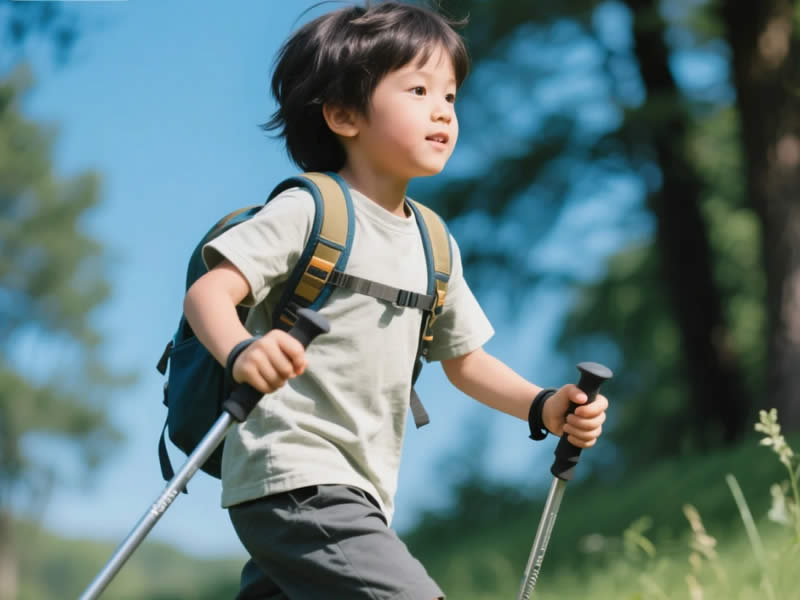
No—shortening adult poles to their minimum is not a good solution for a child. While you can reduce the length, the poles will still be too long and poorly proportioned for a child's height and arm length. The main issues are the grip size, weight, and strap fit—all of which are designed for an adult's hand and strength. This article explains why adult poles are unsuitable, the safety risks involved, and the far better alternatives available.
Why adult poles don't fit a child
1. Grip size (the biggest issue)
The grip of an adult pole is designed for a hand with a circumference of 18‑20 cm (approx. 7‑8 inches). A child's hand is significantly smaller—typically 13‑15 cm for a 9‑year‑old. When a child holds an adult grip, they cannot close their fingers around it properly.
The effect:
- Forced grip: The child has to stretch their fingers to reach the grip, which is tiring and can cause discomfort.
- Poor control: A grip that is too large reduces the child's ability to control the pole, especially on uneven terrain. The pole can twist in the hand.
- Fatigue: Over time, the extra effort to grip a large pole leads to hand and wrist fatigue, which can discourage the child from continuing the walk.
Even if you shorten the pole to its minimum length, the grip size remains unchanged. It is the grip that is the primary barrier.
2. Wrist strap fit
The wrist strap on adult poles is designed for an adult's wrist (typically 16‑18 cm circumference). A child's wrist is much smaller. Even when adjusted fully, the strap will be too loose.
The effect:
- Lack of load transfer: The strap is designed to transfer the load from the hand to the arm. If it is loose, it does not function properly, and the child will have to grip the handle tightly, increasing fatigue.
- Safety risk: A loose strap can cause the pole to slip out of the hand, potentially causing a fall or loss of balance.
3. Weight
Adult poles typically weigh 250‑300 g per pole. Children's poles are lighter—usually 150‑200 g. A heavier pole is tiring to lift and swing, especially for a child's smaller muscles. The extra weight can lead to premature fatigue and a dislike of using poles.
4. Length range
Even at their minimum length, many adult poles are still too long for a child. A 3‑section telescopic adult pole often collapses to 60‑70 cm, while a child's pole typically has a range of 70‑100 cm. For a younger child (e.g., 8‑10 years old), the correct length may be as short as 80‑85 cm—a length that many adult poles cannot reach, even when fully collapsed.
5. Locking mechanism
If an adult pole is shortened to its absolute minimum, the locking mechanism may be at the very end of its range. This can reduce its security—the lock may not clamp as firmly, increasing the risk of the pole collapsing under load.
When shortening adult poles might be acceptable (very rare)
In a genuine emergency or on a very short, flat walk, you might get away with using adult poles for a child, provided:
- The child is older (e.g., 14‑15 years old) and close to adult size.
- The poles are the lightest available (e.g., carbon fibre).
- You can adjust the wrist strap by tying a knot to shorten it (though this is not ideal).
- The walk is short and on flat, even ground.
For any longer walk or any walk on uneven terrain, this is not a safe option.
The better alternative: youth‑specific trekking poles
Several brands make excellent youth‑specific poles that are designed for children's hands and bodies.
Key features:
- Narrow grips: Diameter is smaller, fitting a child's hand comfortably.
- Lightweight: 150‑200 g per pole.
- Length range: 70‑100 cm, perfect for a growing child.
- Adjustable wrist straps: Designed for smaller wrists.
Top youth models:
- Leki Micro RCM: A dedicated children's pole with a narrow grip, lightweight aluminium, and a folding design.
- Black Diamond Trail Back: A robust, adjustable pole with a small, child‑friendly grip and flick‑lock.
- Komperdell Junior: A telescopic pole with a narrow cork grip.
- Decathlon Forclaz (children's range): A budget option with a small foam grip and adjustable aluminium shaft.
Where to buy: Decathlon UK, Trekitt, Cotswold Outdoor, Leki UK, Amazon UK.
If you absolutely must use adult poles (a last‑resort plan)
If buying children's poles is not possible (e.g., you are on a trip and forgot them), here is a damage‑limitation strategy:
- Shorten them fully: Collapse the poles to their minimum length.
- Check the elbow angle: Have the child stand upright with the tip on the ground. Their elbow should be at roughly 90°. If the pole is too long, it is not safe.
- Use a grip wrap: Wrap a layer of foam tape or a soft cloth around the grip to slightly increase its diameter and provide a softer surface. This does not reduce the grip size, but it can make it more comfortable.
- Adjust the strap: If the strap is too long, you can tie a small knot in the strap to shorten it. This is not ideal, but it is better than a loose strap.
- Keep the walk short: Use the poles on a flat, short section of the walk. For anything longer, children's poles are essential.
Summary table: adult vs. children's poles for a child
| Feature | Adult Poles (Shortened) | Youth-Specific Poles |
|---|---|---|
| Grip size | Too large | Small, child-friendly |
| Wrist strap | Too loose | Correctly sized |
| Weight | Heavy (250‑300g) | Light (150‑200g) |
| Length range | Limited (often too long) | Correct (70‑100cm) |
| Safety | Risk of poor control, falls | Safe and comfortable |
The verdict
No, a child should not use adult trekking poles, even when shortened to the minimum. The grip size, weight, and strap fit are all unsuitable for a child's body, leading to discomfort, fatigue, and potential safety risks. Investing in a pair of youth‑specific poles (from brands like Leki, Black Diamond, Komperdell, or Decathlon) is a small investment that will make a huge difference to the child's enjoyment, safety, and confidence on the trail. If you are on a budget, consider second‑hand poles or ask friends with older children if they have a pair to lend. For any serious walking, the right equipment is essential—and a proper fit is the foundation of that.




