




Can trekking poles help an elderly person stand up from a muddy seat?
Yes—trekking poles can assist an elderly person in standing up from a muddy seat, but only under specific conditions and with significant precautions. A trekking pole can provide an extra point of support, reducing the load on the knees and making the act of rising easier. However, the muddiness of the ground, the user's upper‑body strength, and the pole's stability are critical factors. This article explores the benefits, the risks, the safety measures, and the better alternatives available.
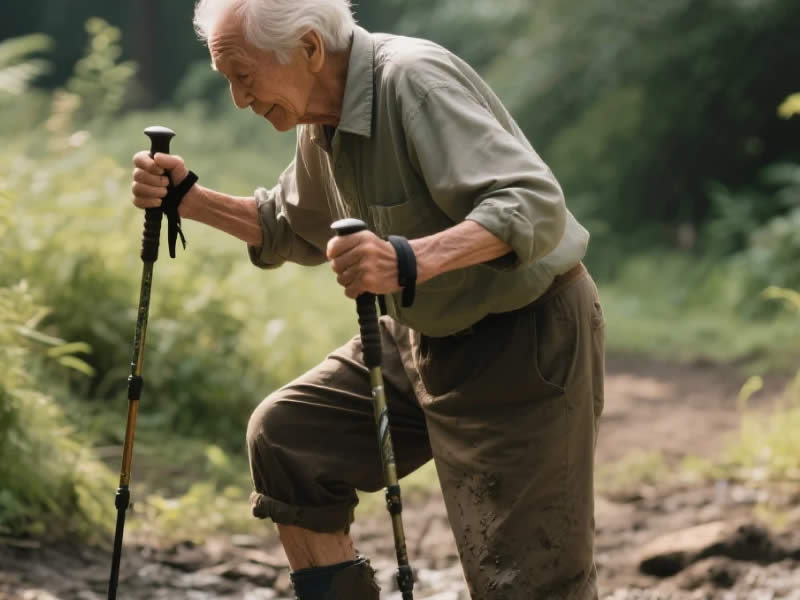
The mechanics of standing up with a pole
Standing from a seated position, especially from a low or soft surface, requires a combination of leg strength, core stability, and balance. As we age, these abilities diminish. A trekking pole can assist by:
- Providing a third point of contact: When you push down on a pole, you create a tripod effect (two feet + one pole), which is more stable than standing on two feet alone.
- Transferring weight: By pushing down on the pole, you transfer some of your body weight from your legs to your arms and shoulders, reducing the effort required by your knees and hips.
- Offering a lever: The pole can act as a lever to help you lift your body upwards, provided you have the arm strength to push.
The benefits for an elderly person
- Reduced knee strain: The pole takes some of the load off the knees, which is particularly helpful for those with arthritis or weak joints.
- Increased stability: The extra point of contact provides a wider base, reducing the risk of wobbling or falling.
- Greater confidence: Knowing you have a support can make the act of standing less daunting.
- Independence: A pole can reduce the need for a carer to physically lift the person, promoting independence.
The critical risks (and why caution is essential)
1. The pole may sink in mud
If the ground is muddy, the pole's tip will sink. This is a significant hazard. A pole that sinks can suddenly drop, causing the user to lurch forward or sideways, potentially leading to a fall. The risk is even greater if the ground is soft and the user is leaning heavily on the pole.
Solution: Plant the pole on a firm, solid object (like a stone, a tree root, or a piece of wood) rather than directly into the mud. Or, use a wide‑base walking stick (quad cane) which is designed for soft ground.
2. The pole may slip
If the pole is on a damp or wet surface, the tip can skid sideways. This is a particular risk with a carbide tip. A slip can cause a sudden loss of balance.
Solution: Use a rubber ferrule (tip cover) on the pole when on hard, slippery surfaces. On mud, a carbide tip is better, but it still needs to be planted on a stable base.
3. The pole may not be long enough
If the seat is low, the pole may be too short to provide effective leverage. If you have to reach down to use the pole, you lose the mechanical advantage.
Solution: If you are using a pole for standing, choose a slightly longer one (e.g., a few centimetres above the standard walking length). For the best result, a walking stick (designed for standing) is a better tool.
4. The user may not have enough upper‑body strength
Pushing down on a pole requires arm and shoulder strength. If the user has arthritis in the wrists, weak shoulders, or poor grip strength, they will not be able to push down effectively.
Solution: If the user has limited upper‑body strength, a trekking pole is not suitable. Use a seat with armrests or a raised seat instead.
Safer alternatives to a trekking pole
For an elderly person, a trekking pole is a compromise. It is a walking aid, not a mobility aid for standing.
1. A walking stick with a wide base (quad cane)
A quad cane has four small feet that provide a wide, stable base. It is designed to be planted firmly on the ground and can be used to push up from a seated position. It is far more stable than a trekking pole on soft ground.
2. A walking stick with a rubber ferrule
A standard walking stick with a large, rubber tip is more stable than a trekking pole. The rubber tip provides a larger contact area and will not sink into mud as easily.
3. A seat with armrests
The safest and simplest solution is to use a seat with armrests. A chair or bench with armrests allows the person to push up using their arms, without needing any external support.
4. A "raised toilet seat" (for indoor use)
For indoor use, a raised seat can be fitted to a toilet or chair to make standing easier, reducing the need for any external support.
If you must use a trekking pole: the safety checklist
- Plant the pole on solid ground: Find a firm patch of ground, a stone, or a tree root. Do not plant it in soft mud.
- Check the lock: Ensure the flick‑lock or twist‑lock is firmly tightened.
- Use two poles: Two poles provide a wider, more stable base. Plant one on either side of the seat.
- Position the pole close to your body: The pole should be vertical, not angled outwards. An angled pole can slide sideways.
- Push down with your arm, not your shoulder: Use the strength of your arm to push, not your shoulder joint, which is more vulnerable.
- Stand up slowly: Do not rely solely on the pole—use your leg muscles as much as possible.
- Practice on a firm surface first: Before trying it in muddy conditions, practise standing from a chair on a stable, dry surface.
Summary table: trekking pole vs. alternative
| Tool | Stability on Mud | Ease of Use | Upper‑Body Strength Required | Best For |
|---|---|---|---|---|
| Trekking pole | Low (sinks) | Moderate | High | Fit, active elderly with strong arms |
| Walking stick (rubber tip) | Moderate | High | Moderate | General use |
| Quad cane | High | Very high | Moderate | Uneven, muddy ground |
| Seat with armrests | N/A | Very high | Low (uses arms on seat) | Anyone with poor balance |
The verdict
A trekking pole can help an elderly person stand up from a muddy seat, but it is not a safe or reliable solution for most elderly individuals, especially those with limited upper‑body strength, poor balance, or weak wrists. The risk of the pole sinking in mud, slipping, or simply not providing enough leverage is significant. For the vast majority of elderly people, a walking stick with a wide base (quad cane) or a seat with armrests is a far safer and more effective solution. If you are unsure, always consult a physiotherapist or occupational therapist, who can assess the individual's specific needs and recommend the correct equipment. A trekking pole is a great tool for walking, but when it comes to standing up, especially in muddy conditions, it's best to use the right tool for the job.




